
Why Understanding Shingle Roof Installation Costs Matters for Your Home
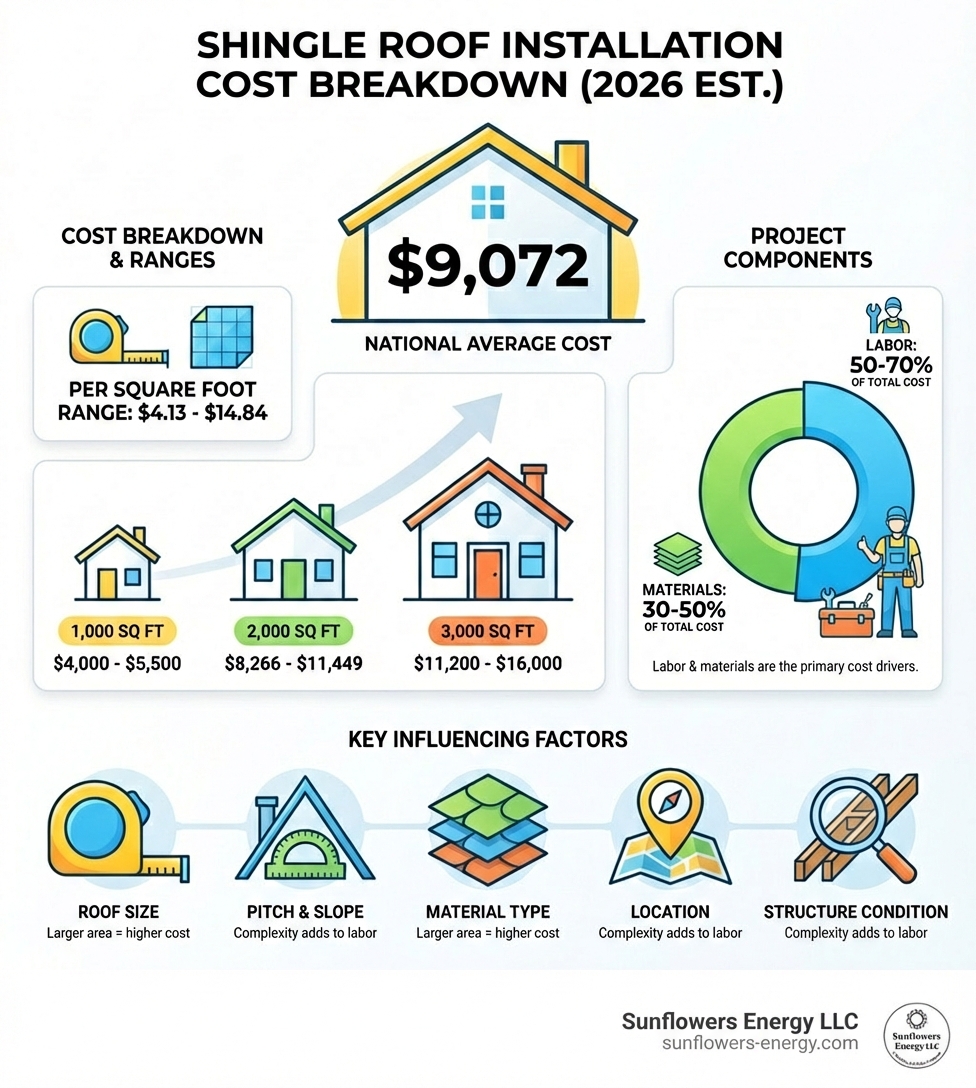
The cost to install shingle roof typically ranges from $5,700 to $16,000 for most homes, with an average of around $9,072 nationwide. However, your actual cost depends on several key factors.
Quick Cost Breakdown:
| Cost Factor | Range |
|---|---|
| Per Square Foot | $4.13 – $14.84 |
| 1,000 sq ft Home | $4,000 – $5,500 |
| 2,000 sq ft Home | $8,266 – $11,449 |
| 3,000 sq ft Home | $11,200 – $16,000 |
| Labor (% of Total) | 50% – 70% |
| Materials (% of Total) | 30% – 50% |
Your roof is your home’s first line of defense against harsh weather. It protects everything valuable inside, including your family. When it’s time to replace it, understanding the true cost helps you budget properly and avoid surprises.
The price you’ll pay depends on factors like your roof’s size, pitch, the type of shingles you choose, your location, and whether your roof’s underlying structure needs repairs. Labor typically makes up about 60% of your total project cost, while materials account for the rest.
In this guide, we’ll break down every cost factor so you can make an informed decision about your roof replacement. You’ll learn when to repair versus replace, how to save money, and what questions to ask contractors before signing any contracts.
Understanding the Average Shingle Roof Cost
When we talk about the average cost to install shingle roof, we’re looking at a national average of roughly $9,072. However, this is just a starting point. For most residential properties, asphalt shingle roof replacements can range from $2,100 to $4,700 for smaller roofs (500-1000 sq ft), $6,000 to $11,800 for medium-sized homes (1500-2500 sq ft), and $9,400 to $16,400 for larger properties (2500-3500 sq ft). Overall, the cost can vary significantly, from $4.13 to $14.84 per square foot.
A key term in roofing is the “square.” A roofing square isn’t a literal square, but a unit of measurement equal to 100 square feet. So, when a roofer quotes you a price per square, they mean per 100 square feet of roof surface. This helps standardize pricing across projects.
It’s important to understand the breakdown of these costs. Labor often makes up a substantial portion of the project, typically around 50% to 70% of the total cost. This includes the skill, time, and safety measures involved in removing old materials and expertly installing your new roof. The remaining 30% to 50% usually covers the materials themselves – the shingles, underlayment, flashing, and other necessary components.
Knowing the lifespan of your chosen shingles is also crucial for long-term planning. Asphalt shingles typically last between 15 to 30 years, depending on the quality and type. You can learn more about this in our guide: How Long Do Asphalt Shingles Last?.
Estimating the Material and Labor Cost to Install Shingle Roof
Let’s dive deeper into the individual components. The labor cost to install shingles averages $2.00 to $3.50 per square foot, or $200 to $350 per roofing square, not including materials. This depends on factors like the type of shingle (standard asphalt fiberglass versus architectural laminated shingles).
Material costs for asphalt shingles typically fall between $2,000 and $4,000 for an entire roof. For a more precise breakdown, basic asphalt shingles can cost $80 to $130 per square, while architectural laminated shingles might range from $100 to $250 per square.
When we combine these, the total cost to install shingle roof (including labor and materials) often ranges from $5,700 to $16,000, with a national average of $9,072. For a 2,000-square-foot home, you might expect to pay between $8,266 and $11,449.
Shingle Type Cost Comparison: 3-Tab vs. Architectural
The type of asphalt shingle you choose significantly impacts both the upfront cost and the long-term performance of your roof. The two most common types are 3-tab and architectural (also known as dimensional) shingles.
| Feature | 3-Tab Asphalt Shingles | Architectural Asphalt Shingles (Laminated) |
|---|---|---|
| Cost | $0.70 – $2.00 per square foot (cheapest option) | $4.00 – $8.00 per square foot (more expensive than 3-tab) |
| Lifespan | 15 – 20 years | 20 – 30 years (some even 40-50 years for premium options) |
| Durability | Lighter, single layer, less wind resistance | Heavier, multi-layered, better wind resistance (up to 130 mph) |
| Aesthetics | Flat, uniform appearance; classic look | Dimensional, textured, often mimics wood shakes or slate |
| Warranty | Typically 20-25 years | Often 30-50 years, or even limited lifetime |
| Installation | Generally simpler, but requires careful alignment | Can be less “finicky” to install, but heavier to handle |
As you can see, 3-tab shingles are the most affordable option upfront. They offer a basic, flat appearance and a shorter lifespan. Architectural shingles, while more expensive, provide a more aesthetically pleasing, three-dimensional look, superior durability, and a longer lifespan. They are heavier and more robust, offering better protection against the elements, which is especially important in areas prone to severe weather.
We often recommend architectural shingles for their improved performance and curb appeal, which can significantly boost your home’s value and provide peace of mind for decades to come.
Key Factors Influencing the Total Cost to Install Shingle Roof
Beyond the basic material and labor costs, several other factors can swing the pendulum on your total investment. We’ve seen projects vary widely based on these elements:
- Roof Size: The larger your roof, the more materials and labor required.
- Roof Pitch (Steepness): A steeper roof is harder and more dangerous to work on, increasing labor costs.
- Roof Complexity: Multiple valleys, dormers, skylights, or chimneys mean more cutting, flashing, and intricate work.
- Geographic Location: Labor rates, material availability, and local regulations vary by state.
- Accessibility: If your roof is hard to reach, it may require special equipment like scaffolding, adding to the cost.
- Roof’s Underlying Condition: Hidden damage to decking or rafters can uncover unexpected repair costs.

How Roof Size and Pitch Affect Pricing
The size of your roof is the primary determinant of material quantity. To estimate your roof’s square footage, you can multiply your home’s heated square footage by a “pitch multiplier.” For a typical roof, this multiplier is around 1.12. For instance, a 2,000 sq ft home might have a roof surface closer to 2,240 sq ft.
However, the pitch – or steepness – of your roof plays an equally critical role. A low-slope roof (like a 2:12 pitch) is easier and safer to work on. As the pitch increases, so does the difficulty and risk. Steeper roofs (e.g., 8:12 or higher) require more safety equipment, such as harnesses and scaffolding, and specialized techniques. This translates directly into increased labor time and, consequently, higher labor costs. Our crews take extra precautions on steep roofs to ensure safety and precision, which can add to the overall cost to install shingle roof.
The Impact of Your Roof’s Underlying Condition
One of the most common “hidden” costs we encounter during a roof replacement is damage to the underlying structure. Once the old shingles are removed, we sometimes find issues with the roof decking (the plywood or OSB that the shingles attach to), sheathing, or rafters.
Signs of rot, water damage, or structural weakness mean these components must be repaired or replaced before new shingles can be installed. Repairing rotted timbers can cost between $1,000 and $10,000, depending on the extent of the damage. Ignoring these issues would compromise the integrity of your new roof and could even void the shingle manufacturer’s warranty. While this might seem like an unexpected expense, it’s a vital step to ensure your new roof is built on a solid foundation and will last for its intended lifespan.
Additional Project Costs to Budget For
Beyond the main materials and labor, several other elements contribute to the final cost to install shingle roof:
- Tear-off and Disposal Costs: Removing and disposing of old shingles typically costs $1 to $5 per square foot, or an extra $1,000 to $1,500 for the entire project. This cost varies based on the type and number of existing shingle layers.
- Underlayment: This protective layer goes between the roof deck and the shingles, providing an extra barrier against moisture. Material costs for underlayment range from $0.10 to $0.80 per square foot. We ensure proper underlayment installation for maximum protection.
- Flashing: Metal flashing around chimneys, skylights, and valleys diverts water. Replacing or installing new flashing can cost $1.00 to $2.00 per linear foot for materials, plus labor.
- Drip Edge: Installed along the eaves and rakes of the roof, drip edge directs water away from the fascia and prevents it from getting under the shingles. Material costs are typically $0.50 to $1.00 per linear foot.
- Ridge Vents: Essential for proper attic ventilation, ridge vents help extend the life of your roof and improve your home’s energy efficiency. Materials cost $2.00 to $3.00 per linear foot.
- Permits and Inspections: Most localities require permits for roof replacement to ensure the work meets local building codes. Permit costs can range from $100 to $500, and inspections typically cost around $220. We handle all necessary permits to ensure your project is compliant and worry-free.
Ready for a precise estimate for your home? Don’t hesitate to reach out for a personalized quote. Get a Free Quote.
Repair vs. Replace: Making the Right Financial Decision
One of the biggest dilemmas homeowners face is deciding whether to repair a damaged roof or opt for a full replacement. This choice often comes down to a careful cost-benefit analysis. While roof repairs typically cost between $380 and $2,000, a full replacement averages $10,500. The decision hinges on the extent of the damage, the age of your roof, and your long-term plans for your home.
We always advise a thorough professional inspection to help you make the most informed decision. Sometimes, a small fix is all that’s needed, saving you thousands. Other times, patching up a failing roof is just delaying the inevitable and can lead to more costly problems down the road.
Signs You Need a Full Roof Replacement
It’s tempting to keep patching over roof damage, but there are clear indicators that a full replacement is the more prudent and cost-effective choice in the long run:
- Widespread Granule Loss: If you see a lot of shingle granules in your gutters or on the ground, it means your shingles are losing their protective coating.
- Curling or Cracked Shingles: Shingles that are curling at the edges, cupping in the middle, or showing significant cracks are a sign of advanced wear and tear.
- Multiple Leaks: While an isolated leak might be repairable, multiple leaks across different areas of your roof often indicate a systemic failure.
- Roof Age Over 20 Years: Asphalt shingles typically last 15-30 years. If your roof is nearing or past this age range, it’s likely time for a replacement, as deterioration will continue.
- Sagging Roof Deck: A visible sag in your roofline is a serious structural issue that requires immediate attention and almost certainly a full replacement.
When a Simple Repair is Enough
On the flip side, a simple repair can be a perfectly viable solution if the damage is minor and localized. Consider a repair if:
- Isolated Damage: Only a few shingles are damaged due to a storm or falling debris, and the rest of the roof is in good condition.
- Minor Leaks: A small, contained leak that can be traced to a specific, easily accessible point.
- Roof Under 15 Years Old: If your asphalt roof is still relatively young, it generally makes more sense to repair than replace.
- Missing Shingles from a Storm: If strong winds dislodge a handful of shingles, these can often be replaced without needing a full reroof.
To help you make the best decision for your home, we offer complimentary, no-obligation inspections. Schedule yours today: Free Roof Inspection.
How to Save Money and Finance Your New Roof
Replacing a roof is a significant investment, but there are smart ways to save money without compromising quality. We believe in transparency and helping you get the most value for your dollar.
One effective strategy is scheduling your project during the off-season. Depending on your location in Arizona, Colorado, Florida, Louisiana, Oklahoma, or Texas, this might be during the cooler months or periods of lower demand. Off-season installation could save you 5% to 15% on labor costs as contractors’ schedules are less packed.
Choosing cost-effective materials is another key. While premium options exist, asphalt shingles remain an excellent balance of affordability and performance. As we discussed, 3-tab shingles are the cheapest, but architectural shingles offer better long-term value and durability.
Finally, always get multiple quotes. We encourage homeowners to compare estimates from at least three licensed and insured contractors. This ensures you understand the average pricing in your area and can identify the best value.
A roof replacement with asphalt shingles can also be a wise investment, offering a solid return on investment (ROI). According to Remodeling Magazine’s 2024 Cost vs. Value Report, an asphalt shingle roof replacement has a 57% ROI, meaning you can recoup a significant portion of your investment when you sell your home. You can read more about this report here: 2024 Cost vs. Value Report.
Smart Ways to Reduce Your Overall Cost
Beyond the general tips, here are some specific strategies to potentially lower your cost to install shingle roof:
- Layering Shingles vs. Tear-off: If your local building codes allow and your roof deck is in good condition, applying a new layer of shingles over existing ones can save on tear-off and disposal costs. However, this isn’t always recommended as it adds weight and can mask underlying issues. Most cities limit roofs to a maximum of two layers.
- DIY Tear-off Considerations: If you’re physically capable and comfortable with heights, you could tear off the old roof yourself to save $1 to $5 per square foot in labor. However, this is a labor-intensive and potentially dangerous task that generates a lot of debris. We generally advise against it, as the savings may not be worth the risk, and proper disposal can still be a challenge.
- Material Selection: Stick with standard asphalt shingles, which can save 40% to 80% on total material costs compared to premium options like metal or tile. If budget is a primary concern, 3-tab shingles are the cheapest, costing $0.70 to $2.00 per square foot.
Financing Options for Your Roof Replacement Project
We understand that a new roof is a significant expense, and not everyone has the cash readily available. Fortunately, several financing options can help make your roof replacement project manageable:
- Home Equity Loans or HELOCs: If you have equity in your home, a home equity loan or a home equity line of credit (HELOC) can provide funds at competitive interest rates. These are often preferred because the interest may be tax-deductible. Lenders like U.S. Bank and Flagstar Bank offer these options.
- Personal Loans: Unsecured personal loans can provide quick access to funds without using your home as collateral. While interest rates might be higher than home equity loans, they offer flexibility.
- Government Grants: In some cases, homeowners may qualify for government assistance. Programs through the U.S. Department of Agriculture (USDA) or other state and local resources can assist low-income homeowners or those in specific rural areas. You can find more information about home repair programs here: Information on home repair programs.
- Homeowners Insurance Claims: If your roof damage is due to a covered peril like severe weather (hail, wind, fire), your homeowners insurance might cover part or all of the replacement cost. It’s crucial to understand your policy. We have a detailed guide on this: Does Homeowners Insurance Cover Roof Replacement?.
- Roofing Company Financing: Many reputable roofing companies, including us, offer in-house financing options with flexible payment plans. This can simplify the process, often with competitive rates and sometimes even $0 down options.
Hiring a Professional: Questions to Ask Your Roofing Contractor
Choosing the right roofing contractor is paramount to ensuring a high-quality, long-lasting roof. We always encourage homeowners to be thorough in their selection process. Here are some critical questions we recommend asking any potential roofing contractor:
- Are you licensed, insured, and bonded? This is non-negotiable. It protects you from liability in case of accidents or property damage.
- Can you provide proof of your experience? Ask how long they’ve been in business and how many roofs they’ve installed. For us, we have decades of experience and have worked on countless roofs.
- What type of workmanship warranty do you offer? A reputable contractor will stand behind their work. We offer comprehensive warranties on our craftsmanship.
- What are the material warranties for the shingles you recommend? Understand the manufacturer’s warranty on the specific shingles being installed.
- Can you provide an itemized estimate listing all potential costs? This ensures transparency and helps you compare quotes accurately, covering materials, labor, tear-off, and any potential additional repairs.
- What is your timeline for the project? A clear schedule helps you plan and minimizes disruption.
- How will you handle debris cleanup? A professional crew will ensure your property is spotless after the job is done.
- Will you obtain all necessary permits? Permitting ensures your roof meets local building codes. We handle all permitting processes for you.
- Can you provide references from past customers? Speaking with previous clients can offer valuable insights into their experience.
We pride ourselves on our transparency and commitment to customer satisfaction. If you have any questions or are ready to discuss your roofing needs, please don’t hesitate to reach out: Contact Us.
DIY vs. Professional: Weighing the Cost to Install Shingle Roof Yourself
The thought of saving thousands on labor by installing a shingle roof yourself can be appealing. DIY labor savings could range from $1,400 to $10,800. However, for most homeowners, we strongly advise against it. Here’s why:
- Potential Labor Savings: Yes, you save on labor costs, which can be 50-70% of the total project.
- Required Tools and Equipment: Do you own a roofing nailer, air compressor, safety harnesses, scaffolding, specialized cutting tools, and a way to safely hoist bundles of shingles onto your roof? Renting or buying these adds up.
- Risks of Improper Installation: Roofing is both an art and a science. Mistakes can lead to leaks, water damage, mold growth, and premature roof failure, costing far more in repairs than any initial savings. A professional crew knows how to expertly install flashing, seal valleys, and ensure proper ventilation.
- Voiding Material Warranties: Most shingle manufacturers will void their warranties if the roof isn’t installed by a certified professional. This means if your shingles fail prematurely due to a manufacturing defect, you might not be covered.
- Safety Concerns: Working on a roof is inherently dangerous. Falls from roofs are a leading cause of construction injuries and fatalities. Professionals have extensive safety training, equipment, and insurance to protect themselves and your property.
While a small, low-slope shed might be a feasible DIY project, your home’s roof is a critical system protecting your biggest investment. The expertise, speed, and safety a professional roofing company provides far outweigh the potential DIY savings for such a complex and vital project.
Frequently Asked Questions about Shingle Roof Costs
We get a lot of questions from homeowners about the cost to install shingle roof and related topics. Here are some of the most common ones:
How long does an asphalt shingle roof last?
The lifespan of an asphalt shingle roof depends significantly on the type and quality of the shingles, as well as installation and maintenance.
- 3-tab asphalt shingles typically last 15 to 20 years.
- Architectural (laminated) shingles generally last 20 to 30 years, with some premium options rated for 40-50 years.
Factors like climate (extreme heat, strong winds, hail in our service areas of Arizona, Colorado, Florida, Louisiana, Oklahoma, and Texas can reduce lifespan), proper attic ventilation, and regular maintenance also play a crucial role in how long your roof will truly last.
What are the cheapest roof shingles?
3-tab asphalt shingles are the cheapest roofing shingle option available. They offer the lowest upfront cost, often ranging from $0.70 to $2.00 per square foot for materials. While they are budget-friendly, it’s important to consider the trade-off between cost and quality. 3-tab shingles are thinner, have less wind resistance, and a shorter lifespan compared to architectural shingles. This means you might save money now, but potentially face replacement costs sooner. For a balance of affordability and durability, architectural shingles are often a more cost-effective choice in the long run.
Does a new shingle roof increase home value?
Yes, a new shingle roof can significantly increase your home’s value and appeal to potential buyers. According to Remodeling Magazine’s 2024 Cost vs. Value Report, a roof replacement with asphalt shingles has a 57% return on investment (ROI). Beyond the tangible ROI, a new roof offers:
- Improved Curb Appeal: A fresh, modern roof instantly improves your home’s exterior, making it more attractive.
- Improved Buyer Confidence: Buyers are more willing to pay a premium for a home with a new roof, knowing they won’t face this major expense for many years.
- Better Protection: A new roof provides superior protection against the elements, which is a major selling point.
- Potential Energy Savings: Modern shingles and proper installation can improve insulation and ventilation, leading to lower energy bills.
Overall, replacing an old or damaged roof with new shingles is one of the most impactful home improvements you can make, both for your family’s safety and your property’s market value.
Conclusion
Understanding the cost to install shingle roof is more than just knowing a price tag; it’s about understanding the investment in your home’s protection and value. We’ve explored the average costs, the significant influence of factors like roof size, pitch, material choice, and underlying structural condition, as well as additional project expenses. We’ve also discussed how to discern between a repair and a full replacement, and smart strategies to save money without cutting corners.
Your roof is a critical component of your home’s integrity. While DIY might seem like a way to save, the complexities, safety risks, and potential for costly mistakes often make professional installation the most sensible and cost-effective choice in the long run.
At Sunflowers Energy, we are committed to providing top-rated residential roofing services, ensuring durable, energy-efficient homes. We combine superior materials and expert installation to offer sustainability and cost savings, always starting with a free, no-obligation onsite inspection. We’re here to help you steer your roofing project with confidence, ensuring your investment protects your family and home for years to come.
Protect your investment with a quality roof. Explore our roofing services today: Roofing.

2 Responses