
Getting hit with an unexpected roofing bill can throw your entire budget off track. Before you call a contractor, knowing how to estimate roof replacement cost on your own gives you a realistic baseline, and protects you from overpaying. Whether you’re planning ahead or responding to storm damage, a ballpark figure helps you make smarter decisions about materials, timing, and financing.
At Sunflowers Energy LLC, we’ve helped countless homeowners and business owners navigate roofing projects from first inspection to final shingle. We’ve seen how understanding the numbers upfront reduces stress and builds confidence. That’s why we put together this step-by-step guide, so you can walk into any conversation with contractors already knowing what to expect.
In this guide, you’ll learn how to measure your roof, factor in materials and labor, adjust for pitch and location, and use simple formulas to calculate a reliable estimate before requesting your first quote.
What drives roof replacement cost
Before you learn how to estimate roof replacement cost, you need to understand the variables that push your final number up or down. Roof replacement isn’t a flat-rate service. Four major factors control your total expense: the materials you choose, the shape and pitch of your roof, your local labor rates, and the permits your municipality requires. Each one adds layers of complexity that affect both your upfront quote and long-term value.
Material choices and quality tiers
Your roofing material accounts for 40 to 50 percent of your total project cost, making it the single biggest lever you can pull. Asphalt shingles typically cost $90 to $150 per square (100 square feet), while metal roofing runs $250 to $600 per square, and slate or tile can exceed $1,000 per square. Within each category, you’ll find entry-level, mid-range, and premium options that differ in warranty length, wind resistance, and aesthetic finish. Choosing a 30-year architectural shingle over a basic 3-tab shingle can add $3,000 to $5,000 to a standard home, but it also extends your roof’s lifespan and boosts curb appeal.
Upgrading from basic to premium materials can double your roof’s warranty period and add significant resale value to your home.
Roof complexity and pitch
A simple gable roof with few penetrations and a moderate pitch costs far less to replace than a multi-level hip roof with dormers, skylights, and valleys. Steep pitches (8:12 or higher) require additional safety equipment and slower work pace, which increases labor hours by 20 to 40 percent. Complex layouts also generate more waste because roofers need to make extra cuts around chimneys, vents, and edges. If your roof has multiple angles or decorative features, expect your contractor to add $1,500 to $4,000 to the base estimate for the extra time and materials those details demand.
Geographic location and permits
Labor rates vary dramatically by region. Urban markets and coastal areas often charge $150 to $200 per hour for roofing labor, while rural communities may charge $75 to $100 per hour. Your local building department also sets permit fees, inspection requirements, and code mandates that influence your total. Some municipalities require ice and water shield underlayment or specific flashing methods that add $500 to $2,000 to your project. States with high contractor insurance costs, strict licensing rules, or frequent storm activity typically see higher baseline prices than regions with milder climates and lighter regulations.
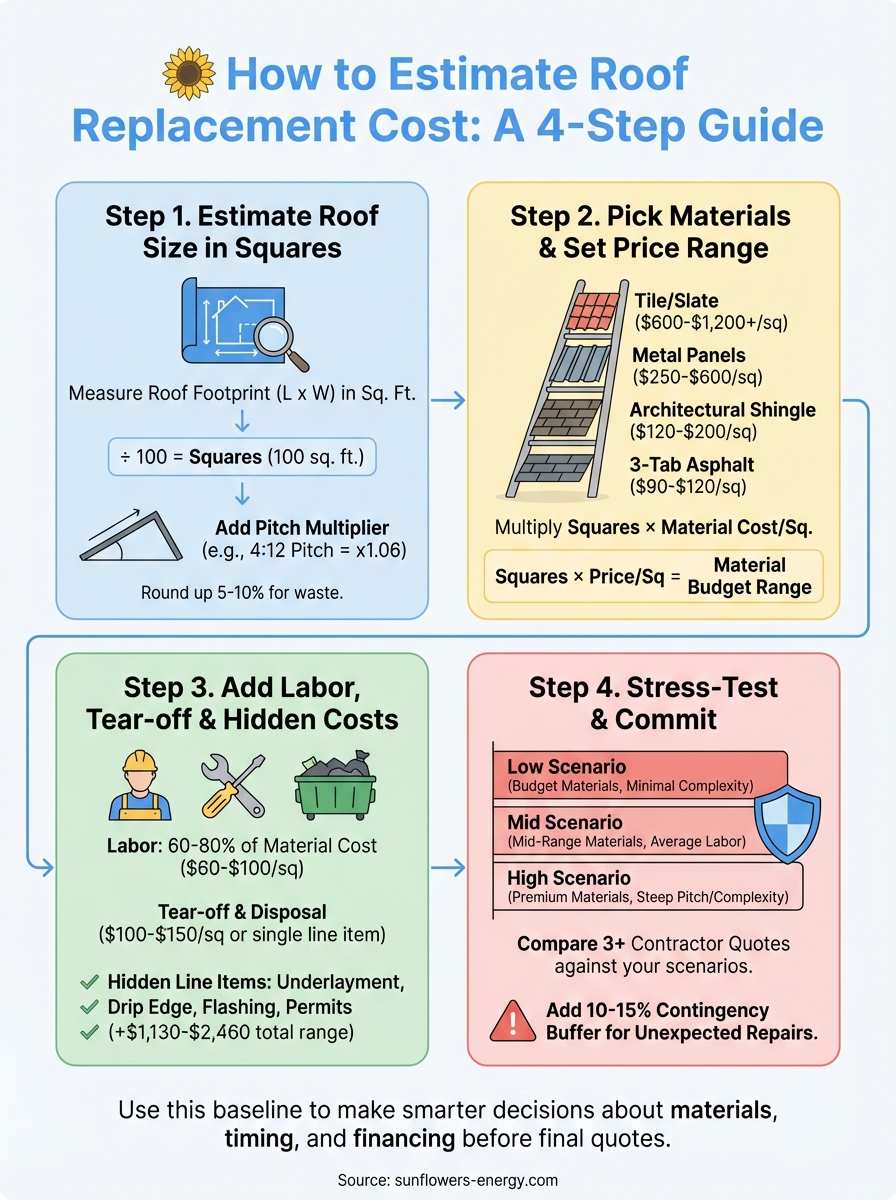
Step 1. Estimate your roof size in squares
The first step in learning how to estimate roof replacement cost is measuring your roof in "squares," the standard unit contractors use for pricing. One roofing square equals 100 square feet of roof surface. A typical single-family home has a roof area between 15 and 30 squares, which translates to 1,500 to 3,000 square feet. You can calculate your roof size using simple measurements from the ground or by requesting your home’s blueprints from the county assessor’s office.
Measure your roof footprint
Start by measuring the length and width of your home’s footprint at ground level. Multiply these dimensions to get your base square footage, then divide by 100 to convert to squares. For example, a home measuring 50 feet by 40 feet has a footprint of 2,000 square feet, or 20 roofing squares. If your home has multiple levels, garages, or extensions, measure each section separately and add them together. This ground-level calculation gives you a baseline before adjusting for slope and overhang.
Account for pitch multiplier
Your roof’s pitch (the angle of the slope) increases the actual surface area beyond the flat footprint. Roofs are measured by rise over run, expressed as a ratio like 4:12 (4 inches of vertical rise for every 12 inches of horizontal run). You multiply your footprint squares by a pitch multiplier to get your true roof size. A 4:12 pitch uses a 1.06 multiplier, while a steep 9:12 pitch uses 1.25. Taking our 20-square example with a 6:12 pitch (1.12 multiplier), you get 20 × 1.12 = 22.4 roofing squares.
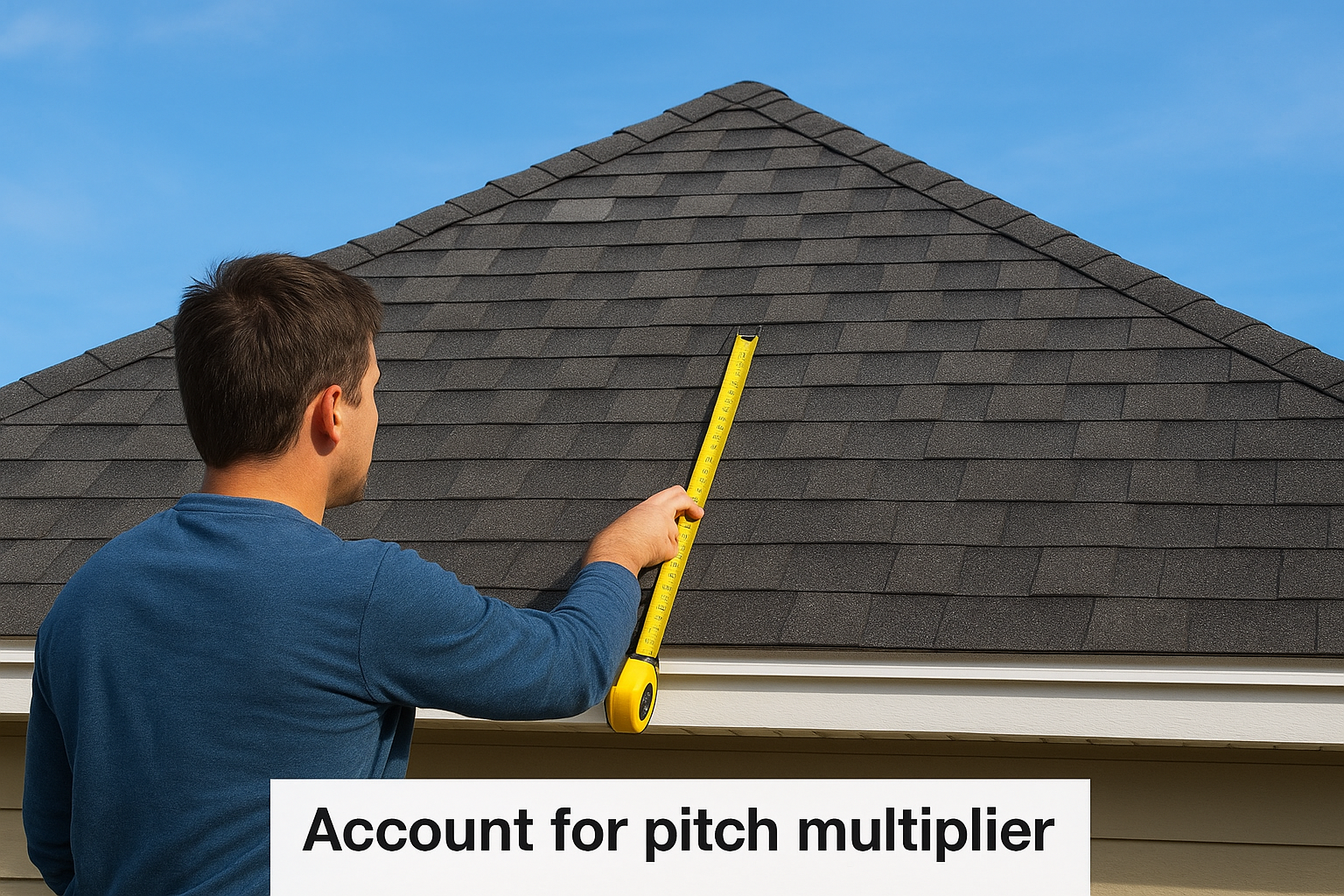
Always round up to the nearest half-square when calculating materials, because waste and starter rows add 5 to 10 percent to your actual consumption.
Here’s a quick reference for common pitch multipliers:
| Roof Pitch | Multiplier |
|---|---|
| 3:12 | 1.03 |
| 4:12 | 1.06 |
| 6:12 | 1.12 |
| 8:12 | 1.20 |
| 10:12 | 1.30 |
Step 2. Pick materials and set a price range
Once you know your roof size in squares, selecting materials becomes the next critical variable in learning how to estimate roof replacement cost. Your material choice determines not only your upfront expense but also your long-term maintenance costs and warranty coverage. Most residential roofs use asphalt shingles, metal panels, or composite materials, each with distinct price points and performance characteristics. Multiply your total squares by the material cost per square to establish your baseline budget range.
Calculate material costs per square
Asphalt shingles remain the most popular choice, offering 3-tab options at $90 to $120 per square and architectural shingles at $120 to $200 per square. Metal roofing costs $250 to $600 per square depending on panel style and finish, while premium materials like slate or clay tile run $600 to $1,200 per square. For a 22-square roof, 3-tab shingles cost $1,980 to $2,640 in materials alone, while architectural shingles push that to $2,640 to $4,400. These figures cover only the primary roofing surface, not underlayment, flashing, or accessories.
Your material selection accounts for 40 to 50 percent of your total roof replacement cost, making it the most direct way to control your budget.
Here’s a quick comparison of common materials:
| Material Type | Cost Per Square | Typical Lifespan | Best For |
|---|---|---|---|
| 3-Tab Asphalt | $90–$120 | 15–20 years | Budget projects |
| Architectural Shingle | $120–$200 | 25–30 years | Most homes |
| Metal Panels | $250–$600 | 40–70 years | Long-term value |
| Tile/Slate | $600–$1,200 | 50–100 years | Premium builds |
Build your pricing range
Create a low, mid, and high estimate by combining your square calculation with material tiers. Take your 22-square example: multiply by $90 for the low end ($1,980), $150 for mid-range ($3,300), and $200 for premium ($4,400). This bracket gives you negotiating power and realistic expectations when contractors submit bids. Add 10 percent to each figure to account for waste, starter strips, and ridge caps that don’t fit into per-square pricing.
Step 3. Add labor, tear-off, and hidden line items
Material costs represent only half of your total expense when learning how to estimate roof replacement cost. Labor typically matches or exceeds your material budget, while tear-off, disposal, and hidden line items add another 15 to 25 percent to your baseline. These costs vary by contractor, location, and roof condition, but you can calculate reasonable ranges using standard industry multipliers. Understanding these additions prevents sticker shock when contractors present final bids.
Calculate labor at 60 to 80 percent of materials
Most roofing contractors charge $60 to $100 per square for labor, which translates to roughly matching your material expense. If your materials cost $3,300 for 22 squares, expect labor between $2,640 and $4,400. Complex roofs with steep pitches or multiple valleys push labor toward the higher end of that range, while simple gable roofs stay closer to the lower figure. Multiply your material cost by 0.8 to 1.2 to generate your labor bracket, giving you a combined materials-plus-labor estimate before adding removal and extras.
Factor in tear-off and disposal fees
Removing your existing roof adds $100 to $150 per square to your project, covering both labor and dump fees. A 22-square roof generates roughly 2 to 3 tons of debris, costing $300 to $600 at most landfills. Contractors typically bundle removal into a single line item of $2,200 to $3,300 for standard residential projects. Homes with multiple layers of old shingles face higher removal costs because extra weight requires more labor and larger dumpsters.
Always request itemized quotes that separate tear-off, disposal, and haul-away fees so you can verify each charge against local averages.
Account for underlayment, flashing, and permits
Your estimate needs room for underlayment, drip edge, valley flashing, and building permits that rarely appear in initial calculations. Underlayment costs $25 to $50 per square, drip edge runs $2 to $4 per linear foot, and permits range from $150 to $500 depending on your jurisdiction. Add these line items together:
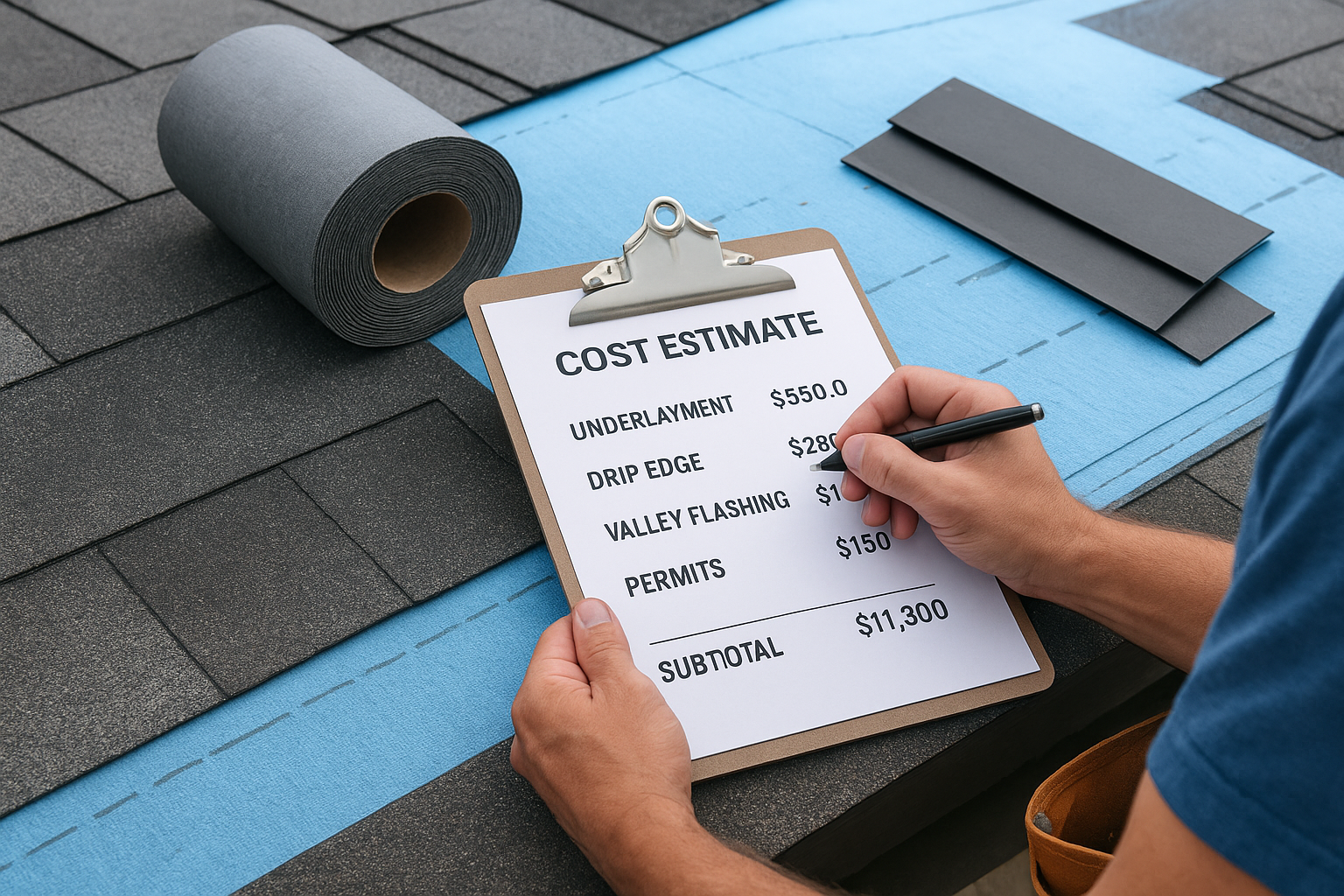
| Line Item | Cost Range |
|---|---|
| Underlayment (22 squares) | $550–$1,100 |
| Drip Edge (140 linear feet) | $280–$560 |
| Valley Flashing | $150–$300 |
| Building Permit | $150–$500 |
| Subtotal | $1,130–$2,460 |
Step 4. Stress-test your estimate before you commit
Your initial calculation gives you a working number, but testing that figure against real-world conditions reveals whether it holds up under pressure. Most homeowners who skip this validation step discover hidden costs mid-project, turning a $12,000 estimate into a $16,000 surprise. You prevent this by running three distinct scenarios and comparing your results to local market data before signing any contract.
Run low, mid, and high projections
Build three separate estimates using the formulas you’ve applied throughout this guide. Your low scenario uses budget materials and minimal tear-off complexity, calculating materials at $90 per square, labor at 0.8 times materials, and standard line items. Your mid-range projection uses $150 per square for materials and 1.0 labor multiplier, while your high scenario accounts for premium materials at $200 per square and 1.2 labor multiplier. If your low estimate lands at $10,500, mid at $14,800, and high at $18,200, you’ve established a realistic bracket that protects you from underbidding.
Running three scenarios before requesting quotes gives you negotiating leverage and helps you spot artificially low bids that signal cut corners or hidden fees.
Compare against contractor quotes
Request at least three formal bids from licensed contractors, then stack them against your self-calculated estimates. Quotes that fall 20 percent below your low scenario often indicate missing line items or substandard materials, while bids exceeding your high projection by more than 15 percent deserve scrutiny. Ask contractors to break down any variance between your numbers and theirs, focusing on tear-off complexity, waste factors, and permit costs you may have underestimated.
Add a 10 percent contingency buffer
Roof replacements rarely finish at the exact quoted price. You discover rotted decking, damaged fascia, or code violations that require unplanned repairs during tear-off. Building a 10 to 15 percent contingency into your budget covers these surprises without derailing your project. For a $15,000 estimate, set aside an additional $1,500 to $2,250 in accessible funds to handle unexpected substrate repairs or upgraded ventilation requirements.
Your next move
You now have the tools to calculate a realistic roof replacement estimate without relying solely on contractor quotes. By measuring your roof in squares, selecting materials within your budget, and adding labor plus hidden line items, you’ve built a defensible baseline that protects you from inflated pricing and rushed decisions. This process transforms an overwhelming expense into a manageable project with clear financial boundaries you can plan around.
The next step is turning your estimate into a formal quote. Reach out to three licensed contractors in your area, share your calculations, and compare their bids against your numbers. Look for transparency in their line items, proper licensing, and warranties that back their work. When you’re ready to move forward with confidence, schedule your free on-site inspection with Sunflowers Energy LLC and we’ll walk you through every detail, from materials selection to final installation, ensuring your roof replacement stays on budget and exceeds expectations.

I was recommended this website by my cousin. I am not
sure whether this post is written by him as no one else know
such detailed about my trouble. You’re incredible!
Thanks!
The step-by-step structure is useful because roof replacement cost begins with area and complexity, then adds tear-off, material, labor, access, and local conditions. Keeping those layers separate makes it easier to understand why two roofs with similar footprints can produce very different quotes.