
Evaluate roofing materials for solar: durability guide
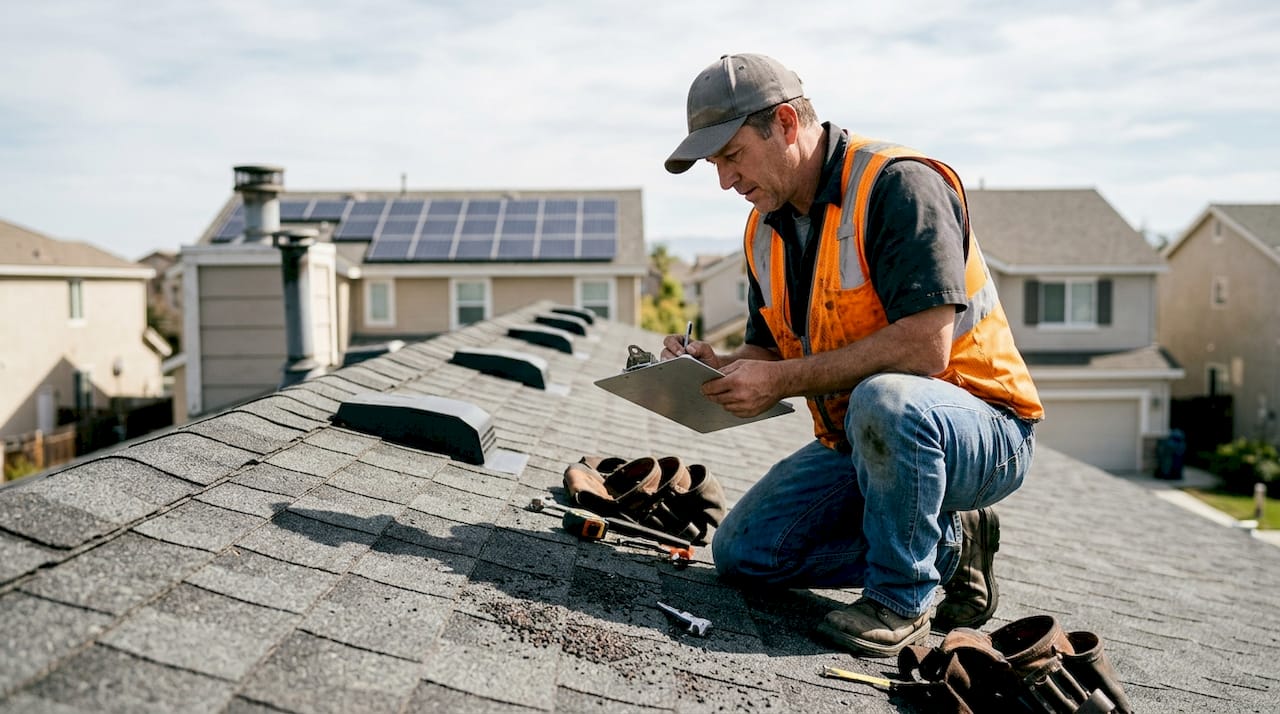
Choosing the wrong roofing material before a solar installation can quietly drain your return on investment before a single panel is mounted. Roofing material selection is essential for solar longevity and efficiency, yet many homeowners skip the evaluation entirely. The result? Panels installed on a roof with only five years of life left, forcing a costly removal and reinstall mid-system. This guide walks you through a clear, step-by-step evaluation process, covering the benchmarks, compatibility checks, and common pitfalls that determine whether your roof and solar system will perform together for decades.
Table of Contents
- Checklist and prerequisites for evaluating roofing materials
- Step-by-step process: how to evaluate roofing materials for solar installations
- Common mistakes and troubleshooting for solar roofing evaluations
- Expected outcomes and performance benchmarks of evaluated roofing materials
- Next steps: optimize your roofing and solar solution
- Frequently asked questions
Key Takeaways
| Point | Details |
|---|---|
| Match roof lifespan to solar | Your roof should have at least 25 years of life remaining to maximize your solar investment. |
| Check ratings and codes | Verify fire, wind, and ENERGY STAR reflectance ratings to ensure safety and efficiency. |
| Sync repairs with solar install | Replace or repair the roof before installing solar panels to avoid costly rework. |
| Consider climate and load | Choose materials certified for your climate zone and structural load needs, especially in extreme weather areas. |
| Prioritize lifecycle cost | Look beyond upfront price and compare life cycle costs plus payback to boost energy savings long term. |
Checklist and prerequisites for evaluating roofing materials
Before you compare materials side by side, you need a solid foundation of facts about your existing roof and local requirements. Skipping this step is like buying a car without checking if it fits in your garage. Understanding roofing and energy savings starts with knowing exactly what your roof can handle structurally and climatically.
Here are the five prerequisites every homeowner or property manager should confirm before evaluating materials:
- Roof slope: Slope affects which materials are viable and how solar panels can be mounted and angled for maximum output.
- IECC climate zone: Your International Energy Conservation Code (IECC) zone determines reflectance requirements and whether cool-roof exemptions apply in colder regions.
- Structural dead load capacity: Your roof framing must support the combined weight of the roofing material and solar panels without compromise.
- Fire and wind ratings: Materials should meet ASTM E108 fire rating standards (Class A, B, or C) and wind resistance testing under ASTM D3161.
- ENERGY STAR solar reflectance: If energy efficiency is a priority, confirm the material meets ENERGY STAR reflectance thresholds.
The solar roofing checklist below summarizes the key data points to gather before you begin:
| Prerequisite | What to confirm | Why it matters |
|---|---|---|
| Roof slope | Pitch in degrees or ratio | Material compatibility and panel angle |
| IECC climate zone | Zone 1-8 classification | Reflectance and insulation requirements |
| Dead load capacity | Pounds per square foot | Structural safety for panels |
| Fire rating | Class A, B, or C | Code compliance and insurance |
| Solar reflectance | ENERGY STAR threshold met | Cooling efficiency and utility savings |
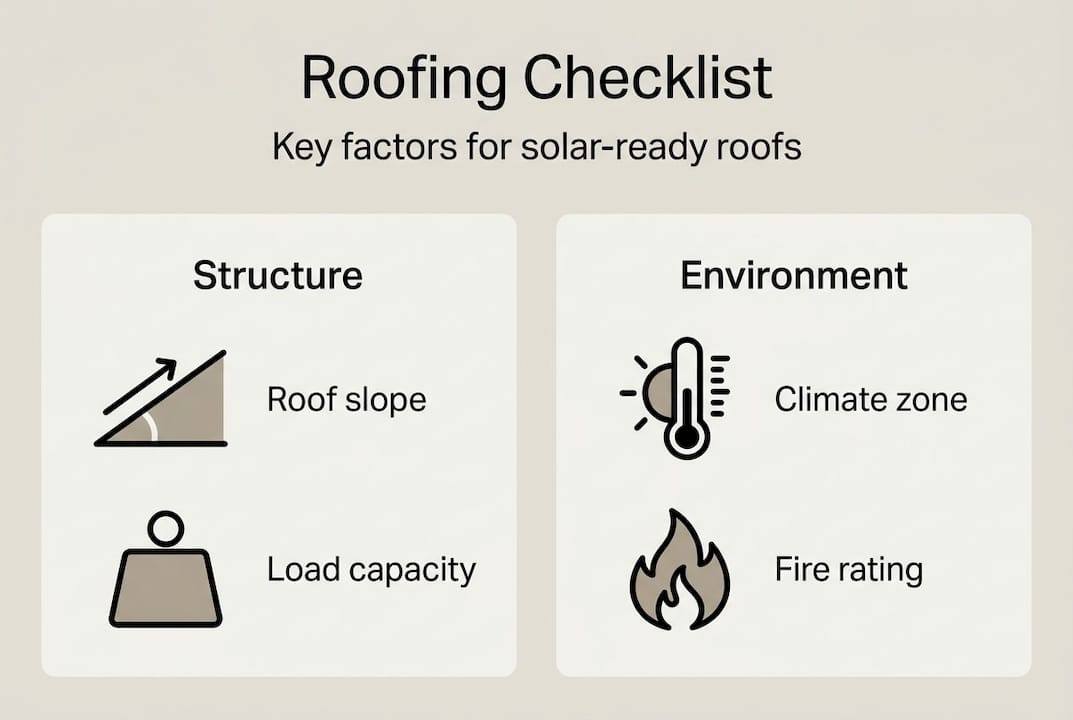
The evaluation checklist confirms these five factors: roof slope, IECC climate zone, structural dead load capacity, fire and wind ratings, and ENERGY STAR solar reflectance. Gathering this data upfront saves you from expensive surprises during installation. Reviewing energy-efficient roofing benefits can also help you prioritize which factors matter most for your specific property.
Step-by-step process: how to evaluate roofing materials for solar installations
With your checklist complete, follow this structured sequence to evaluate materials confidently.
Step 1: Assess material age and remaining lifespan
Start with what you have. Durability benchmarks show asphalt shingles last 15 to 30 years, metal roofs 40 to 70 years, and tile or slate 50 to 100-plus years. Since solar panels carry a 25 to 30-year warranty, your roof material should match or exceed that lifespan. If your asphalt shingles are already 18 years old, plan a replacement before installation.
Step 2: Verify structural integrity and load capacity
Have a licensed contractor or structural engineer inspect the roof deck, rafters, and framing. Solar panels add roughly 2 to 4 pounds per square foot of dead load. Older homes with undersized framing may need reinforcement before any heavy material or panel system is added. Reviewing a solid roofing system guide helps you understand what components need inspection.
Step 3: Match material to solar system compatibility
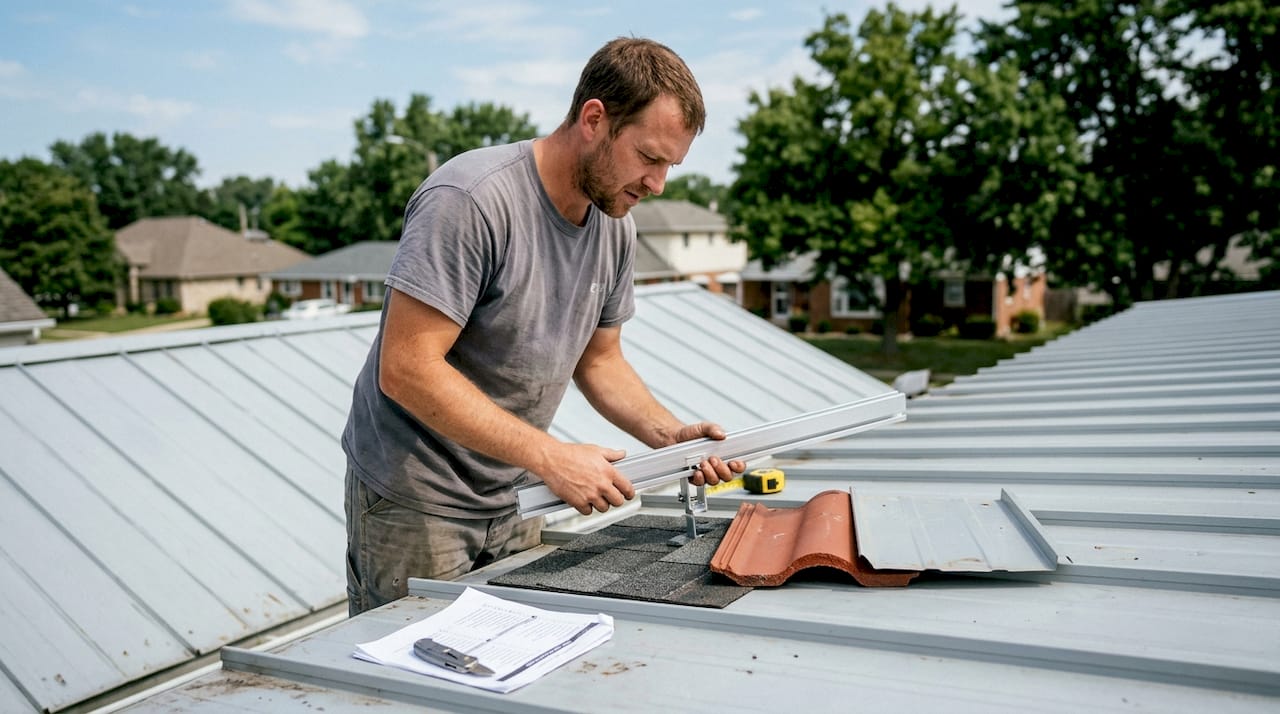
Solar compatibility varies significantly by material. Metal roofs are the best option, offering easy mounting and superior durability. Asphalt shingles are common and straightforward to work with. Tile and slate are challenging due to weight and fragility during installation. Use this comparison when choosing solar roofing for your property:
| Material | Solar compatibility | Lifespan | Relative cost |
|---|---|---|---|
| Metal | Excellent | 40-70 years | High upfront, low lifecycle |
| Asphalt shingles | Good | 15-30 years | Low upfront, moderate lifecycle |
| Tile/Slate | Challenging | 50-100+ years | High upfront and lifecycle |
For a detailed breakdown, the asphalt vs metal roof comparison covers cost, durability, and solar performance side by side.
Step 4: Confirm code compliance and permits
Check local building codes, HOA rules, and utility interconnection requirements. Some jurisdictions require a structural engineer’s letter before approving solar permits on older roofs. A roof lifecycle study confirms that code compliance is a critical factor in long-term performance outcomes.
Step 5: Calculate lifecycle cost vs. upfront expense
A cheaper material today can cost more over 30 years when you factor in replacement, panel removal, and reinstallation. Metal roofing costs more upfront but rarely needs replacement within a solar system’s lifetime.
Pro Tip: Schedule your roof replacement and solar installation together. Bundling both projects reduces labor costs, eliminates the need to remove panels for a future reroof, and maximizes your energy savings from day one.
Common mistakes and troubleshooting for solar roofing evaluations
Even a well-planned evaluation can go sideways if you overlook a few critical variables. Here are the most common mistakes and how to avoid them.
- Ignoring roof age: A roof with fewer than 10 years of remaining life will force a panel removal and reinstall, adding thousands to your project cost and undermining solar ROI.
- Skipping structural checks: Panel weight stresses older roofs. Never assume your framing is adequate without a professional inspection.
- Using unadjusted reflectance values: Always verify aged (3-year weathered) reflectance values for compliance. Fresh material values degrade over time and may not meet code after weathering.
- Overlooking regional climate codes: IECC Zones 5 through 8 are exempt from cool-roof requirements because reflective roofs in cold climates can actually increase heating loads.
- Missing local wind or impact standards: Florida’s High Velocity Hurricane Zone (HVHZ) requires Miami-Dade Notice of Acceptance (NOA) approval for roofing materials.
“Verify aged reflectance values for compliance, engage a structural engineer for heavy materials and solar load, and follow the NRCA and ICC code sequence to avoid costly rework.” NRCA guidelines
Research on cool roofs and PV systems confirms that combining reflective roofing with solar panels can optimize both cooling efficiency and energy generation, but only when the material is correctly specified for your climate zone.
Pro Tip: For tile, slate, or any heavy roofing material paired with solar, get an engineer’s stamp on the structural assessment. This protects your warranty, satisfies permit requirements, and gives you documented proof of compliance.
Understanding the role of roofing in energy efficiency helps you see why these details are not just bureaucratic boxes to check. They directly affect your utility bills and system performance. Exploring roof sustainability benefits also shows how the right material choice supports long-term environmental and financial goals.
Expected outcomes and performance benchmarks of evaluated roofing materials
Once you complete a thorough evaluation, here is what you can realistically expect from each material category.
Energy savings and payback periods
A lifecycle cost and payback study found that cool roofs achieve an economic payback period of approximately 1.75 years, while photovoltaic (PV) roofs take around 10.9 years. However, PV roofs generate far greater annual energy savings, averaging 139 kWh per square meter compared to just 6.5 kWh per square meter for cool roofs alone. The takeaway: cool roofing pays back faster, but solar generates dramatically more energy over time.
Material lifespan and ROI benchmarks
Review roof material benchmarks to set realistic expectations for each option:
| Material | Lifespan | Payback alignment with solar | Key advantage |
|---|---|---|---|
| Asphalt shingles | 15-30 years | Moderate (may need mid-life reroof) | Low upfront cost |
| Metal roofing | 40-70 years | Excellent | Durability and easy solar mounting |
| Tile/Slate | 50-100+ years | Excellent | Longevity and premium aesthetics |
Safety and compliance as success indicators
A successful evaluation ends with documented proof: a structural engineer’s report, fire and wind rating certificates, and permit approvals. These are not just paperwork. They protect your investment, validate your warranty, and confirm your system is built to last.
Exploring sustainable roofing benefits and reviewing a detailed solar efficiency guide will help you connect material performance to real-world energy savings on your utility bills.
Next steps: optimize your roofing and solar solution
You now have the knowledge to evaluate roofing materials with confidence, from structural checks to climate zone compliance. The next step is putting that knowledge into action with expert support.
At Sunflowers Energy, we offer a free roof inspection to assess your current roof’s condition, structural capacity, and solar readiness. Our team specializes in both premium roofing services and cutting-edge solar installations, so you get a single, coordinated solution rather than two separate contractors working at cross purposes. Whether you are planning a new installation or evaluating an aging roof, our solar efficiency guide is a great resource to explore alongside a personalized quote. Contact us today and let us help you protect your home from the top down.
Frequently asked questions
What roofing materials last the longest for solar installations?
Tile and slate roofs last 50 to 100-plus years, metal roofs 40 to 70 years, and asphalt shingles 15 to 30 years. Choose a material whose lifespan matches or exceeds your solar panels’ 25 to 30-year warranty.
How do roof slope and climate zone affect material and solar choices?
Roof slope determines which materials are structurally viable and how panels are mounted for optimal angle. Climate zone, particularly IECC Zones 5 through 8, can exempt your property from cool-roof reflectance requirements that apply in warmer regions.
What fire and wind ratings should my roof material have for solar?
Aim for a Class A fire rating and high wind resistance. Materials should be tested under ASTM E108 for fire and ASTM D3161 for wind resistance, with FM 4470 uplift testing for solar assemblies where required.
Is it better to replace a roof before installing solar panels?
Yes, especially if your roof has fewer than 10 years of life remaining. Syncing roof replacement with your solar install avoids costly panel removal later and maximizes efficiency from the start.
What is the best material for solar panels in areas with heavy snow or wind?
Metal roofs are the top choice, handling snow guards and high wind loads reliably. In high-wind zones like Florida’s HVHZ, always confirm your material carries Miami-Dade NOA approval and meets regional impact standards.
Recommended
- What is a roofing system? A 2026 guide for homeowners – Sunflowers Energy LLC A Roofing and Solar Companys
- Role of roofing in sustainability: energy savings in 2026 – Sunflowers Energy LLC A Roofing and Solar Companys
- How roofing boosts energy savings and solar efficiency – Sunflowers Energy LLC A Roofing and Solar Companys
- How to Choose Solar Roofing for Maximum Savings – Sunflowers Energy LLC A Roofing and Solar Companys