
Why Switch to Renewable Energy? Lower Costs, Boost Value
TL;DR:
- Solar is now cheaper than natural gas and coal, offering quick payback and long-term savings.
- Proper system design, roof condition, and policy understanding are essential for maximizing investment benefits.
- Switching to renewables significantly reduces carbon emissions, enhances property value, and promotes energy independence.
Most people still believe switching to renewable energy means paying a steep upfront price with a distant payoff. That belief is outdated. Utility-scale solar now costs just $30 to $40 per megawatt-hour, making it cheaper than natural gas and far below coal. For homeowners and business owners, that shift in the energy market translates into real, measurable savings on monthly bills, stronger property values, and a meaningful reduction in carbon output. This guide breaks down the economic case, the environmental impact, the role of your roof, and the honest challenges you should know before you commit.
Table of Contents
- The economic case for switching to renewable energy
- Energy independence, reliability, and grid interaction
- Carbon reduction and sustainability: Your impact matters
- Roofing and system integration: Maximizing your renewable investment
- The uncomfortable truth about switching to renewables: What the typical pitch leaves out
- Ready to switch? Take the next step toward clean energy savings
- Frequently asked questions
Key Takeaways
| Point | Details |
|---|---|
| Lowest electricity cost | Solar PV now produces energy cheaper than both natural gas and coal. |
| Real savings and ROI | Most users see double-digit bill savings and boosted property value from renewables. |
| Energy independence | Generating your own power reduces reliance on unpredictable utility costs. |
| Significant carbon reduction | Switching to renewable energy can cut CO2 emissions by up to 77% for businesses. |
| Roofing integration matters | Combining roof upgrades with solar maximizes efficiency and system value. |
The economic case for switching to renewable energy
Let’s break down the real numbers that make renewable energy a practical investment, not just an environmental statement.
The most common hesitation we hear is about cost. The reality? Solar’s cost per MWh is now lower than natural gas and far below coal for new electricity generation. That cost advantage flows directly to you as a property owner through lower bills and faster payback periods than most people expect.
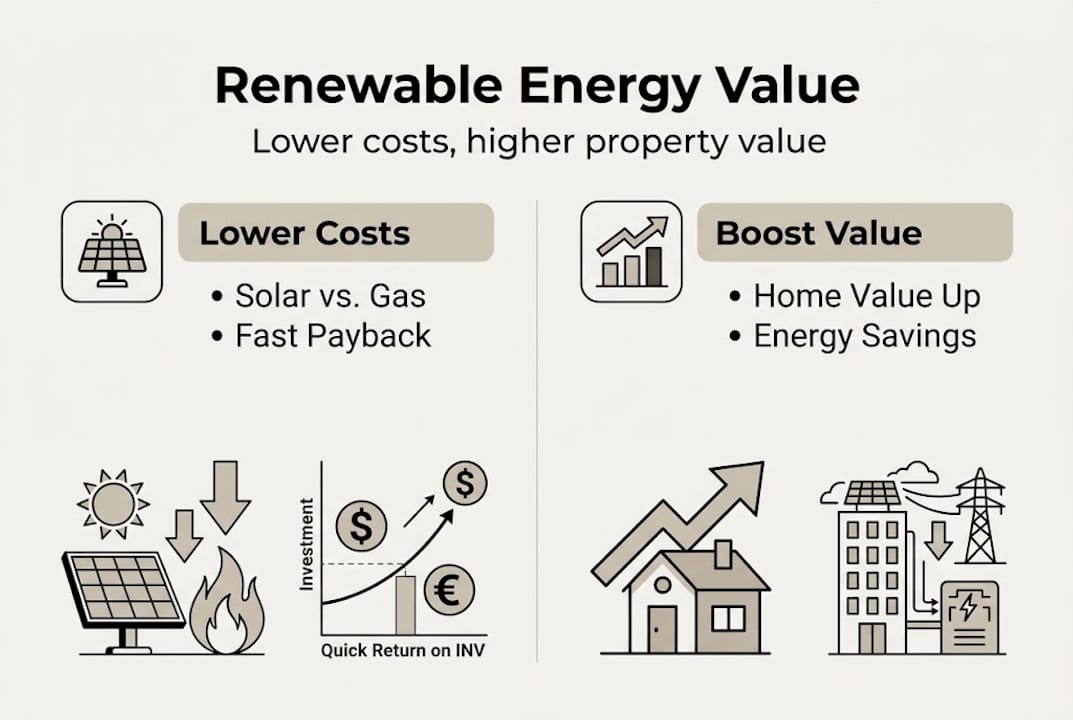
For homeowners, typical solar payback periods range from 4 to 7 years depending on system size, local utility rates, and available incentives. Commercial operations see similarly strong returns. A recent study of dairy farms found a payback period of 3.25 to 3.83 years with significant long-term savings, showing that businesses with consistent daytime energy demand can recover costs even faster.
Here is a quick look at how solar stacks up financially:
| Factor | Homeowner benefit | Business benefit |
|---|---|---|
| Payback period | 4 to 7 years | 3 to 5 years |
| Bill savings | 10% or more for most | Higher with daytime use |
| Property value increase | Up to 6.9% average | Improved asset value |
| Tax incentives | Federal ITC available | Accelerated depreciation |
Beyond the monthly savings, solar increases what your property is worth. Studies show home values rise 6.9% on average after solar installation. For a $400,000 home, that is roughly $27,600 in added equity. You can explore more about solar panels’ financial benefits to see how those numbers apply to your specific situation.
Key financial benefits at a glance:
- Lower monthly bills starting from the first full billing cycle after installation
- Federal Investment Tax Credit (ITC) reducing your net system cost by a significant percentage
- Net metering credits for excess power sent back to the grid
- Increased resale value that outpaces most home improvement projects
- Protection from utility rate hikes over the life of the system
Pro Tip: Shift your high-energy tasks like running dishwashers, laundry, and EV charging to peak solar production hours (typically 10 a.m. to 3 p.m.). This maximizes self-consumption and reduces what you pull from the grid, boosting your overall return. You can review residential solar advantages to understand how usage patterns shape your savings.
Energy independence, reliability, and grid interaction
Understanding the economics is the first step. The next is seeing how solar reshapes your relationship with the power grid entirely.
One of the most underappreciated benefits of going solar is how much energy you can generate and use on-site, without touching the grid at all. For businesses, self-consumption rates reach 70 to 88% when solar generation aligns well with operating hours. That means the vast majority of what your panels produce goes directly into your operations, not back to the utility.

For homeowners, self-consumption is typically lower but still meaningful, especially when paired with smart home systems or battery storage. The more you consume directly, the less you pay per kilowatt-hour.
Here is how self-consumption compares across property types:
| Property type | Typical self-consumption rate | Primary driver |
|---|---|---|
| Residential | 30 to 50% | Evening usage patterns |
| Small business | 55 to 70% | Business hours overlap |
| Commercial/industrial | 70 to 88% | Daytime operational load |
Steps to optimize your grid interaction:
- Analyze your load profile before sizing your system so generation matches your actual usage curve
- Consider battery storage if your grid has time-of-use pricing or unreliable supply
- Enroll in net metering where available to earn credits for surplus power
- Review your utility’s fixed charges since some utilities are restructuring rates in ways that affect solar ROI
- Work with a certified installer who understands local interconnection rules and grid policies
One honest complexity worth knowing: net metering critics argue that fixed grid infrastructure costs get shifted to non-solar customers when solar users reduce their bills through credits. This debate is shaping utility policy in several states, and it could affect the long-term value of your credits. Staying informed about your state’s net metering rules is a smart move before you finalize your system design.
“Energy independence is not just about saving money. It is about controlling your exposure to grid volatility and utility rate increases that have historically outpaced inflation.”
Your roof’s impact on solar efficiency also plays a direct role in how well your system interacts with the grid. A well-oriented, structurally sound roof captures more sunlight and reduces system losses. For businesses exploring larger installations, reviewing commercial solar installation tips can help you plan a system that truly fits your demand profile.
Carbon reduction and sustainability: Your impact matters
Even beyond cost and independence, switching to renewables makes a powerful statement about your environmental impact.
The carbon savings from solar are not abstract. They are measurable and significant. Businesses that have installed solar systems have seen CO2 reductions of 61 to 77% compared to their pre-solar emissions. For a commercial operation running on grid power, that kind of reduction is equivalent to taking dozens of cars off the road every year.
For homeowners, the impact is similarly real. A typical residential solar system offsets 3 to 4 metric tons of CO2 annually. Over a 25-year system lifespan, that adds up to 75 to 100 metric tons per home. Multiply that across a neighborhood and the collective impact becomes substantial.
Key sustainability benefits for homes and businesses:
- Significant CO2 reduction from day one of system operation
- Lower dependence on fossil fuels that are subject to price volatility
- Contribution to local air quality improvements over time
- Alignment with corporate sustainability goals for businesses seeking ESG credibility
- Positive brand perception as customers increasingly favor eco-conscious providers
For businesses, sustainability is no longer just a values statement. It is a competitive advantage. Clients, partners, and investors are paying closer attention to environmental performance. A solar installation signals long-term thinking and operational discipline.
“The most effective sustainability investments are the ones that also improve your bottom line. Solar does both simultaneously.”
The home value rise of 6.9% from solar adoption reflects how the market rewards sustainability. Buyers are willing to pay more for homes with lower operating costs and a smaller carbon footprint. That premium is not just feel-good value. It is real equity.
Pro Tip: Pairing a roofing upgrade with your solar installation can further enhance your sustainability profile. A weather-resistant, energy-efficient roof reduces heat transfer into your home, lowering cooling loads and making your solar system work even more effectively. Learn more about residential solar impact and how it connects to broader home efficiency goals. Businesses can also review commercial solar solutions to see how a full-system approach drives both savings and sustainability.
Roofing and system integration: Maximizing your renewable investment
To unlock the most value from renewables, it pays to think holistically, especially about your roof.
Your roof is not just the surface your panels sit on. It is the foundation of your entire solar investment. A roof that is nearing the end of its life, poorly oriented, or structurally compromised can reduce system output and create expensive problems down the road. Pairing roofing projects with solar enables seamless installation and optimized long-term return.
Here is why coordinating these two projects makes so much sense:
- Avoid double labor costs by scheduling roofing work before or during solar installation, not after
- Assess roof angle and orientation to confirm your layout maximizes sun exposure throughout the day
- Replace aging shingles first so you do not have to remove and reinstall panels later, which adds significant cost
- Choose durable roofing materials like premium asphalt shingles that can support panel weight and last 25 or more years
- Coordinate financing so both projects can be bundled into a single loan or incentive package where possible
- Inspect for storm damage before installation since hidden structural issues can compromise both the roof and panel performance
The right roofing material also affects how efficiently your system performs. Light-colored or reflective shingles reduce heat buildup on the roof surface, which keeps panel temperatures lower. Solar panels actually produce more electricity when they run cooler, so this is a practical efficiency gain, not just an aesthetic choice.
Pro Tip: Treating your roof replacement and solar installation as a single project reduces disruption, streamlines permitting, and often qualifies for combined financing options. One crew, one timeline, maximum value. Explore the details of roof replacement with solar and understand when it makes sense to replace old roofing before committing to a solar system.
Timing matters too. If your roof has 5 or fewer years of life remaining, replacing it before solar installation is almost always the smarter financial move. A proactive approach protects your panels and your warranty.
The uncomfortable truth about switching to renewables: What the typical pitch leaves out
Now let’s get real about what most guides gloss over when discussing renewables.
The headline numbers on solar savings are accurate, but they do not tell the whole story. The cost figures cited for solar generation often exclude storage and backup systems, and that gap matters. Critics note that when storage costs are fully accounted for, total system costs can rise dramatically, sometimes approaching 7 times the base solar cost in off-grid scenarios.
Grid policy is another moving target. Net metering rules are being revised in several states, and what looks like a strong credit today may be restructured within your system’s payback window. That does not mean solar is a bad investment. It means you need to plan with your eyes open.
Our honest advice: analyze your actual load profile before sizing a system. Work with installers who model your real usage, not just average assumptions. Ask specifically about battery storage costs and whether your local grid policies are stable. Upgrading to solar with a clear, personalized plan is what separates a strong investment from a disappointing one. The benefits are real. So are the variables.
Ready to switch? Take the next step toward clean energy savings
If the evidence has convinced you that solar and roofing upgrades are worth pursuing, your next move is to get the right guidance before you commit.
At Sunflowers Energy, we specialize in helping homeowners and businesses design systems that fit their actual energy needs, not generic templates. Whether you are exploring residential solar types or looking for a detailed breakdown on how to maximize solar energy savings, we have the resources to guide your decision. We also offer expert energy-efficient roofing solutions that integrate seamlessly with solar installations. Contact us today for a free onsite inspection and personalized quote. Let us help you power your home or business from the top down.
Frequently asked questions
How much can homeowners really save by switching to solar?
61% of solar adopters expect over 10% reduction in energy bills, and the average home value increases by 6.9%, making solar one of the highest-return home upgrades available.
Does solar power really work on cloudy days?
Yes. Solar panels still generate electricity on cloudy days, though at reduced output. System performance varies with weather, but generation does not stop when skies are overcast.
What’s the main drawback or hidden cost when installing solar?
Battery storage is the most significant hidden cost, running $300 to $800 per kWh of capacity, which can substantially affect your total project budget and payback timeline.
Why is it smart to pair roofing upgrades with solar installation?
Pairing both projects ensures your roof can support the system for its full lifespan, avoids costly panel removal later, and often allows you to bundle financing for maximum efficiency and value.
Recommended
- Why upgrade to solar panels: cut bills by 70% and add 4.1% home value – Sunflowers Energy LLC A Roofing and Solar Companys
- Why Choose Solar Panels in 2026: Cut Costs by 70% & Boost Value – Sunflowers Energy LLC A Roofing and Solar Companys
- Why Upgrade to Solar: Savings, Value, and Impact – Sunflowers Energy LLC A Roofing and Solar Companys
- Why Choose Solar Roofing: Savings, Durability, Value – Sunflowers Energy LLC A Roofing and Solar Companys
- Unlock savings: Key factors shaping heat pump costs in Canada | CoolFix Appliance & HVAC Service