Understand Solar Inverters: Boost Energy Efficiency & Savings
TL;DR:
- Solar inverters convert DC electricity from panels into usable AC power for homes and the grid.
- Types include string, micro, and hybrid inverters, each suited for different shading, expansion, and backup needs.
- Inverter efficiency significantly impacts energy savings and system ROI, with 97% or higher being ideal.
Solar panels get all the attention, but they can’t power your home on their own. Every solar system depends on a component most homeowners never think about: the solar inverter. This device is the brain of your entire setup, converting the electricity your panels generate into a form your appliances can actually use. A solar inverter converts DC electricity from your panels into AC electricity for your home and the grid. In this guide, you’ll learn exactly how inverters work, which type fits your situation, what efficiency numbers actually mean for your savings, and how to protect your investment long term.
Table of Contents
- What is a solar inverter and why is it essential?
- Types of solar inverters: string, micro, and hybrid explained
- Solar inverter efficiency: what matters for savings?
- Lifespan, maintenance, and real-world ROI for solar inverters
- Our take: Why most people overlook inverters and why you shouldn’t
- Get tailored solar solutions and maximize your savings
- Frequently asked questions
Key Takeaways
| Point | Details |
|---|---|
| Solar inverters are essential | They convert solar panel DC power into useable AC electricity for your home or business. |
| Efficiency impacts savings | Choosing inverters with 97%+ efficiency and MPPT tech can boost your energy savings noticeably. |
| Choose the right type | String, micro, and hybrid inverters offer different strengths; match your needs for best results and backup. |
| Lifespan and maintenance matter | Most inverters last 8–15 years and require regular care to maximize ROI. |
What is a solar inverter and why is it essential?
Your solar panels absorb sunlight and produce direct current, or DC, electricity. The problem is that your refrigerator, lights, and HVAC system all run on alternating current, or AC, electricity. That gap is exactly what a solar inverter bridges.
A solar inverter converts DC electricity into AC electricity that your home and the utility grid can use. It does this through rapid electronic switching using transistors, flipping the current direction thousands of times per second to create a smooth, usable AC wave. Without this conversion, the electricity your panels produce is completely incompatible with standard appliances.
Think of it this way: your solar panels are like a water pump, but they pump water in only one direction. Your home’s plumbing needs water that flows back and forth in a rhythm. The inverter is the mechanism that makes that rhythm happen.
Here’s what an inverter actually manages in real time:
- Voltage regulation: Keeps output stable even when sunlight fluctuates
- Grid synchronization: Matches the frequency and phase of the utility grid
- Safety shutoff: Disconnects automatically during grid outages to protect utility workers
- Performance monitoring: Tracks energy production and flags issues
- Maximum power extraction: Constantly adjusts to pull the most power from your panels
“Without a solar inverter, even the most advanced solar panels are useless for powering your home or feeding energy back to the grid.”
A common misconception is that bigger or more efficient panels automatically mean more usable electricity. In reality, a low-quality inverter can bottleneck your entire system, wasting energy that your panels worked hard to capture. Understanding solar panel efficiency explained is valuable, but pairing that knowledge with inverter performance is what actually drives results.
Pro Tip: When reviewing solar quotes, always ask for the inverter’s efficiency rating alongside the panel specs. A premium panel paired with a mediocre inverter will underperform every time.
Types of solar inverters: string, micro, and hybrid explained
Not all inverters are built the same. The type you choose directly affects how much energy you capture, how your system handles shade, and whether you can store power for outages. Let’s break down the three main categories.
| Inverter type | Best for | Shade tolerance | Battery backup | Relative cost |
|---|---|---|---|---|
| String inverter | Full-sun, simple roofs | Low | No (grid-tied) | Lowest |
| Microinverter | Shaded or complex roofs | High | Optional | Higher |
| Hybrid inverter | Resilience and storage | Moderate to high | Yes | Highest |
String inverters connect all your panels in a series, like links in a chain. They’re cost-effective and reliable for rooftops with consistent, unobstructed sun exposure. The downside is that string inverters are vulnerable to shade: if one panel underperforms due to a shadow or debris, the entire string’s output drops. For straightforward residential and commercial rooftops with great sun exposure, they remain a strong value choice.
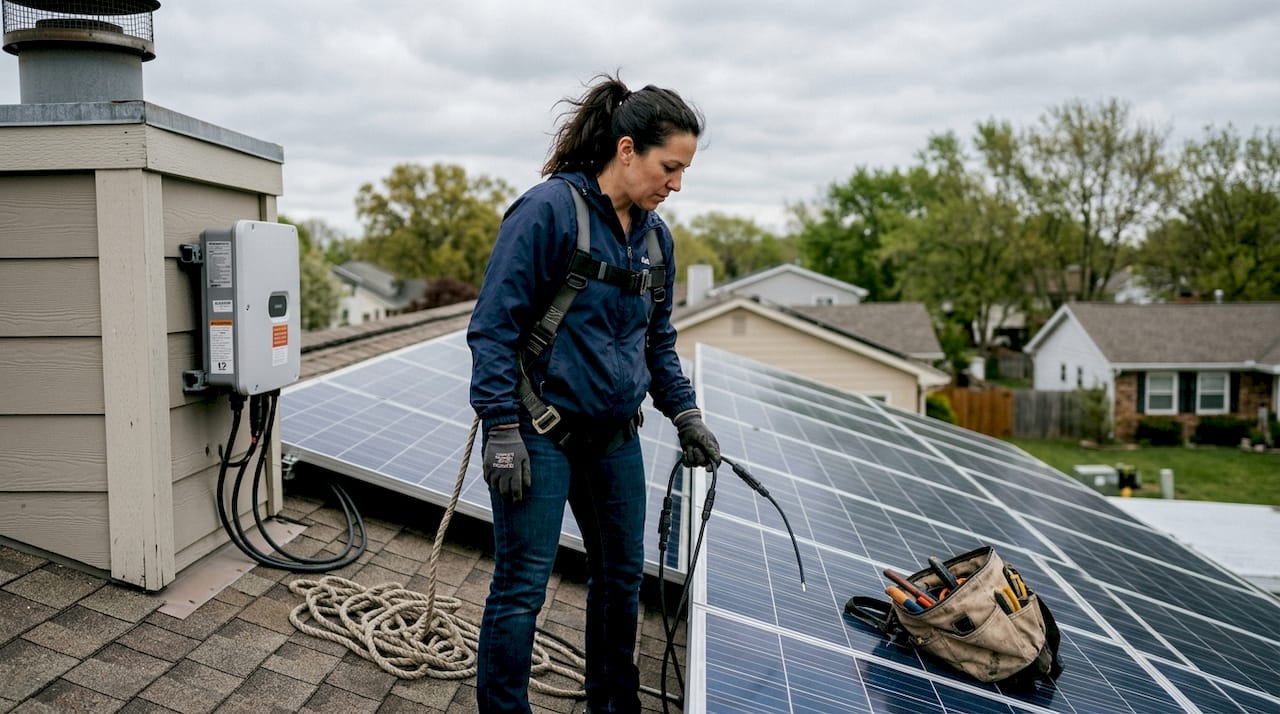
Microinverters attach directly to each individual panel. Each panel operates independently, so shading or soiling on one panel doesn’t affect the rest. Microinverters use per-panel MPPT (Maximum Power Point Tracking) to optimize every module separately, which is a significant advantage for complex rooflines or partially shaded environments. They also make it easier to expand your system later.
Hybrid inverters combine the functions of a standard grid-tied inverter with a battery management system. They let you store excess solar energy and draw from it during outages or peak-rate hours. For commercial solar applications where energy resilience is critical, hybrid inverters are increasingly the smart choice.
Here’s a quick guide to matching inverter type to your situation:
- Full-sun roof, tight budget: String inverter
- Shaded or multi-angle roof: Microinverter
- Want battery backup or energy independence: Hybrid inverter
- Large commercial facility: Hybrid or string with optimizers
Exploring residential solar benefits can help you frame which inverter type aligns with your home’s goals, while businesses should review commercial solar solutions to understand how inverter choice scales for larger operations.
Pro Tip: If your roof has even one chimney, vent, or tree casting a shadow for part of the day, microinverters will likely outperform a string setup significantly over the system’s lifetime.
Solar inverter efficiency: what matters for savings?
With different inverter types in mind, let’s look at what really translates to monthly savings: efficiency. Inverter efficiency measures how much of the DC power coming in actually becomes usable AC power coming out. Even small differences in this number add up to real money over time.
Key efficiency benchmarks to know:
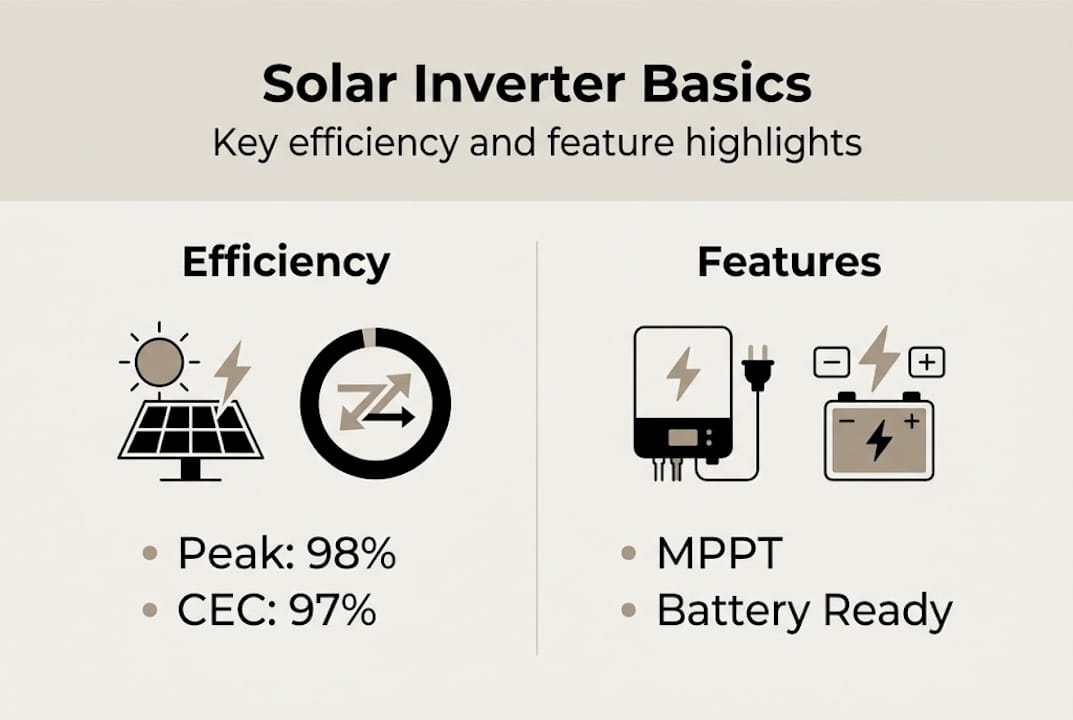
- Peak efficiency: The best-case performance under ideal lab conditions, typically 95 to 98.5%
- CEC weighted efficiency: A California Energy Commission standard that reflects real-world performance across varying power levels, with 97% or higher being ideal
- Euro weighted efficiency: Similar to CEC but weighted for European climate conditions, useful for comparing products globally
- MPPT efficiency: How well the inverter tracks the optimal power point as sunlight changes throughout the day
According to efficiency benchmarks in recent research, peak inverter efficiency ranges from 95 to 98.5%, with CEC and Euro weighted ratings above 97% representing the best performers for real-world ROI. A 2% efficiency gain in a 5 kW system saves roughly 200 kWh per year, which translates to meaningful reductions on your annual electricity bill.
MPPT, or Maximum Power Point Tracking, is the feature that makes a real difference day to day. Solar panels don’t produce a fixed output. Clouds, temperature changes, and the sun’s angle constantly shift how much power they generate. MPPT continuously adjusts the inverter’s operating point to extract the maximum available power at any given moment. Check inverter efficiency ratings to compare top models before purchasing.
| Efficiency rating | What it means | Impact on a 5 kW system |
|---|---|---|
| Below 95% | Below average, avoid if possible | Loses 250+ kWh/year |
| 95 to 96% | Acceptable, older technology | Loses 150 to 250 kWh/year |
| 97 to 98% | Good, current standard | Near-optimal performance |
| 98.5%+ | Premium, cutting-edge | Best real-world output |
When shopping, use this checklist to evaluate efficiency features:
- CEC weighted efficiency of 97% or higher
- Multiple MPPT inputs for complex panel arrangements
- Low standby power consumption
- Wide voltage input range for consistent performance
- Real-time monitoring with efficiency alerts
Our efficiency guide walks through how to read these specs in practice, and pairing this with our energy savings optimization resource can help you build a system that saves up to 30% more yearly.
Lifespan, maintenance, and real-world ROI for solar inverters
Now let’s deal with what matters most for peace of mind: how long inverters last and how you can keep yours running smoothly.
Most solar inverters last between 8 and 15 years, with warranties typically ranging from 5 to 10 years or more depending on the manufacturer and model. String inverters tend to be cheaper upfront but may need replacement before your panels do. Microinverters and hybrid units often carry longer warranties and deliver higher ROI in shaded or complex installations.
Several factors affect how long your inverter lasts:
- Heat exposure: Inverters installed in hot, unventilated spaces degrade faster
- Humidity and moisture: Outdoor or poorly sealed units face corrosion risks
- Electrical surges: Lightning or grid fluctuations can shorten lifespan without surge protection
- Usage patterns: Systems that cycle on and off frequently experience more wear
- Quality of installation: Poor wiring connections accelerate component stress
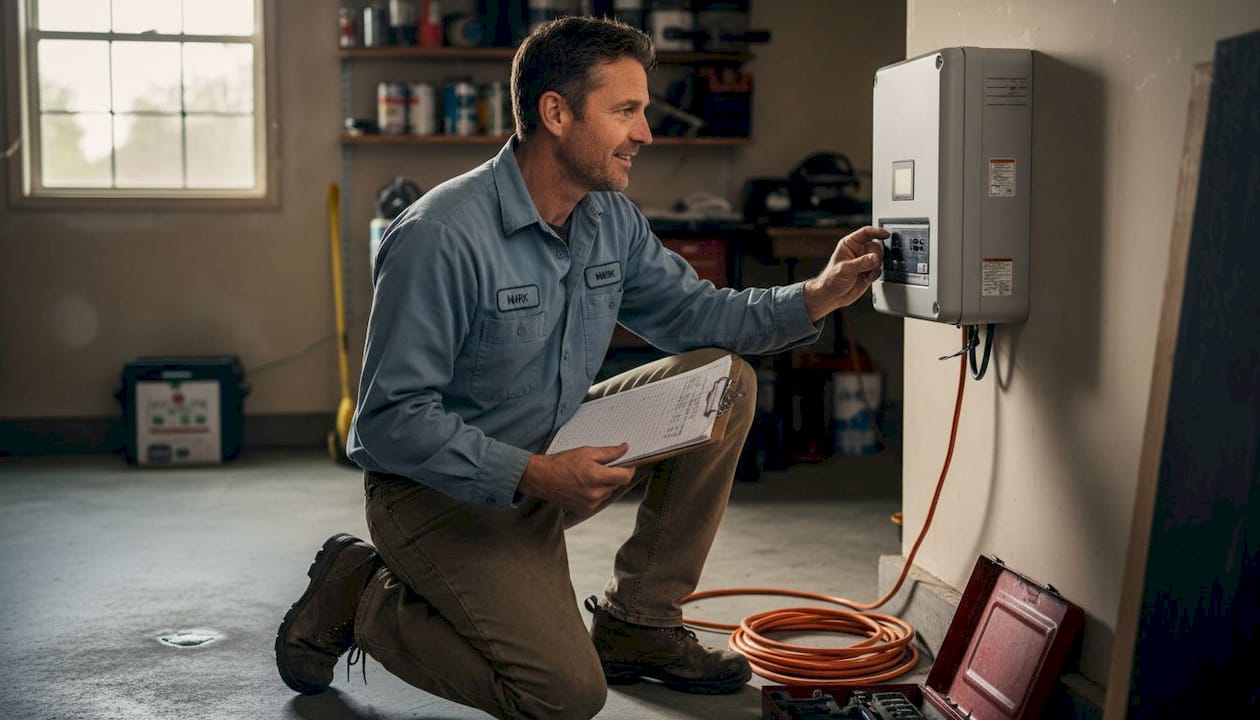
Pro Tip: Install your inverter in a shaded, ventilated location, such as a garage wall or shaded exterior wall, rather than in direct sunlight. This single step can add years to its working life.
For ROI planning, factor in one inverter replacement over a 25-year solar system lifespan. Budget roughly $1,000 to $2,500 for a string inverter replacement, or $150 to $350 per unit for microinverters. Hybrid inverter replacements can run higher, but the energy resilience they provide often justifies the cost for businesses.
Simple maintenance steps that protect your investment:
- Check for error codes or warning lights monthly
- Keep ventilation areas clear of dust and debris
- Inspect wiring connections annually for corrosion or looseness
- Review your monitoring dashboard for unexpected output drops
- Schedule a professional inspection every 2 to 3 years
Understanding solar panel lifespan alongside inverter longevity helps you plan replacements strategically. Our panel maintenance resources and maintenance checklist give you a practical framework to keep your entire system performing at its best year after year.
Our take: Why most people overlook inverters and why you shouldn’t
After working with hundreds of residential and commercial solar customers, we’ve noticed a consistent pattern: people spend hours comparing panel brands and almost no time evaluating inverters. It’s understandable. Panels are visible, tangible, and easy to market. Inverters sit quietly in a garage or utility room, doing their job without fanfare.
But here’s the uncomfortable truth: the inverter determines how much of your panels’ potential you actually capture. We’ve seen customers with premium panels lose 10 to 15% of their annual output simply because they chose a budget inverter with mediocre MPPT performance.
Upgrading from a standard string inverter to a high-efficiency hybrid or microinverter system often delivers more real-world savings than adding extra panels. It’s a smarter use of your budget in many cases. When you review solar quotes, look closely at the inverter specs, not just the panel brand.
Our solar energy efficiency guide can help you evaluate the full picture. Don’t let the inverter be an afterthought. It’s the component that turns sunlight into actual savings.
Get tailored solar solutions and maximize your savings
Ready to take control of your energy bill and get the right inverter for your needs? Choosing the correct inverter is one of the highest-impact decisions in any solar project, and getting expert guidance makes all the difference.
At Sunflowers Energy, we help homeowners and business owners select, install, and optimize complete solar systems, including the inverter technology that drives real savings. Explore our maximize home savings guide to see how efficiency choices add up, or browse our solar system types resource to find the right fit for your property. Contact us today for a free onsite inspection and personalized quote.
Frequently asked questions
How does a solar inverter work in simple terms?
A solar inverter converts DC electricity your solar panels produce into AC power your home or business can actually use, making solar energy compatible with standard appliances and the utility grid.
Is it worth paying for a more efficient solar inverter?
Yes. Inverters above 97% weighted efficiency can save roughly 200 kWh or more per year in a 5 kW system, which maximizes your return on investment over the system’s lifetime.
How long do solar inverters typically last?
Most solar inverters last 8 to 15 years depending on the type, installation quality, and how well they are maintained, with warranties typically covering 5 to 10 or more years.
How do I choose the right inverter type for my solar system?
Choose microinverters for shaded or complex roofs, string inverters for full-sun setups with uniform exposure, and hybrid inverters when you want battery backup and energy resilience during outages.
Recommended
- Solar Energy Efficiency Guide for Maximized Home Savings – Sunflowers Energy LLC A Roofing and Solar Companys
- Why Upgrade to Solar: Savings, Value, and Impact – Sunflowers Energy LLC A Roofing and Solar Companys
- Benefits of Solar Roofing: Transforming Home Efficiency – Sunflowers Energy LLC A Roofing and Solar Companys
- Solar Power for Beginners: Savings and Sustainability – Sunflowers Energy LLC A Roofing and Solar Companys