
Solar payback period explained for smarter home investments

TL;DR:
- Solar payback periods vary from 5 to 10 years based on location and incentives.
- Calculating payback involves subtracting incentives from system costs and dividing by annual savings.
- Factors like electricity rates, net metering policies, and system size significantly influence recovery time.
Most homeowners assume solar pays for itself in three to five years. That number gets repeated so often it feels like fact. The truth is more nuanced, and understanding the real timeline could be the difference between a smart investment and a disappointing one. Your payback period depends on where you live, how much electricity you use, what incentives you qualify for, and dozens of other variables unique to your home. This guide breaks down the payback formula, the factors that speed it up or slow it down, and how to get an accurate estimate that reflects your actual situation.
Table of Contents
- What is the solar payback period?
- How to calculate your solar payback period
- Key factors that influence your payback period
- Special scenarios and common pitfalls
- How to get a personalized solar payback estimate
- A practical perspective on solar payback periods
- Ready to optimize your solar investment?
- Frequently asked questions
Key Takeaways
| Point | Details |
|---|---|
| Payback period definition | It shows how long it will take your solar system to pay for itself through energy savings. |
| Key factors | Electric rates, incentives, and system size most impact payback timeline. |
| Avoiding surprises | Edge cases like batteries and roof replacements lengthen payback—factor them in. |
| Personalized estimates | Use detailed tools and local quotes for the most accurate payback calculations. |
| Beyond the numbers | Payback period matters, but consider total home value and energy independence too. |
What is the solar payback period?
The solar payback period is the amount of time it takes for your solar system to generate enough electricity savings to cover what you paid for it. Think of it as your break-even point. Once you cross that line, every kilowatt-hour your panels produce is essentially free money in your pocket.
This metric matters because it gives you a direct financial yardstick. Unlike vague promises about “going green” or “saving on bills,” the payback period puts a number on your investment. You can compare it to other home improvements, weigh it against your financial goals, and decide whether solar makes sense right now.
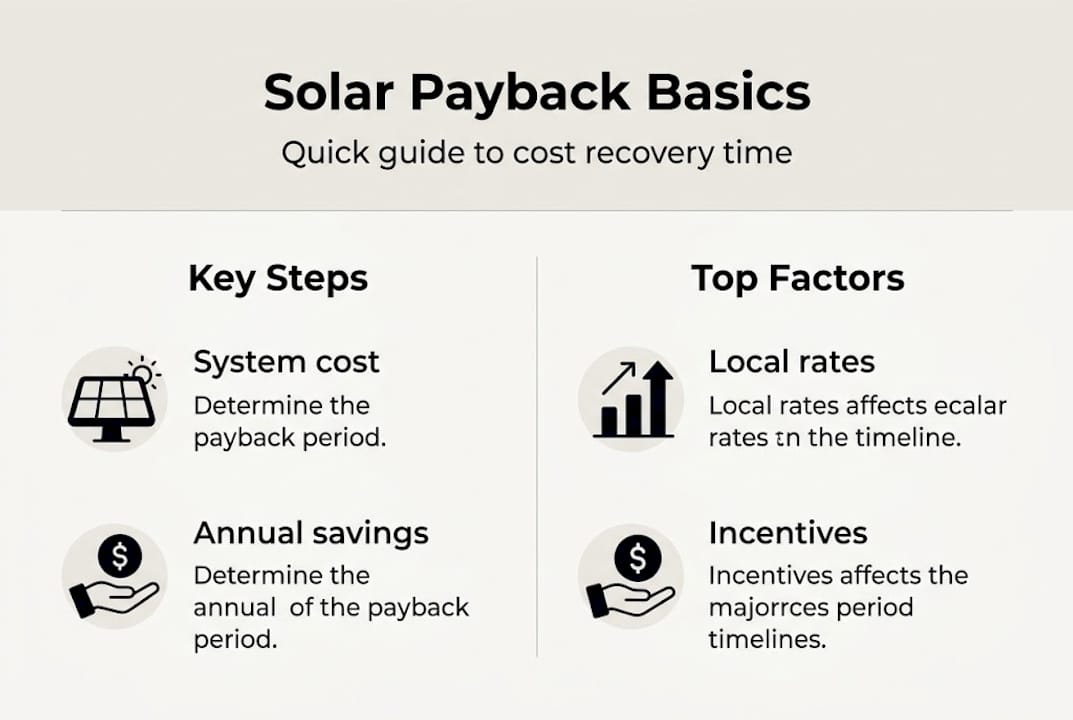
Understanding the solar payback period basics is the first step toward making a confident decision. The payback period formula is central to any solar investment decision because it translates system performance into real financial terms you can act on.
For most U.S. homeowners, the payback period falls somewhere between 5 and 10 years. But that range is wide for a reason. A homeowner in California paying $0.30 per kWh with strong net metering might break even in 5 years. A homeowner in a low-rate state with weak export policies might wait 12 years or longer.
Here’s what the payback period tells you at a glance:
- Break-even timeline: How many years until your savings match your upfront cost
- Investment quality: Shorter payback usually means better financial conditions for solar
- Risk indicator: Longer paybacks carry more exposure to policy changes or system issues
- Comparison tool: Helps you evaluate different system sizes or financing options
“The payback period is not just a number. It is the clearest signal of whether solar is financially right for your home right now.”
Once you know what it means, the next step is calculating yours.
How to calculate your solar payback period
The formula is straightforward. Take your total system cost, subtract any incentives you receive, then divide by your estimated annual electricity savings. That gives you your payback period in years.
Payback period = (Total system cost minus incentives) divided by annual savings
Let’s walk through a realistic example using 2026 numbers.
| Variable | Example value |
|---|---|
| Gross system cost | $25,000 |
| Federal ITC (30%) | $7,500 |
| Net system cost | $17,500 |
| Annual electricity savings | $1,800 |
| Payback period | ~9.7 years |
That example reflects a mid-sized home with average electricity use. Your numbers will shift based on your specific inputs.
Here are the key variables you need to gather:
- System cost: Get quotes for your actual home. The solar installation cost varies by system size, roof type, and installer.
- Incentives: The federal Investment Tax Credit (ITC) sits at 30% in 2026. State and local incentives can add more.
- Annual production: Use NREL’s PVWatts tool to estimate how many kWh your system will generate based on your location and roof angle.
- Electricity rate: Check your utility bill for your current rate per kWh. Higher rates mean faster payback.
- Annual savings: Multiply your system’s annual production by your electricity rate.
According to SEIA 2026 insights, rising electricity prices are improving solar ROI across most U.S. markets, which means the savings side of your equation is growing stronger every year.

The payback calculation details can get more precise when you factor in rate escalation and system degradation over time.
Pro Tip: Run your numbers with at least two different electricity rate scenarios. If rates rise 3% annually, your payback period could shrink by one to two years compared to a flat-rate assumption.
Key factors that influence your payback period
The math gives you a starting point, but real-world conditions shape your actual outcome. Several variables can push your payback period shorter or longer in ways that matter a lot.
Local electricity rates are the single biggest driver. Areas with rates above $0.20 per kWh combined with full retail net metering consistently see payback periods as short as five years. Low-rate states where electricity costs $0.10 to $0.12 per kWh make it much harder for savings to add up quickly.
Net metering policies determine how much credit you receive for excess power your panels send back to the grid. Full retail net metering is the gold standard. Some states have moved to reduced export rates, which cuts your effective savings and extends your payback.
Here is a quick comparison of the fastest and slowest payback scenarios:
| Factor | Fastest payback | Slowest payback |
|---|---|---|
| Electricity rate | Above $0.20/kWh | Below $0.12/kWh |
| Net metering | Full retail credit | Reduced or no credit |
| Incentives | ITC plus state credits | Federal ITC only |
| Self-consumption | High (70%+) | Low (under 40%) |
| System sizing | Right-sized | Oversized or undersized |
Your solar savings workflow should account for all of these factors before you commit to a system.
Other factors worth noting:
- Self-consumption rate: The more solar power you use directly in your home rather than exporting, the faster you recover your investment
- System size: A right-sized system avoids wasted production and maximizes savings per dollar spent
- Battery storage: Adding a battery adds cost and typically extends your payback, which we cover in the next section
- Available incentives: State rebates, utility programs, and local credits can dramatically reduce your net cost
Special scenarios and common pitfalls
Even a well-calculated payback period can mislead you if you overlook a few critical scenarios. These are the situations where homeowners most often end up surprised.
Adding a battery system is the most common payback extender. A quality home battery adds $8,000 to $15,000 to your project cost. Unless you have time-of-use rates or frequent outages that justify the expense, batteries extend payback significantly and should be evaluated separately from your solar ROI.
Roof replacement during the solar lifetime is another hidden cost. If your roof needs replacement within the next 10 to 15 years, you will pay to remove and reinstall your panels. That adds $1,500 to $3,000 or more to your total cost. Review the solar and roof replacement costs before you finalize your project plan.
Planning to move soon changes the calculation entirely. If you expect to sell within five years, you may not reach your break-even point. Solar can add resale value, but that depends heavily on your local market.
Here are the most common pitfalls to avoid:
- Assuming national average payback periods apply to your specific home
- Ignoring net metering policy changes that could reduce future credits
- Forgetting to account for system degradation (panels lose about 0.5% efficiency per year)
- Underestimating installation costs by using online estimates without a site inspection
- Overlooking the impact of shading, roof angle, or local weather on production
Pro Tip: Before signing any contract, ask your installer to provide a site-specific production estimate and confirm your utility’s current net metering policy in writing. Policies can change, and locking in your assumptions protects your investment.
For homeowners considering storage, understanding solar batteries and storage in detail will help you decide whether the added cost makes financial sense for your situation.
How to get a personalized solar payback estimate
Generic calculators and national averages will only get you so far. A truly accurate payback estimate requires inputs specific to your home, your utility, and your energy habits.
Here is how to build a reliable projection:
- Pull your electricity bills: Gather 12 months of usage data in kWh. Seasonal variation matters, and a single month’s bill will mislead you.
- Use NREL PVWatts: This free tool from the National Renewable Energy Laboratory estimates solar production based on your exact address, roof pitch, and panel orientation.
- Request multiple quotes: Get at least three proposals from local installers. Each should include a production estimate, system cost, and projected savings. Site-specific quotes provide the most accurate payback projections available.
- Verify your incentives: Confirm the federal ITC, any state tax credits, and utility rebates you qualify for. Incentive availability changes, so check current eligibility before calculating.
- Ask about rate escalation: Request that your installer model savings at both flat rates and a 3% annual rate increase. The difference can be significant over a 25-year system life.
Pro Tip: Avoid relying on a single installer’s calculator. Each company’s tool is built to favor their proposal. Cross-reference with NREL PVWatts and an independent estimate for a clearer picture.
Personalizing your estimate is not just about accuracy. It is about confidence. When you understand your solar estimate from the ground up, you can negotiate better, spot inflated projections, and make a decision you feel good about for years.
A practical perspective on solar payback periods
Here is something most solar guides will not tell you: obsessing over the shortest possible payback period can actually cost you money.
We see homeowners turn down a well-sized, premium system because a competitor promised a one-year-faster payback using lower-quality panels or an undersized design. That trade-off rarely holds up over 25 years. Faster payback from a cheaper system often means lower production, higher maintenance risk, and less resale value.
The payback period is a useful starting point, not the finish line. The smarter question is: what does this system do for my long-term financial position? A system that pays back in 8 years but generates strong savings for 25 years outperforms one that breaks even in 6 years but underperforms for two decades.
We also encourage you to think about electricity price stability. Locking in your energy costs through solar is a hedge against utility rate increases, and that value compounds over time in ways a simple payback calculation does not capture. If you are still weighing the full picture, our guide on whether solar is worth it covers the broader financial case in detail.
Balance payback speed with system quality, long-term savings, and home value. That is how smart solar buyers protect their investment.
Ready to optimize your solar investment?
You now have the tools to evaluate solar with confidence. Understanding your payback period is just the beginning.

At Sunflowers Energy, we provide homeowners with detailed, site-specific solar assessments that go beyond generic estimates. Whether you want to understand your installation cost and ROI or need a step-by-step walkthrough of the solar installation steps, our team is ready to help. We combine cutting-edge technology with personalized service to make sure your solar investment delivers real, lasting value. Contact us today for a free onsite inspection and a custom quote built around your home’s actual numbers.
Frequently asked questions
What is a good solar payback period for homeowners?
A good payback period is typically between 5 and 10 years, with the fastest paybacks occurring in areas with high electricity rates and full retail net metering policies.
Does adding a solar battery affect my payback period?
Yes. Adding a battery typically adds $8,000 to $15,000 in upfront costs, which extends your payback period unless time-of-use rates or outage protection justify the added expense.
How do current incentives affect payback period in 2026?
The federal ITC remains at 30% in 2026, directly reducing your net system cost and shortening your payback. 2026 solar incentives may shift in coming years, so acting sooner captures the full benefit.
How accurate are online solar payback calculators?
Online tools provide useful estimates, but accuracy improves significantly when you input your actual energy use, local rates, and confirmed incentives. Site-specific calculators deliver the most reliable projections.
What can make my payback period longer than average?
Low electricity rates, weak net metering, adding a battery, or needing a roof replacement during your system’s life can all extend your payback well beyond the national average.
Recommended
- Solar Payback Period Guide: Calculate Your Savings Timeline – Sunflowers Energy LLC A Roofing and Solar Companys
- Why upgrade to solar panels: cut bills by 70% and add 4.1% home value – Sunflowers Energy LLC A Roofing and Solar Companys
- Master the Solar Energy Savings Workflow for Your Home – Sunflowers Energy LLC A Roofing and Solar Companys
- Solar Energy Efficiency Guide for Maximized Home Savings – Sunflowers Energy LLC A Roofing and Solar Companys