
Your roof is one of the biggest investments you’ll make as a homeowner, and the shingles you pick will determine how well it holds up over the next 20 to 50 years. Knowing how to choose asphalt shingles comes down to understanding the differences between types, weighing durability against budget, and matching the right product to your home’s specific needs. Get it wrong, and you’re looking at premature repairs or a full replacement far sooner than expected.
The problem is that most homeowners only think about their roof when something goes wrong. By then, choices feel rushed and overwhelming. At Sunflowers Energy LLC, we install and maintain residential roofing systems every day, so we see firsthand what performs well and what doesn’t. That hands-on experience is exactly what shaped this guide, real insights from actual roofing work, not recycled spec sheets.
Below, we break down the three main types of asphalt shingles, what drives their cost differences, how to evaluate durability ratings, and which factors matter most for your climate and budget. By the end, you’ll have a clear framework to make a confident decision, whether you’re building new or replacing an aging roof that’s past its prime.
What to know before you choose asphalt shingles
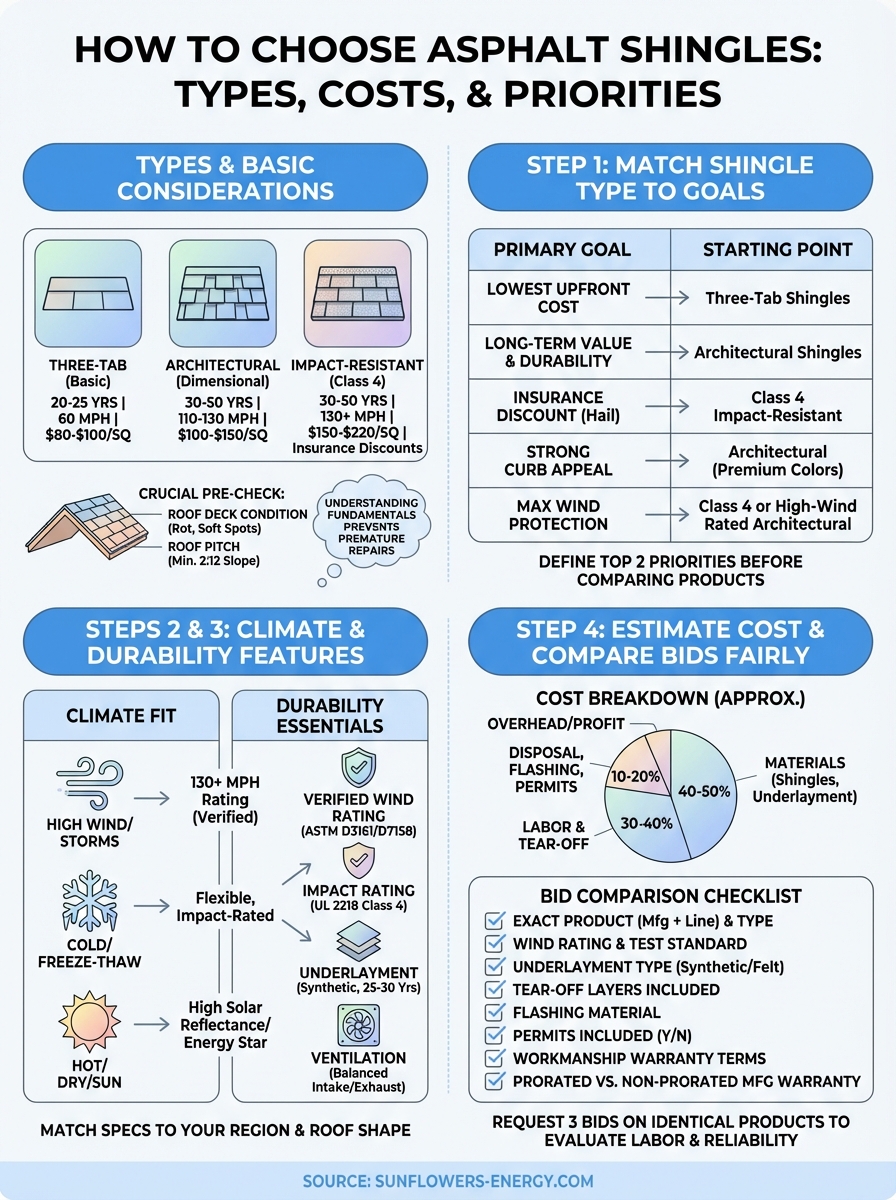
Before you start comparing colors or price tags, you need a clear picture of what you’re actually buying. Asphalt shingles fall into three main categories: three-tab, architectural (dimensional), and impact-resistant (Class 4). Each type carries a different price point, lifespan, and structural makeup, and picking the wrong type for your roof can cost you significantly in premature repairs. Understanding these fundamentals is the real starting point for knowing how to choose asphalt shingles that will actually hold up.
The shingle type you choose now sets the ceiling on how long your roof will perform, so it’s worth getting this decision right before you think about aesthetics or brand names.
The three main asphalt shingle types
Three-tab shingles are the most basic option available. They’re flat, lightweight, and typically carry a 20 to 25-year manufacturer warranty. The tradeoff is that they’re thinner, more vulnerable to wind damage, and most are only rated for winds up to 60 mph, which leaves them exposed in storm-prone areas.
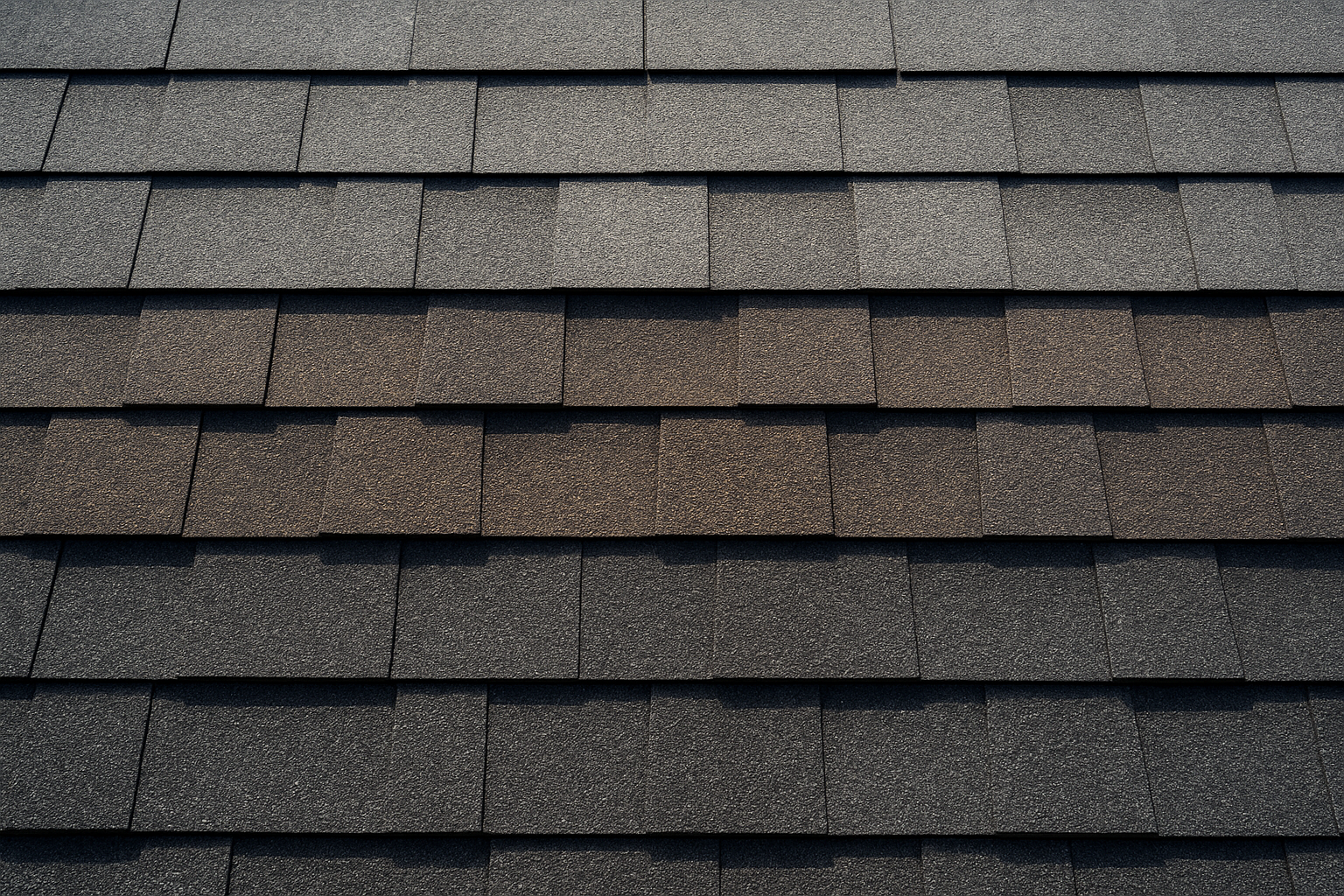
Architectural shingles, also called dimensional or laminate shingles, are the most common choice in residential roofing today. They’re built with two bonded layers of fiberglass mat, which gives them a textured appearance and a longer lifespan, typically 30 to 50 years depending on the manufacturer. Most architectural shingles carry wind ratings between 110 and 130 mph, making them a reliable fit for homes in areas with moderate to heavy storms.
Impact-resistant (Class 4) shingles sit at the top of the performance range. These pass UL 2218 testing, which involves dropping a 2-inch steel ball from 20 feet onto the shingle without cracking it. If you’re in a hail-prone region, Class 4 shingles can qualify you for homeowner’s insurance premium discounts of 20% to 30% depending on your insurer and state, which helps offset the higher upfront cost.
| Shingle Type | Typical Lifespan | Wind Rating | Avg. Cost per Square |
|---|---|---|---|
| Three-tab | 20-25 years | Up to 60 mph | $80-$100 |
| Architectural | 30-50 years | 110-130 mph | $100-$150 |
| Impact-resistant (Class 4) | 30-50 years | 130+ mph | $150-$220 |
How your roof deck and pitch affect your choice
Your shingle selection doesn’t happen in isolation. The condition of your roof deck, the wood sheathing underneath the shingles, directly affects how well any shingle will perform regardless of price. If your deck has soft spots, rot, or improper fastening, even a premium product will fail early. Before committing to a shingle line, have a contractor inspect the deck and confirm it meets the manufacturer’s installation requirements outlined in the product spec sheet.
Roof pitch is the other factor most homeowners overlook. Most asphalt shingles require a minimum slope of 2:12 for standard installation, and some manufacturers require a steeper pitch for their warranty to remain valid. A low-slope roof below 4:12 may need modified methods, such as double-layering underlayment, to prevent water infiltration. Confirm your roof’s slope before selecting a product, and review the manufacturer’s installation guide to make sure your roof qualifies under the stated warranty terms.
What warranty terms actually mean in practice
Manufacturer warranties and contractor workmanship warranties are two separate documents, and both matter when something goes wrong. A manufacturer warranty covers defects in the shingle material itself, while a workmanship warranty covers how the shingles were installed. A 50-year shingle paired with a weak workmanship warranty puts most of the financial risk on you if a failure occurs in year four due to improper installation.
When you review warranty paperwork, look specifically for prorated versus non-prorated coverage. A non-prorated warranty pays the full replacement cost regardless of shingle age. A prorated warranty reduces the payout over time, so a shingle that fails at year 20 may only be covered for a fraction of its current replacement value. Always request the full warranty document from your contractor, not just the one-page summary.
Step 1. Pick the right shingle type for your goals
Knowing the three shingle types is only part of knowing how to choose asphalt shingles. The other part is connecting those types to what you actually need from your roof. Before you talk to a contractor or request samples, define your goals clearly. Are you prioritizing long-term cost savings, maximum storm protection, curb appeal, or a path to an insurance discount? Your answer shapes every product decision that follows.
Define your priorities before you compare products
Start by writing down your top two concerns for this roof. Common goals include staying under a tight budget, getting the longest possible lifespan, qualifying for a hail-resistance insurance discount, or matching an aesthetic standard required by your HOA. Once you identify your top two, you can immediately rule out shingle types that don’t serve them.
Your goal isn’t to find the "best" shingle on the market. It’s to find the best shingle for your specific situation, budget, and location.
For example, if your primary goal is minimizing upfront cost and you live in a region with mild weather, three-tab shingles may be a reasonable choice. If your goal is long-term value and you plan to stay in the home for 20 or more years, architectural shingles almost always deliver a better cost-per-year of coverage than three-tab products.
Match each shingle type to a clear goal
Use this quick reference to align your goal with the right starting point before you request quotes:
| Your Primary Goal | Recommended Starting Point |
|---|---|
| Lowest upfront cost | Three-tab shingles |
| Long-term value and durability | Architectural (dimensional) shingles |
| Insurance discount in hail-prone area | Class 4 impact-resistant shingles |
| Strong curb appeal for resale | Architectural shingles with premium color lines |
| Maximum wind protection | Class 4 or high-wind-rated architectural shingles |
Once you identify your starting point, ask your contractor to show you at least two product options within that category from different manufacturers. Compare their warranty terms, material weight (heavier shingles typically resist wind uplift better), and any available testing certifications such as UL 2218 or FM 4473. This approach gives you a real comparison rather than a single default recommendation that may reflect what the contractor has in stock rather than what fits your goals.
Step 2. Match shingles to your climate and roof layout
Even the best shingle on paper will underperform if it’s the wrong fit for your local climate or roof configuration. This is one of the most overlooked steps in how to choose asphalt shingles, because most homeowners focus on cost and color without considering wind patterns, temperature cycling, and moisture exposure that will stress the material year after year. Matching the product to your environment and roof geometry directly affects how long your warranty stays valid and how well the shingles hold up between replacements.
Factor in your regional weather conditions
Climate determines which shingle specifications you actually need, not just which ones look good in a catalog. If you live in the Gulf Coast, Southeast, or Midwest, where severe storms and high winds are common, look for shingles rated at 130 mph or higher and verify that rating appears on the product label, not just in marketing copy. In colder northern climates, thermal cycling (repeated freezing and thawing) degrades shingles faster, so prioritize products with flexible fiberglass mats and impact ratings that resist cracking under freeze-thaw stress.
If your area gets frequent hail, check your insurer’s list of approved Class 4 shingles before you buy, because not every impact-resistant product qualifies for the same discount.
For hot, dry climates like the Southwest, look for shingles with a high solar reflectance index (SRI) or an Energy Star rating. These products reduce heat absorption, which lowers attic temperatures and can cut cooling costs by 10% to 15% according to the EPA’s Energy Star program.
Account for your roof’s shape and complexity
Your roof’s geometry plays a direct role in how well shingles seal and shed water. Complex rooflines with multiple valleys, dormers, or a steep pitch above 8:12 place extra stress on shingles at transition points. For these configurations, choose architectural shingles with factory-applied sealant strips that bond tightly at edges and valleys where wind uplift is highest.
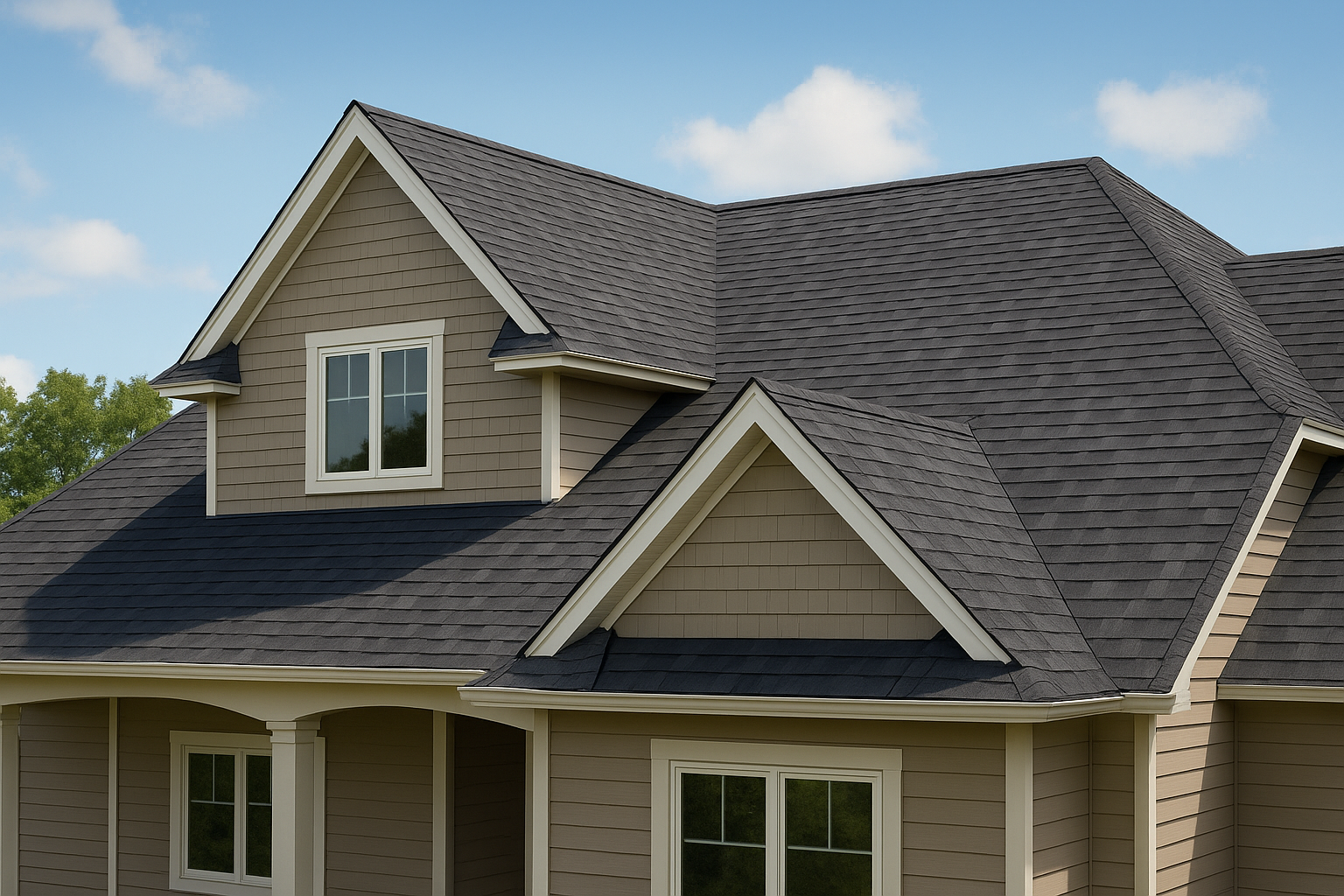
Low-slope sections between 2:12 and 4:12 require modified installation procedures. On those sections, double-layer self-adhering underlayment is typically required to keep your warranty intact, and some manufacturers explicitly exclude low-slope applications from standard warranty terms. Review the product’s technical data sheet before purchasing to confirm your specific roof configuration qualifies for full coverage.
Step 3. Choose durability features that pay off
Durability isn’t a single spec on a label. It’s a combination of material ratings, installation components, and ventilation that work together to extend your roof’s lifespan. When you’re working through how to choose asphalt shingles, this step is where you separate products that will actually last from ones that look fine for a few years and then quietly start failing. The features below consistently make a measurable difference in real-world performance, and they’re worth verifying before any contract is signed.
Verify wind and impact ratings before you buy
Every shingle carries a wind resistance rating, but not all ratings are tested the same way. Look for shingles tested under ASTM D3161 or ASTM D7158, which are the two most common wind-resistance test standards in the industry. Class F under D3161 means the shingle passed at 110 mph, while Class H means it passed at 150 mph. Ask your contractor to show you the product’s technical data sheet and confirm the wind rating references one of those test standards directly, not just the marketing description.
If a shingle’s product page lists a wind rating but the technical data sheet doesn’t cite ASTM D3161 or D7158, treat that number as unverified.
For impact resistance, UL 2218 Class 4 is the benchmark that most insurers recognize for premium discounts. Confirm your contractor is ordering the Class 4 version of the product specifically, not a lower-rated variation from the same product line, since manufacturers often sell multiple impact tiers under the same brand name. This is a common source of confusion that can disqualify you from a discount you were counting on.
Include underlayment and ventilation in your durability plan
The shingle itself only performs as well as the system beneath it. Synthetic underlayment rated for 25 to 30 years gives you a secondary moisture barrier that outlasts traditional felt paper by a wide margin. Felt can tear during installation and degrade within five to ten years. Specify synthetic underlayment in your contract and confirm it’s listed by the shingle manufacturer as a compatible product, since mismatched components can void your warranty even if both products are individually high quality.
Attic ventilation is the other factor that determines how long your shingles hold up. Poor ventilation traps heat against the underside of the deck, which accelerates adhesive breakdown in the shingles above it. The EPA’s Energy Star program recommends balanced intake and exhaust ventilation to maintain consistent attic temperatures year-round. Ask your contractor to assess your current ventilation setup before installation begins and put any required corrections in writing as part of the project scope.
Step 4. Estimate total cost and compare bids fairly
Roofing bids vary widely, and that gap often has nothing to do with quality. Understanding what drives your total cost and knowing how to read a bid correctly are the final pieces of how to choose asphalt shingles without overpaying or getting shortchanged on material grade.
Break down the cost components
A roofing estimate covers more than just shingles. Material costs typically account for 40% to 50% of the total bid, while labor, tear-off, disposal, underlayment, flashing, and permits make up the rest. When you compare bids, each line item needs to match across contractors, not just the bottom line number.
Use this breakdown to check your bids component by component:
| Cost Component | What to Verify |
|---|---|
| Shingles | Product name, type, and quantity in squares |
| Underlayment | Synthetic vs. felt, brand specified |
| Tear-off and disposal | Number of existing layers being removed |
| Flashing | Material type (aluminum vs. galvanized steel) |
| Permits | Included or billed separately |
| Workmanship warranty | Length and coverage terms |
If a bid doesn’t list each component separately, ask the contractor to itemize it before you sign anything.
Compare bids on the same product, not just the price
Contractors often quote different products under similar descriptions, which makes side-by-side comparison misleading. Ask every contractor to bid on the exact same shingle, identified by manufacturer and product line, so you’re evaluating labor and reliability rather than a quiet product swap.
Request three bids minimum. When you receive them, look past the total and confirm that each bid specifies the same shingle brand, type, and wind rating you identified in earlier steps. If one contractor substitutes a lower-tier product, that’s a real cost difference, not a better deal.
Use a bid comparison template
Copy this template and fill it in for each contractor before you decide:
Contractor Name:
Shingle Product (Manufacturer + Line):
Shingle Type (3-tab / Architectural / Class 4):
Wind Rating + Test Standard (ASTM D3161 or D7158):
Total Squares:
Underlayment Specified:
Tear-off Layers Included:
Flashing Material:
Permit Included (Y/N):
Workmanship Warranty (Years):
Manufacturer Warranty (Prorated Y/N):
Total Bid Price:
Filling this out puts every contractor on the same comparison sheet. Any bid missing two or more fields is a signal that the contractor’s scope is vague, which typically leads to unexpected charges once the project is underway.
Next steps for a confident roof decision
You now have a complete framework for how to choose asphalt shingles that hold up for your specific climate, budget, and long-term goals. Start by confirming your roof deck condition and slope, then identify your shingle type based on your top two priorities. From there, verify wind and impact ratings against ASTM standards, specify synthetic underlayment in your contract, and use the bid comparison template from Step 4 to hold every contractor to the same standard before you sign anything.
Taking action is straightforward from here. Get a professional assessment of your current roof before you commit to any product or contractor. Sunflowers Energy LLC provides free on-site inspections and estimates for homeowners across our service area, with no pressure to buy. If you’re ready to get accurate numbers and an honest evaluation of what your specific roof actually needs, schedule your free roofing inspection and move forward knowing exactly what you’re getting.