
Your flat roof has served its purpose, but now it’s showing signs of wear, pooling water, visible cracks, or persistent leaks. When replacement becomes inevitable, choosing from the available flat roof replacement options can feel overwhelming. At Sunflowers Energy LLC, we install and repair both residential and commercial roofing systems, so we understand the weight of this decision on your property and budget.
Not all flat roofing materials perform equally. Some excel in durability but cost more upfront. Others offer budget-friendly installation but require more frequent maintenance. The right choice depends on your building type, local climate, and how long you plan to own the property. Making an informed decision now can save you thousands in repairs and energy costs down the road.
This guide breaks down seven flat roof replacement options, comparing their costs, lifespans, and real-world performance. We’ll cover everything from traditional built-up roofing to modern single-ply membranes and eco-friendly alternatives. By the end, you’ll know exactly which material fits your needs, and your wallet.
1. TPO single-ply membrane
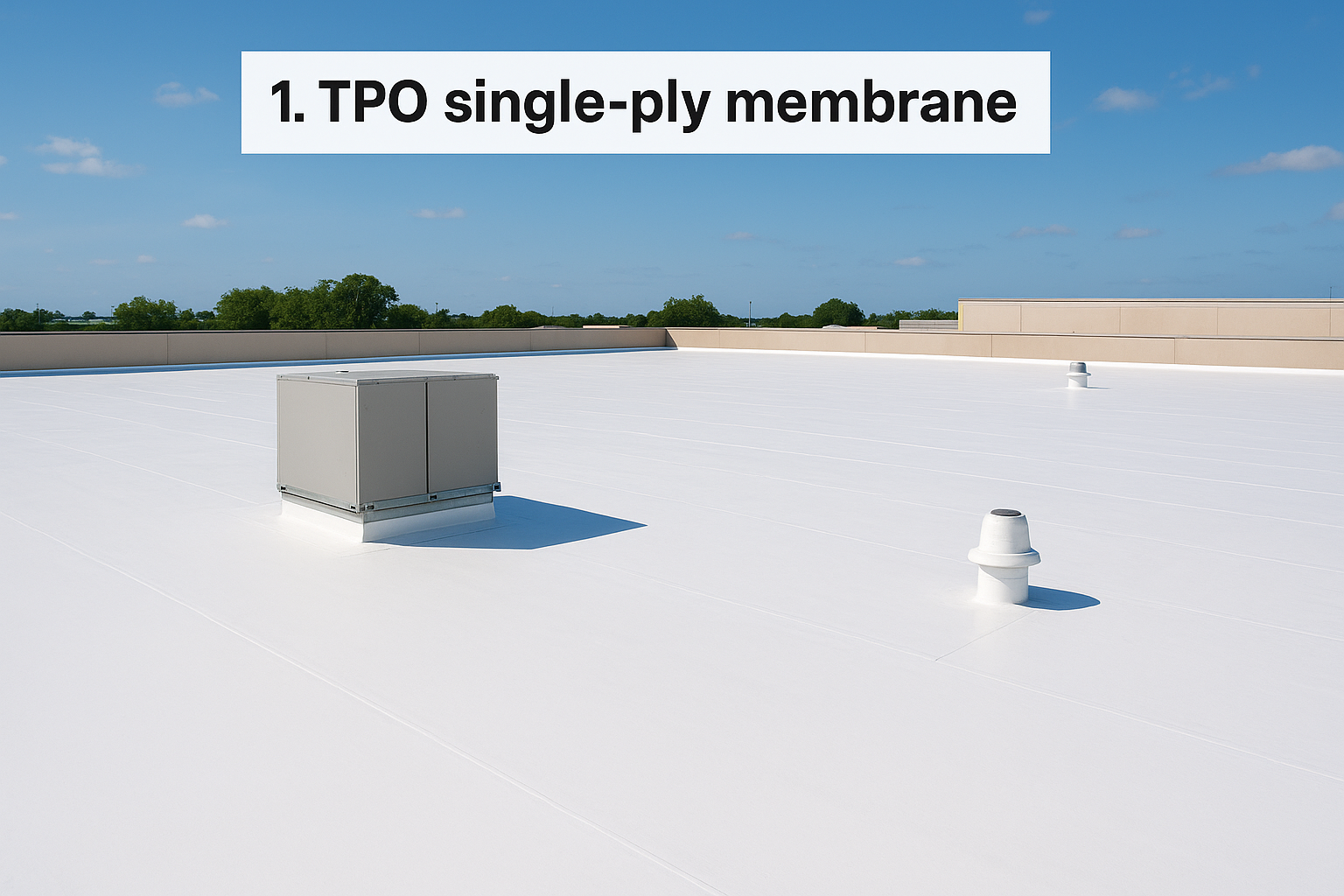
TPO (thermoplastic polyolefin) has become one of the most popular flat roof replacement options over the past two decades. This white or light-gray membrane combines polypropylene and ethylene-propylene polymers to create a flexible, heat-reflective roofing system. You’ll find TPO on commercial buildings, warehouses, and increasingly on residential flat roofs where energy efficiency matters.
How it’s built and installed
Your contractor installs TPO as a single-ply membrane rolled across your roof deck. The process starts with mechanical fasteners or adhesive securing the membrane to the substrate, then heat-welded seams bond the overlapping edges together. This heat-welding process creates seams that are often stronger than the membrane itself, reducing leak points compared to glued or taped systems.
Key pros
TPO offers excellent reflectivity that keeps your building cooler in summer months, cutting air conditioning costs by up to 30% in hot climates. The material resists UV degradation, chemical exposure, and punctures better than many alternatives. Installation costs less than PVC, and the heat-welded seams provide reliable waterproofing. You also get flexibility in cold weather without cracking, which matters if you’re in a region with temperature swings.
TPO’s reflective surface can reduce your cooling costs by hundreds of dollars annually while extending the life of your HVAC system.
Key cons and failure points
The main weakness you’ll face with TPO is inconsistent quality across manufacturers. Early TPO formulations from the 1990s and 2000s had durability issues, and not all manufacturers have perfected their recipes. Seam failures can occur if installers don’t properly heat-weld the joints, and low-quality membranes may shrink over time, pulling away from fasteners. You need experienced installers who understand proper welding temperatures.
Cost range and lifespan
Expect to pay $5.50 to $9.50 per square foot installed for TPO roofing, making it more affordable than PVC but pricier than EPDM. Your TPO roof should last 15 to 25 years depending on membrane thickness, installation quality, and climate conditions. Thicker membranes (60 or 80 mil) cost more upfront but extend lifespan and resist punctures better than standard 45-mil options.
Best fit for climate, building, and use
TPO works best on commercial and residential flat roofs in warm to moderate climates where reflectivity matters. You’ll get maximum benefit in sunny regions like the Southwest or Southeast United States. The material performs well on low-slope roofs with minimal foot traffic, making it ideal for warehouses, retail spaces, and modern flat-roofed homes where energy savings justify the investment.
2. PVC single-ply membrane
PVC (polyvinyl chloride) stands as the premium choice among single-ply flat roof replacement options. This membrane uses chlorinated polymers reinforced with polyester or fiberglass to create a durable, chemical-resistant roofing system. You’ll typically see PVC on commercial buildings, restaurants with grease-producing vents, and properties where long-term performance justifies higher upfront costs.
How it’s built and installed
Your roofing team installs PVC similarly to TPO, using mechanically fastened or fully adhered methods with heat-welded seams. The installation process requires precise temperature control during welding to ensure proper bonding. Most contractors prefer hot-air welding equipment that creates permanent, watertight seams stronger than the membrane itself.
Key pros
PVC delivers superior chemical resistance that makes it ideal for buildings with kitchen exhaust, industrial facilities, or areas with acid rain exposure. The material resists grease, oil, and harsh chemicals that destroy other roofing systems. You get excellent fire resistance, strong welded seams, and a lifespan that often exceeds 25 years with proper maintenance.
PVC’s chemical resistance makes it the only practical choice for buildings with restaurant operations or chemical exposure.
Key cons and failure points
The main drawback you’ll encounter is cost, with PVC being one of the most expensive flat roofing materials. Your initial investment runs significantly higher than TPO or EPDM. Plasticizers can leach out over time in extreme heat, making the membrane brittle, though modern formulations have improved this issue.
Cost range and lifespan
Budget $7 to $12 per square foot installed for PVC roofing. Your roof should last 20 to 30 years with proper installation and maintenance, making the higher upfront cost worthwhile for many property owners.
Best fit for climate, building, and use
PVC works best on commercial buildings requiring chemical resistance, particularly restaurants, hospitals, and industrial facilities. You’ll benefit most in climates with moderate to high UV exposure where durability justifies the premium price.
3. EPDM rubber membrane
EPDM (ethylene propylene diene monomer) represents one of the most time-tested and budget-friendly flat roof replacement options available today. This synthetic rubber membrane comes in black or white sheets, typically made from oil and natural gas byproducts. You’ll find EPDM on residential garages, commercial buildings, and low-slope structures where proven performance and affordability matter more than premium features.
How it’s built and installed
Your contractor installs EPDM using fully adhered, mechanically fastened, or ballasted methods. The membrane comes in large sheets (sometimes covering an entire roof) that minimize seam count. Installation involves adhesive or tape to bond seams rather than heat welding, making the process simpler but potentially creating weaker points than TPO or PVC.
Key pros
EPDM offers the lowest upfront cost among modern flat roofing materials while delivering reliable waterproofing. The material resists UV rays, ozone, and temperature extremes without breaking down. You get a proven track record spanning over 50 years of commercial use, and installation requires less specialized equipment than heat-welded alternatives.
Key cons and failure points
The main vulnerability you’ll face involves seam failures where adhesive or tape bonds weaken over time. Black EPDM absorbs heat rather than reflecting it, potentially increasing cooling costs in warm climates. Punctures from sharp objects happen more easily than with thicker alternatives, and repairs show visibly against the dark surface.
EPDM’s proven 50-year track record makes it the safe choice when budget constraints limit your flat roof replacement options.
Cost range and lifespan
Expect to pay $4 to $8 per square foot installed for EPDM roofing. Your roof should last 20 to 25 years with proper maintenance, though some well-maintained systems exceed 30 years.
Best fit for climate, building, and use
EPDM works best on residential and light commercial buildings where initial cost matters most. You’ll benefit in cold climates where the material’s flexibility prevents cracking, though white EPDM performs better in hot regions requiring reflectivity.
4. Modified bitumen
Modified bitumen combines traditional asphalt technology with modern polymer modifiers to create a hybrid roofing system. This material improves on old-style tar and gravel roofs by adding rubber or plastic polymers (APP or SBP) that increase flexibility and durability. You’ll recognize modified bitumen by its multi-layer construction and torch-down or cold-applied installation method common on commercial buildings and residential flat roofs.
How it’s built and installed
Your roofing contractor applies modified bitumen in multiple layers over a base sheet. Installation typically uses torch-applied heat to melt the underside and bond it to the substrate, though self-adhering and cold-applied versions exist for buildings where open flames aren’t allowed. The overlapping sheets create redundant waterproofing layers that resist leaks.
Key pros
Modified bitumen offers excellent puncture resistance and performs well in foot traffic areas. The multi-layer construction provides redundancy if the top layer fails. You get flexibility in cold weather and can choose granulated surfaces that reflect heat or smooth surfaces for coating applications.
Key cons and failure points
The torch-down installation method creates fire risk during application, requiring experienced installers with proper safety equipment. Seams can separate if not properly heated, and the dark surface absorbs heat unless you opt for reflective coatings.
Modified bitumen’s multi-layer construction gives you redundant waterproofing that protects against single-point failures common in other flat roof replacement options.
Cost range and lifespan
Budget $5 to $8 per square foot installed for modified bitumen. Your roof should last 15 to 20 years with regular maintenance and recoating.
Best fit for climate, building, and use
Modified bitumen works best on commercial and industrial buildings requiring durability and foot traffic resistance, particularly in cold climates where flexibility prevents cracking.
5. Built-up roofing
Built-up roofing (BUR) stands as the oldest and most proven flat roofing system still in use today. This traditional approach layers alternating sheets of roofing felt with hot tar or cold-applied adhesive to create a waterproof barrier. You’ll often see BUR topped with gravel or a mineral cap sheet, giving it the classic "tar and gravel" appearance common on older commercial buildings and apartment complexes.
How it’s built and installed
Your contractor builds BUR systems by applying multiple layers of bitumen (asphalt or coal tar) and reinforcing fabrics directly on your roof deck. The process involves heating asphalt in a kettle and mopping it between layers of felt, typically creating three to five plies for redundant protection. A final flood coat of bitumen gets covered with gravel or a granulated cap sheet to protect against UV damage and foot traffic.
Key pros
BUR provides exceptional durability and can handle heavy foot traffic better than single-ply membranes. The multi-layer construction creates redundant waterproofing that prevents single-point failures. You get proven performance spanning over 100 years of commercial use, and the gravel surface resists punctures from debris.
Built-up roofing’s multi-layer construction has protected commercial buildings for over a century, making it one of the most reliable flat roof replacement options available.
Key cons and failure points
The installation process creates strong odors that can disrupt occupied buildings, and the weight of multiple layers requires structural support. Seam blisters can form when moisture gets trapped between layers, and the dark surface absorbs heat unless you apply reflective coatings.
Cost range and lifespan
Expect to pay $5 to $10 per square foot installed for BUR systems. Your roof should last 20 to 30 years with proper maintenance, though some well-maintained systems exceed 40 years.
Best fit for climate, building, and use
BUR works best on commercial buildings requiring durability and foot traffic resistance, particularly older structures already supporting heavy roofing systems where proven performance matters more than energy efficiency.
6. Spray polyurethane foam
Spray polyurethane foam (SPF) offers a unique approach among flat roof replacement options by creating a seamless, monolithic roofing system. This material starts as a liquid that expands into rigid insulation when sprayed, forming both waterproofing and thermal barriers in one application. You’ll find SPF on commercial buildings, industrial facilities, and properties where existing roof irregularities make traditional membranes impractical.
How it’s built and installed
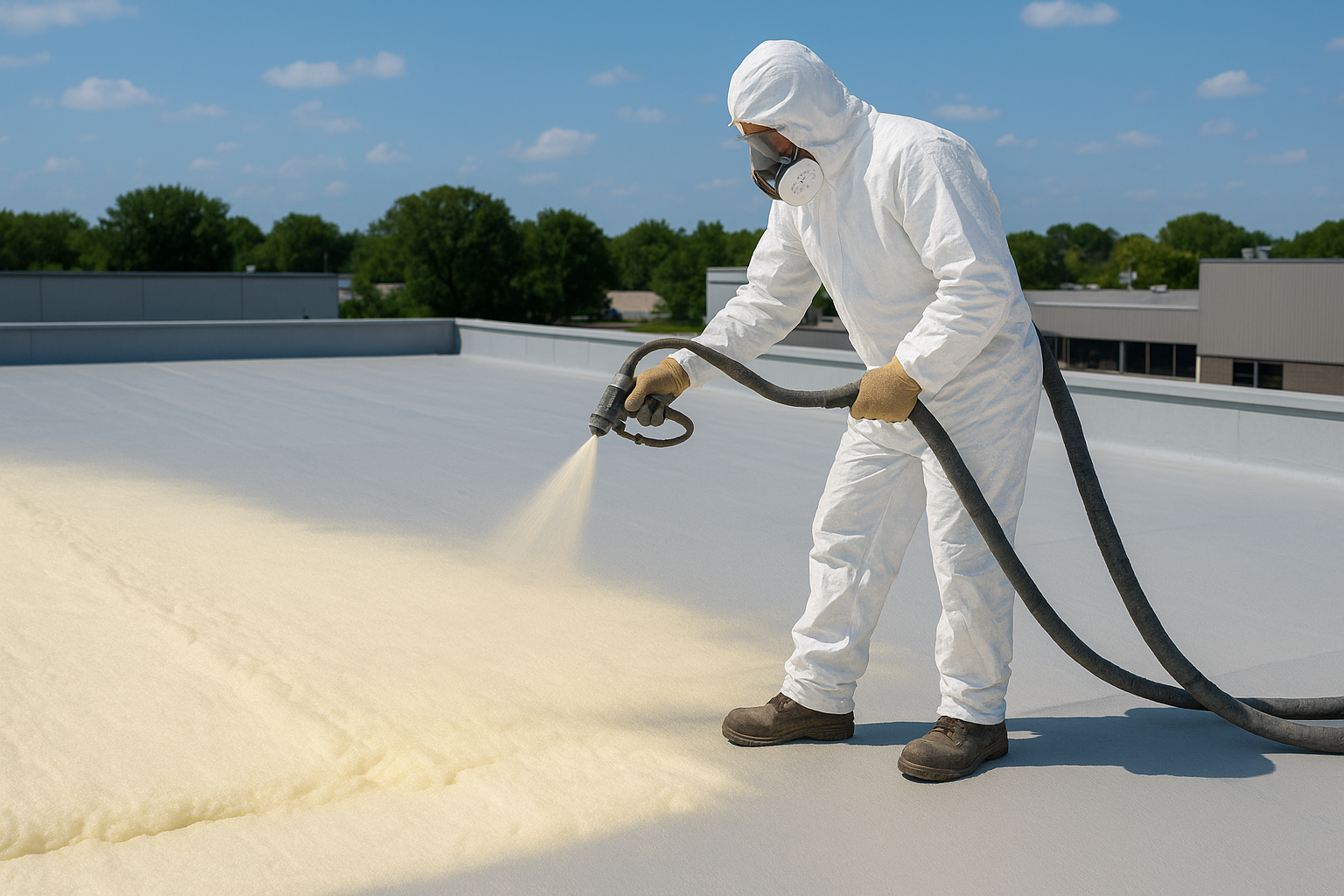
Your contractor sprays liquid polyurethane directly onto your existing roof deck using specialized spray equipment. The material expands to 20 or 30 times its liquid volume, filling gaps and creating a seamless surface. Installation requires multiple passes to build up adequate thickness (typically 1.5 to 3 inches), followed by a protective coating layer that shields the foam from UV damage and physical wear.
Key pros
SPF provides excellent insulation that can reduce energy costs by 30% or more while adding minimal structural weight. The seamless application eliminates leak-prone seams entirely. You get the ability to apply SPF over existing roofing systems, avoiding tear-off costs, and the material conforms to irregular surfaces that challenge traditional membranes.
Key cons and failure points
The main challenges you’ll face involve application sensitivity to weather conditions like temperature, humidity, and wind. Poor installation creates voids or inconsistent thickness that compromise performance. UV exposure degrades uncoated foam quickly, requiring protective coatings every 10 to 15 years.
SPF’s seamless application eliminates every seam on your roof, removing the most common failure point in other flat roofing systems.
Cost range and lifespan
Budget $6 to $12 per square foot installed for SPF roofing. Your roof should last 20 to 30 years with proper coating maintenance.
Best fit for climate, building, and use
SPF works best on commercial and industrial buildings requiring superior insulation, particularly in climates with extreme temperatures where energy savings justify the investment and ongoing coating maintenance.
7. Standing seam metal for low-slope roofs
Standing seam metal brings commercial-grade durability to low-slope applications through interlocking metal panels designed for minimal pitch. This system uses raised seams that run vertically across your roof, creating watertight channels that shed water efficiently even on slopes as low as 1:12. You’ll find standing seam metal on modern commercial buildings, architectural projects, and upscale residential properties where longevity and appearance justify premium pricing.
How it’s built and installed
Your contractor installs standing seam panels over a solid substrate using concealed fasteners that attach to clips beneath the raised seams. The panels interlock at their edges, and installers mechanically crimp or snap the seams together to create continuous waterproof barriers. Installation requires specialized tools and skilled labor to ensure proper panel alignment and seam closure.
Key pros
Standing seam metal delivers exceptional longevity that outlasts virtually all other flat roof replacement options, often lasting 40 to 50 years or more. The material resists fire, wind, and impact damage better than membrane systems. You get minimal maintenance requirements, excellent color retention, and the ability to accommodate building movement through the panel’s expansion joints.
Key cons and failure points
The primary obstacle you’ll face involves high upfront costs that exceed most other roofing systems by 50% to 100%. Oil canning (visible waviness in flat panel areas) can occur with thinner gauges, affecting appearance though not performance. Fastener failures at the clips can allow panels to separate in extreme wind events.
Standing seam metal’s 40 to 50-year lifespan means you’ll likely never replace your roof again during your ownership.
Cost range and lifespan
Budget $10 to $16 per square foot installed for standing seam metal roofing. Your roof should last 40 to 50 years with minimal maintenance, making the total cost of ownership competitive despite premium initial pricing.
Best fit for climate, building, and use
Standing seam metal works best on commercial and high-end residential buildings where long-term value matters more than initial cost, particularly in areas with severe weather requiring maximum durability and wind resistance.
What to do next
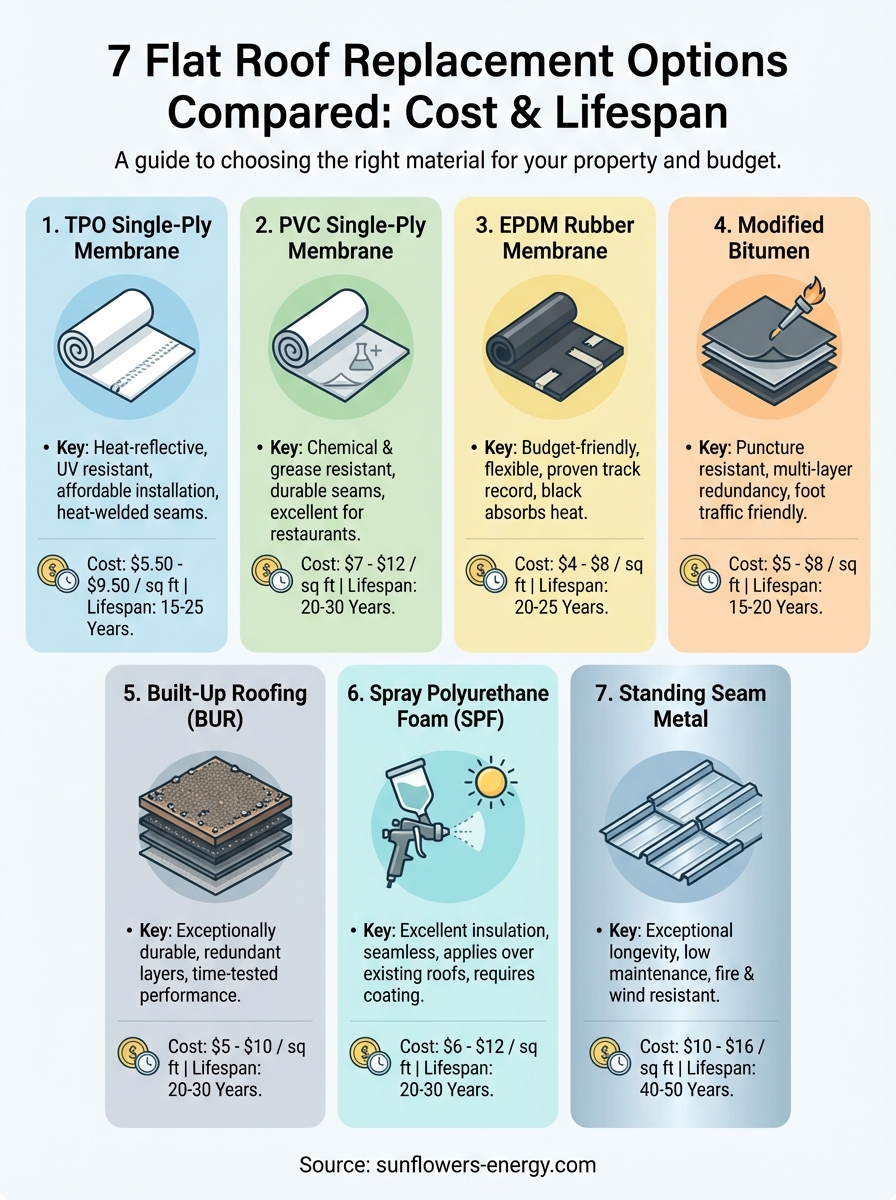
You now understand the seven major flat roof replacement options available for your property. Each material offers distinct advantages based on your budget, climate, building type, and long-term ownership plans. TPO and EPDM provide budget-friendly solutions for most applications, while PVC and standing seam metal deliver premium performance at higher costs. Modified bitumen, built-up roofing, and spray foam fill specific niches where their unique properties match your needs.
Your next step involves getting a professional assessment of your existing roof condition and structural capacity. The right material depends on factors only an onsite inspection can reveal, including deck condition, drainage patterns, and load-bearing capacity. Making this decision without expert input risks choosing a system that underperforms or fails prematurely.
Schedule a free roof inspection with Sunflowers Energy LLC to discuss which flat roofing system fits your property best. Our team installs all seven options covered in this guide and provides transparent pricing with no-obligation quotes.

5 Responses