
Choosing between asphalt shingles vs metal roof comes down to more than just price tags. It’s a decision that affects your home’s protection, energy efficiency, and long-term value for decades to come. Both materials have earned their place on American homes, but they serve very different priorities, and the right pick depends on your budget, your climate, and how long you plan to stay in your home.
At Sunflowers Energy LLC, we install and maintain residential roofs every day, and this is one of the most common questions homeowners ask us. We’ve seen firsthand how the wrong roofing choice costs people thousands in premature replacements, while the right one pays for itself over time. That hands-on experience is exactly what shaped this guide, real numbers and real trade-offs, not vague generalizations.
This article breaks down the 2026 costs, expected lifespan, durability, maintenance demands, and return on investment for both asphalt shingles and metal roofing. By the end, you’ll have a clear framework for deciding which material makes the most financial and practical sense for your specific situation.
Why this comparison matters for your home
Your roof is not a minor purchase. Most homeowners replace their roof once, maybe twice in their lifetime, and the material you choose locks in decades of maintenance costs, energy bills, and insurance rates. When you weigh asphalt shingles vs metal roof, you’re not just picking a look, you’re committing to a long-term financial and structural decision that touches almost every area of homeownership.
Your roof is one of your biggest financial decisions
A new roof typically ranks as one of the top three most expensive home improvements a homeowner will make, right alongside HVAC replacement and major kitchen renovations. The material you select shapes your upfront cost, your annual maintenance budget, and ultimately how much value your home holds when you decide to sell. Choosing the wrong material for your situation doesn’t just cost you money today; it creates a compounding cycle of repairs and early replacement that drains your budget year after year.
The choice you make today on roofing material can either save you tens of thousands of dollars over 30 years or cost you that same amount in avoidable replacements and repairs.
Lenders, insurers, and buyers all evaluate your roof when assessing your home’s value and risk profile. Insurance premiums, mortgage approvals, and resale appraisals are directly influenced by what sits on top of your house. That makes this decision significantly more consequential than most homeowners initially expect.
Climate and location change the calculus
Not every roof performs the same way in every environment. Hail-prone regions in the Midwest, for example, create very different demands on a roof than the humid Gulf Coast or the freeze-thaw cycles common across northern states. A material that holds up beautifully in Arizona may degrade much faster in a coastal Florida climate, where salt air, heavy rain, and persistent humidity accelerate wear in ways that lab tests rarely capture.
Your specific weather patterns should carry real weight in this comparison. Wind resistance ratings, impact resistance grades, and moisture management capabilities vary significantly between asphalt shingles and metal roofing, and those differences become obvious after the first serious storm season. Matching your roofing material to your local conditions is one of the most direct ways to protect your investment over the long term.
Local building codes also play a role. Many municipalities have specific requirements for wind uplift resistance or fire ratings, which can narrow your options depending on where you live. Before you commit to either material, it’s worth confirming what your area demands and which option clears those standards with room to spare.
Costs in 2026, including labor and tear-off
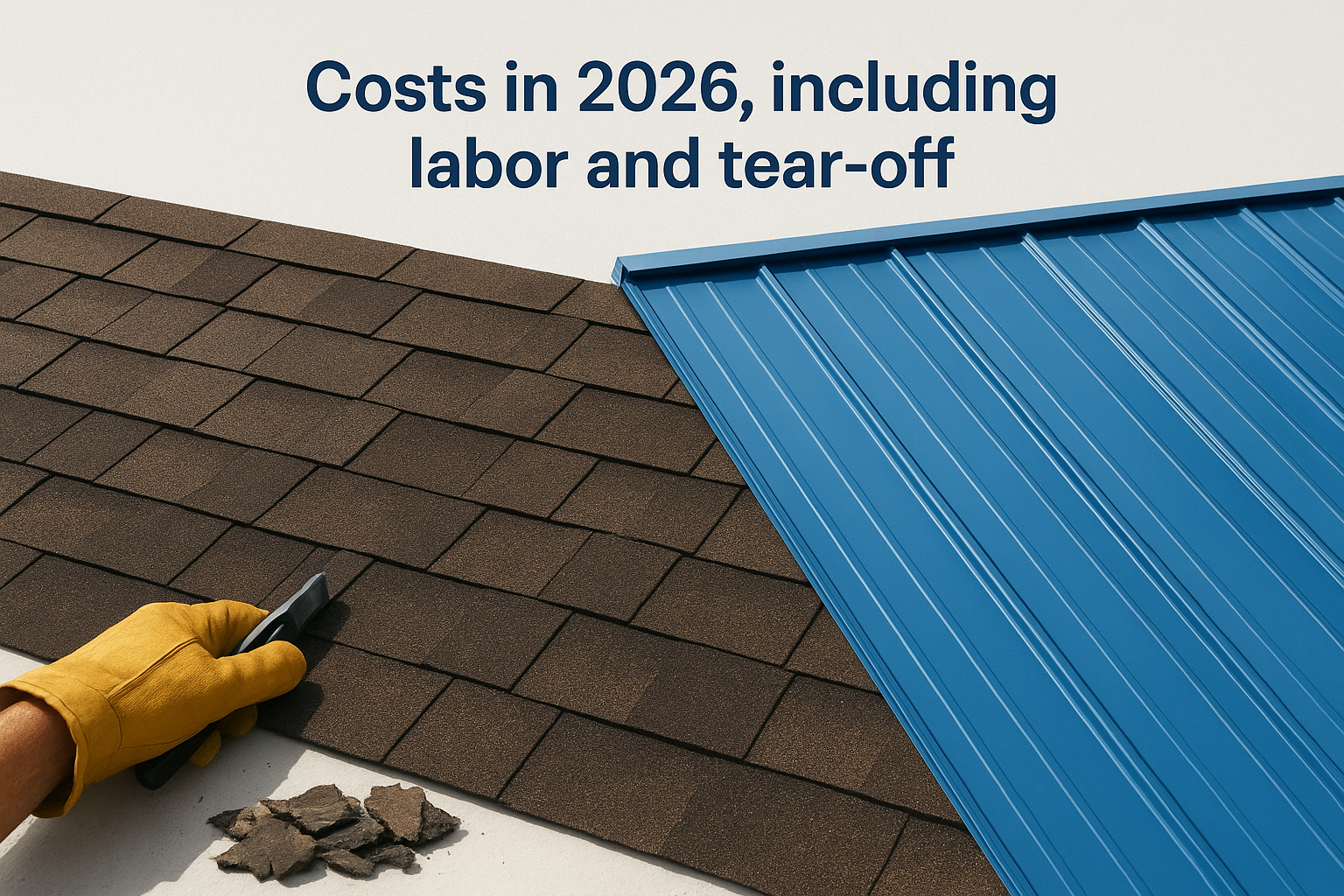
When you compare asphalt shingles vs metal roof on price alone, asphalt shingles win the upfront battle by a significant margin. Understanding what drives those numbers, including materials, labor, and tear-off fees, helps you see the full picture before you commit to either option.
What asphalt shingles cost in 2026
Asphalt shingle installation in 2026 runs between $4.50 and $9.00 per square foot installed, which puts a typical 2,000-square-foot roof in the $9,000 to $18,000 range. That spread reflects regional labor rates and shingle quality, with architectural (dimensional) shingles sitting at the higher end compared to basic 3-tab options.
Tear-off adds another layer to your budget. Removing your old roof typically costs $1.00 to $2.50 per square foot, meaning a full tear-off on a 2,000-square-foot roof can add $2,000 to $5,000 before a single new shingle goes down. Some contractors skip tear-off by layering new shingles over old ones, but that shortcut limits your shingle warranty and can hide underlying deck damage you’ll eventually pay for.
Never let a contractor talk you into skipping tear-off without first inspecting the roof deck for rot, moisture damage, or structural issues.
What metal roofing costs in 2026
Metal roofing carries a higher upfront price, typically $10.00 to $20.00 per square foot installed depending on the panel type. Standing seam metal, the premium option, runs $15.00 to $20.00 per square foot, while corrugated or exposed-fastener panels can fall closer to $10.00 to $14.00.
Labor accounts for a larger share of metal roofing costs because installation requires more skill and time. Expect labor to represent 40% to 60% of your total project cost, which means choosing an experienced and certified crew matters as much as choosing the right panel system.
Lifespan and durability in real-world weather
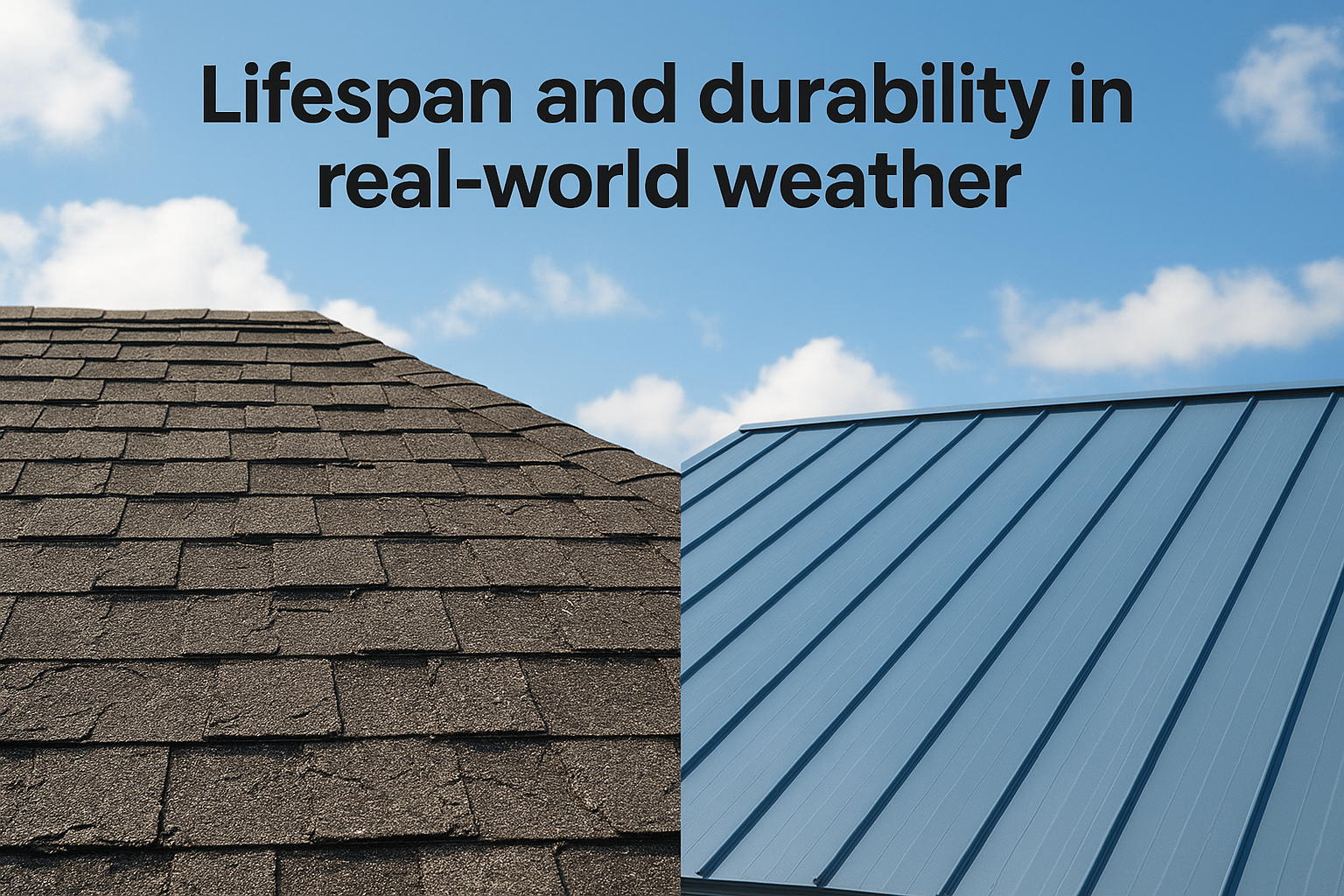
When comparing asphalt shingles vs metal roof, lifespan is where the gap between the two materials becomes most visible. What a manufacturer prints on a warranty sheet and what actually happens on your roof after 10 years of real storms, UV exposure, and temperature swings are two different things.
How long asphalt shingles actually last
Standard 3-tab asphalt shingles carry a 20-to-25-year warranty, but most homeowners see meaningful degradation starting around year 15 to 18 in harsh climates. Architectural shingles perform better, with real-world lifespans closer to 22 to 28 years when installed correctly and maintained consistently. Heavy UV exposure, standing moisture, and recurring freeze-thaw cycles all shorten that window.
The biggest durability risk with asphalt is granule loss. Granules protect the asphalt mat from UV rays, and once they start washing off, your shingles age rapidly. A single severe hailstorm can accelerate granule loss by years, meaning your 20-year shingle may need replacement at 12 to 15 years in storm-heavy regions.
In climates with frequent hail or severe storms, plan your asphalt shingle budget around a realistic 15-to-20-year replacement cycle, not the warranty number printed on the packaging.
How metal roofing holds up over decades
Standing seam metal roofs carry manufacturer warranties of 40 to 50 years, and many installations easily exceed that in moderate climates. Steel and aluminum panels resist granule loss, cracking, and warping in ways that asphalt cannot match. Even in coastal environments with salt air exposure, properly coated metal panels hold up significantly longer than any asphalt product on the market.
Metal also handles extreme temperature cycling far better than asphalt does. Where repeated freeze-thaw cycles cause asphalt to crack and curl at the edges, metal panels flex without breaking their seal or fastening points. That physical resilience directly translates into fewer emergency repairs and a longer overall service life for your roof.
Maintenance, repairs, and common failure points
Maintenance costs are where the asphalt shingles vs metal roof comparison often surprises homeowners most. The upfront price tells only part of the story; how much time and money each material demands over its service life is what determines your real cost of ownership.
Asphalt shingle maintenance and failure points
Asphalt shingles require active attention every few years to stay in good condition. You should expect to clean moss and algae growth, reseal flashing around chimneys and vents, and replace individual damaged shingles after heavy storms. These tasks are relatively inexpensive when addressed promptly, but ignored problems escalate quickly into deck rot and interior water damage that cost far more to fix.
The most common failure points on asphalt roofs are flashing separations, cracked ridge caps, and shingles that lift or curl at the edges due to improper nailing or prolonged UV exposure. Valleys and low-slope areas collect debris and moisture, making them the first spots to deteriorate on an older asphalt roof.
If your asphalt roof is past the 15-year mark, schedule a professional inspection every two years, not every five, to catch flashing failures and granule loss before they become interior damage.
Metal roof maintenance and failure points
Metal roofing demands significantly less routine maintenance than asphalt, but it is not completely hands-off. You should clear debris from valleys and gutters annually, inspect sealant around penetrations every five to seven years, and check exposed fasteners on corrugated panels for backing out or corrosion.
The primary failure point on standing seam metal roofs is the sealant at penetrations, not the panels themselves. On exposed-fastener systems, rubber washers around screws degrade over time and allow water infiltration if not replaced on schedule. Catching these specific points early keeps a metal roof performing well past its warranty period.
ROI factors: energy, insurance, resale, and sustainability
When you compare asphalt shingles vs metal roof through a return-on-investment lens, metal roofing consistently pulls ahead over time, even though it costs more upfront. The four ROI factors that matter most are energy performance, insurance discounts, resale value, and long-term sustainability, and each one favors metal to a meaningful degree.
Energy savings and insurance benefits
Metal roofing reflects solar heat rather than absorbing it, which reduces your cooling load during summer months. Homeowners in warm climates typically report 10% to 25% reductions in cooling costs after switching to a reflective metal roof, according to Oak Ridge National Laboratory research. Asphalt shingles absorb heat and transfer it directly into your attic, forcing your HVAC system to work harder throughout the hottest months of the year.
Over a 40-year metal roof lifespan, energy savings alone can offset a significant portion of the higher installation cost compared to replacing asphalt twice in that same period.
Insurance companies in many states offer premium discounts of 20% to 30% for metal roofing because of its superior impact resistance and fire rating. Class 4 impact-rated metal panels, the highest available rating, qualify for those discounts in most hail-prone markets. Asphalt shingles rarely achieve equivalent ratings, and even impact-resistant asphalt products typically yield smaller premium reductions.
Resale value and sustainability
Metal roofing consistently delivers a stronger resale return than asphalt because buyers recognize they are inheriting a roof with decades of remaining life. A home with a 5-year-old metal roof appraises differently than one carrying a 15-year-old asphalt roof approaching replacement. Remodeling Magazine’s annual Cost vs. Value report has tracked metal roofing as one of the stronger exterior upgrades for resale return year over year.
Sustainability also factors into long-term value. Metal panels contain 25% to 95% recycled content and are fully recyclable at end of life, unlike asphalt shingles, which contribute millions of tons to landfills annually.
Final take
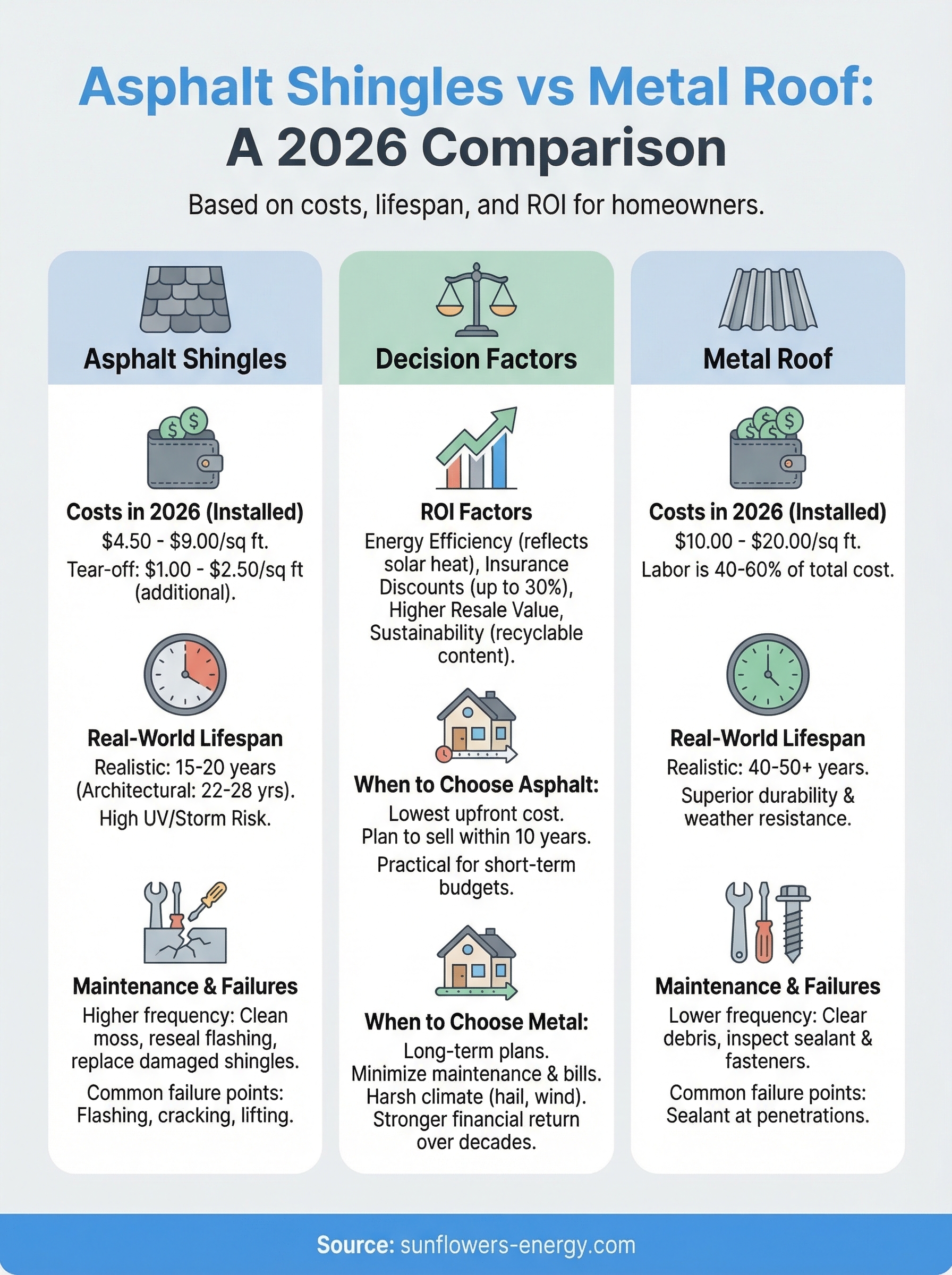
The asphalt shingles vs metal roof decision ultimately comes down to your timeline and priorities. If you need the lowest possible upfront cost and plan to sell within 10 years, asphalt shingles are the practical choice. If you plan to stay in your home long-term and want to minimize replacement cycles, maintenance calls, and energy bills, metal roofing delivers a stronger financial return over the full life of your roof.
Neither option is a mistake. The error most homeowners make is choosing based on upfront price alone without factoring in lifespan, local climate demands, and the compounding cost of early replacement and ongoing maintenance. Run the full numbers for your specific situation before you commit.
When you’re ready to see what either option actually costs on your home, get a free on-site inspection and estimate from Sunflowers Energy. You’ll walk away with real project numbers from a team that installs both roofing systems every day.