
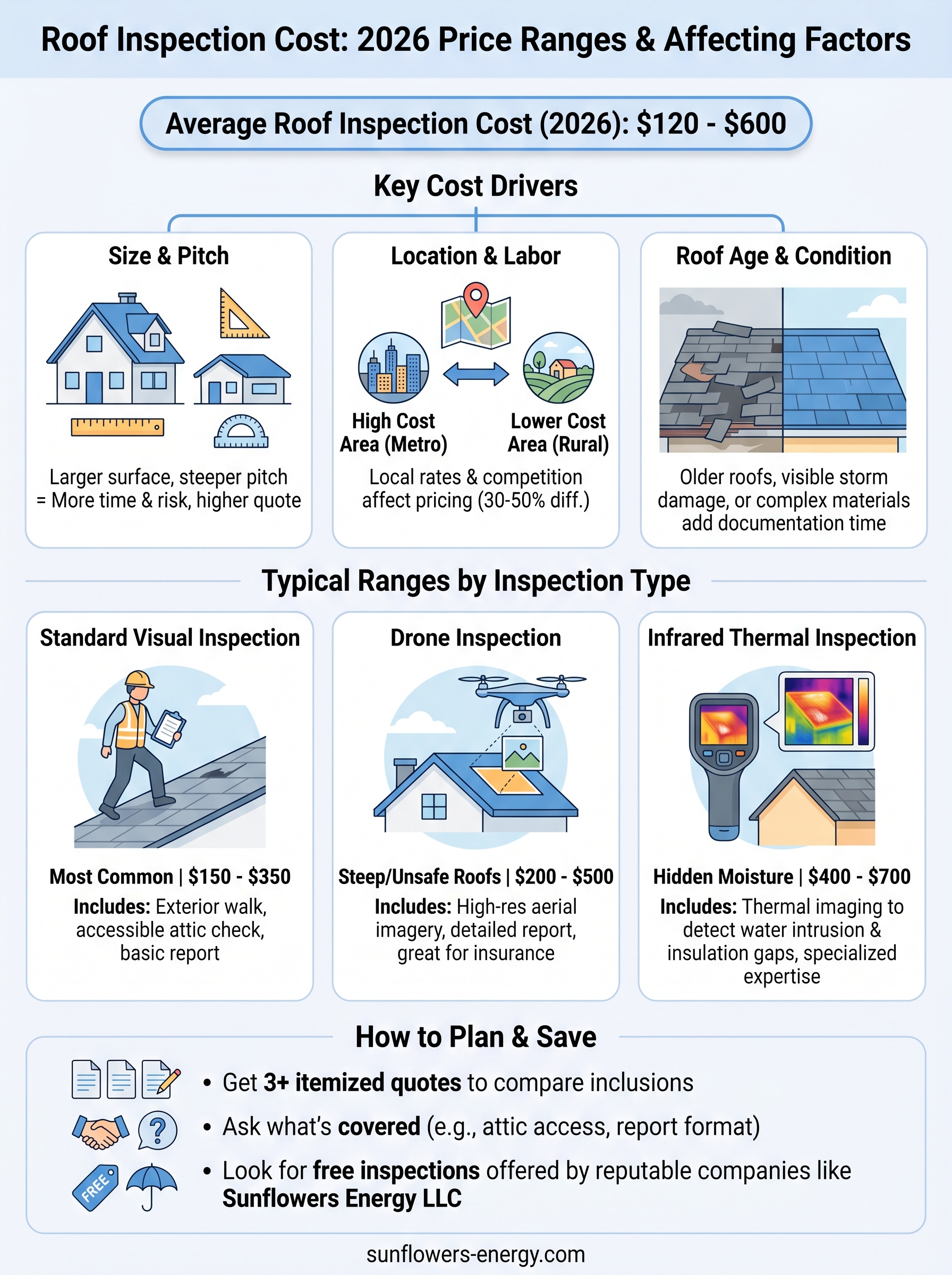
Before you hire someone to climb up on your roof, you probably want to know what it’ll actually cost. That’s a smart move. The average roof inspection cost in 2026 ranges from $120 to $600, depending on your roof’s size, pitch, location, and the type of inspection you need. That’s a wide spread, and understanding why prices vary so much can save you from overpaying or, worse, skipping an inspection altogether.
A roof inspection isn’t just a formality. It’s how you catch small problems, cracked flashing, lifted shingles, hidden moisture damage, before they turn into thousands of dollars in repairs. Whether you’re buying a home, filing a storm damage claim, or just haven’t looked up there in a few years, knowing the real numbers helps you budget with confidence and ask the right questions when getting quotes.
At Sunflowers Energy LLC, we provide free on-site roof inspections and estimates for homeowners and business owners across our service area. We’ve seen firsthand how pricing confusion keeps people from protecting their biggest investment. This guide breaks down current price ranges by inspection type, the key factors that drive costs up or down, and when you might not need to pay for an inspection at all.
Why roof inspection prices vary
The roof inspection cost you see quoted can differ by hundreds of dollars, and that gap is not arbitrary. Contractors base their pricing on several concrete variables: how long the job will take, what equipment it requires, and how much physical risk is involved. Understanding these factors helps you evaluate quotes more accurately and avoid overpaying for a straightforward inspection or underpaying for one that won’t give you the detail you actually need.
Your roof’s size and pitch
Roof size is the most direct pricing factor. Inspectors typically measure in roofing squares, where one square equals 100 square feet of surface area. A larger roof takes more time to walk, document, and assess. A 2,500-square-foot home might have a roof in the 25 to 35 square range, but add dormers, multiple roof levels, or complex geometry, and that number climbs fast. More surface area means more time on the job, which means a higher quote.
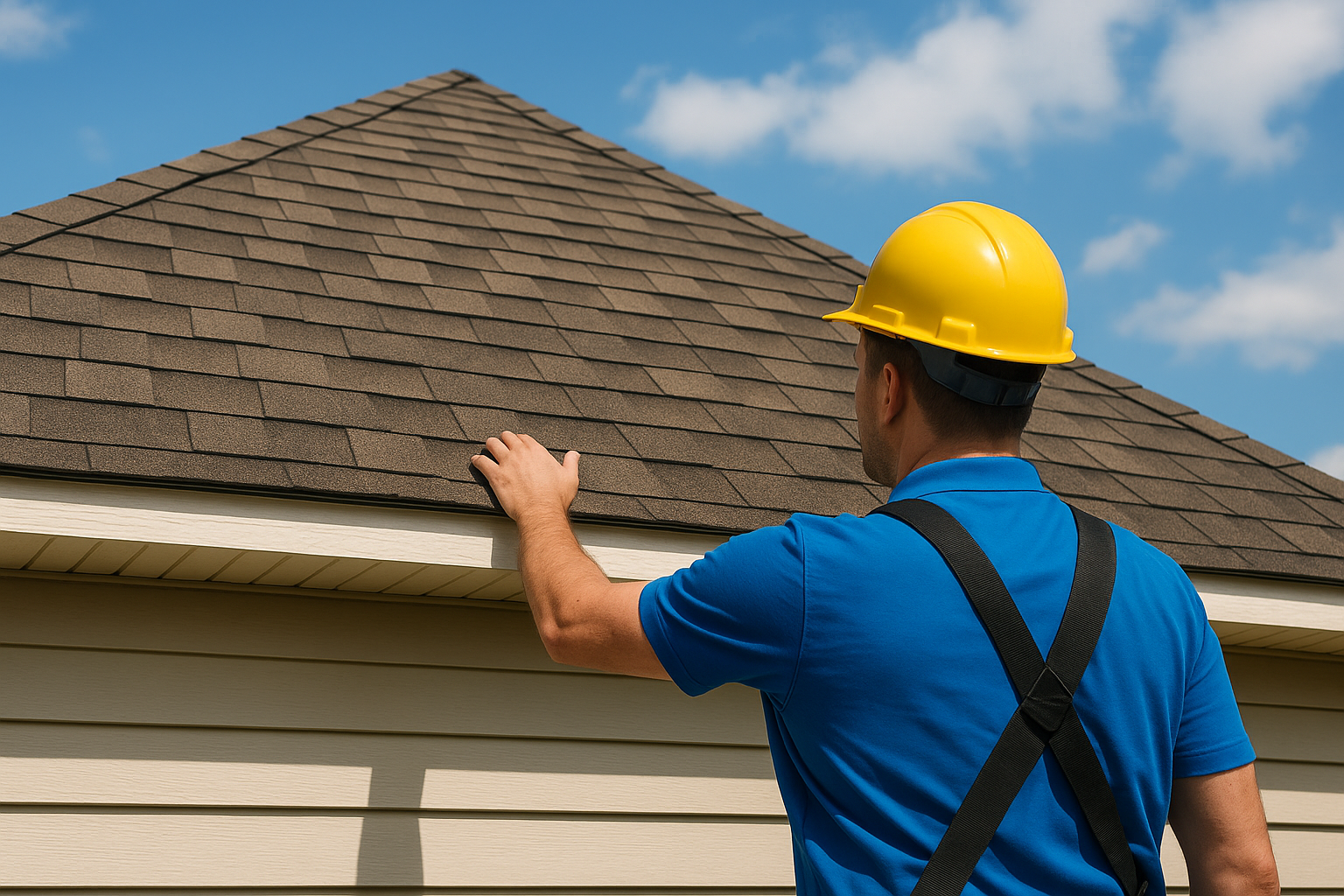
Pitch, or steepness, adds another cost layer. A low-slope or flat roof is relatively safe and quick to walk. A steep-pitch roof above a 6:12 ratio requires fall protection equipment, slower movement, and greater caution from the inspector. That added risk and time get built into the rate, and you will notice the difference when comparing quotes between a ranch-style home and a two-story with a sharply angled gable roof.
A steep roof does not just slow the inspector down. It can also limit which inspection methods are safe to use, sometimes pushing you toward a drone or infrared option instead of a standard physical walkthrough.
Your location and local labor rates
Geographic location is one of the biggest drivers of price variation you will find when shopping for a roof inspection. Contractors in high cost-of-living metro areas like New York City, Los Angeles, or Chicago carry higher overhead, business insurance, and operating costs. Those costs flow directly into their pricing. In smaller cities and rural markets, the same scope of work often runs 30 to 50 percent less simply because the local cost structure is lower.
Local competition levels matter too. Markets with many active roofing contractors tend to have more competitive pricing because you have real options. In areas where fewer inspectors operate, limited supply gives contractors less pricing pressure, and rates can climb independent of your roof’s actual complexity.
Roof age and condition
Older roofs require more thorough documentation. A 20-year-old roof may have moisture intrusion in one area, lifted shingles along another section, and deteriorating flashing near the chimney. Each issue requires separate notes, photos, and assessment. A newer roof in solid condition can often be reviewed faster, which can translate to a meaningfully lower total cost on your end.
Visible storm or weather damage adds another layer of complexity. When an inspector needs to produce a detailed report for an insurance claim, the documentation work alone adds significant time to the job. Some contractors charge separately for insurance-grade inspection reports rather than including that work in their base quote. You should ask upfront whether insurance documentation is included or billed as an add-on before you agree to a price.
Roof inspection cost in 2026: typical ranges
Knowing the actual numbers helps you budget before you call a single contractor. The national average roof inspection cost sits between $120 and $600 in 2026, but most homeowners with a standard residential roof end up paying somewhere in the $200 to $350 range for a basic professional inspection. The extremes on either end usually reflect unusually simple jobs on the low side, and large, complex, or specialty inspections on the high end.
Standard visual inspections
A standard visual inspection is the most common type. An inspector walks the roof surface, checks the attic if accessible, examines flashing, gutters, and drainage, and produces a written report. Most standard inspections for a typical single-family home fall between $150 and $350. Smaller homes under 1,500 square feet often come in closer to $120 to $180, while larger homes in the 3,000-plus square foot range push toward $300 to $400 even for a basic walkthrough.
| Home Size | Typical Visual Inspection Cost |
|---|---|
| Under 1,500 sq ft | $120 – $200 |
| 1,500 – 2,500 sq ft | $200 – $300 |
| 2,500 – 3,500 sq ft | $280 – $375 |
| 3,500+ sq ft | $350 – $500+ |
These ranges cover the inspection itself and do not include repair estimates or insurance documentation fees, which contractors often bill separately.
Specialty and insurance-grade inspections
Drone and infrared inspections carry higher price points because of the equipment and expertise involved. Drone inspections typically run $200 to $500, while infrared thermal scans, which detect hidden moisture and insulation gaps, generally cost between $400 and $700 for a residential property. These options make the most sense when your roof is steep, when you are dealing with an active insurance claim, or when you suspect water damage that a standard visual check would miss.
Insurance-grade inspections fall into a separate category worth understanding. These reports are more detailed and more time-intensive, often ranging from $300 to $600, because the inspector must produce documentation that meets your insurance provider’s specific requirements. Some contractors charge a flat rate that covers both the inspection and the report; others bill separately. Always confirm what is included before you book.
What drives the total roof inspection cost
The size and pitch of your roof explain a lot of the price variation, but they are not the only variables at play. Several additional factors push the total roof inspection cost higher or lower depending on your specific situation. Knowing what those factors are lets you have a more informed conversation with any contractor before you agree to a price.
Roof material and system complexity
Different roofing materials require different inspection approaches. Asphalt shingles are the most common residential material and straightforward to assess. Metal roofing, tile, slate, and flat membrane systems each have their own failure points and require an inspector who knows what to look for on that specific material. Specialty material inspections take longer and sometimes require a contractor with a narrower expertise, both of which increase what you pay.
System complexity adds time in the same way. A roof with multiple valleys, skylights, chimneys, solar panels, or HVAC equipment mounted on the surface gives an inspector more areas to document and assess carefully. Each penetration point is a potential leak source, and a thorough inspector will check every one. The more features your roof has, the more time the job takes.
If your roof has solar panels installed, confirm before booking that the inspector has experience evaluating roofs with panel systems, since standard inspectors may not assess the mounting hardware or membrane condition beneath the panels.
Attic access and interior review
A complete inspection includes more than just the exterior surface. Inspectors who review the attic look for signs of moisture, inadequate ventilation, daylight coming through the decking, and structural issues with the rafters or sheathing. This interior review adds time to the job, and some contractors price it as a separate line item rather than including it in the base quote. Always ask whether the attic is part of what you are paying for.
Report type and documentation requirements
The format and depth of the report affect your final bill. A basic written summary with photos costs less to produce than a detailed report formatted for an insurance claim, a real estate transaction, or a lender review. If you need official documentation for a specific purpose, tell the inspector upfront so they can price the job accurately and you avoid surprise charges when the report is delivered.
Roof inspection types and what each one costs
Not every inspection works the same way, and the method an inspector uses directly shapes what you pay. The three main inspection types each serve different purposes, suit different roof conditions, and carry different price tags. Choosing the right one for your situation means you get useful information without paying for more than you need.
Visual inspection
A visual inspection is the most common and most affordable option. The inspector physically walks the roof, checks the attic if accessible, and examines flashing, gutters, and the overall surface condition. Most residential visual inspections cost between $150 and $350, depending on your roof’s size and local labor rates. This type works well for routine checkups, pre-purchase reviews, and situations where your roof is accessible and relatively low-pitch.
If your roof inspection cost estimate seems unusually low for a visual inspection, ask whether the attic review is included, since some contractors price that separately.
Drone inspection
Drone inspections are the right call when your roof is too steep or too damaged for safe physical access. A licensed operator flies a drone over the surface and captures high-resolution photos or video from multiple angles. The inspector then reviews that footage to produce a written report. Drone inspections typically run between $200 and $500 for a residential property, and you get detailed imagery without an inspector setting foot on your roof.
The footage from a drone inspection can be especially useful if you are filing a storm damage claim. Clear aerial photography gives you strong visual documentation that insurance adjusters can review directly, which reduces back-and-forth during the claims process.
Infrared thermal inspection
Infrared inspections use thermal imaging cameras to detect temperature differences across your roof’s surface. Wet or compromised insulation retains heat differently than dry material, and those differences show up clearly on a thermal scan. This makes infrared the most reliable method for catching hidden moisture intrusion that a visual walkthrough would miss entirely. Residential infrared inspections generally fall in the $400 to $700 range.
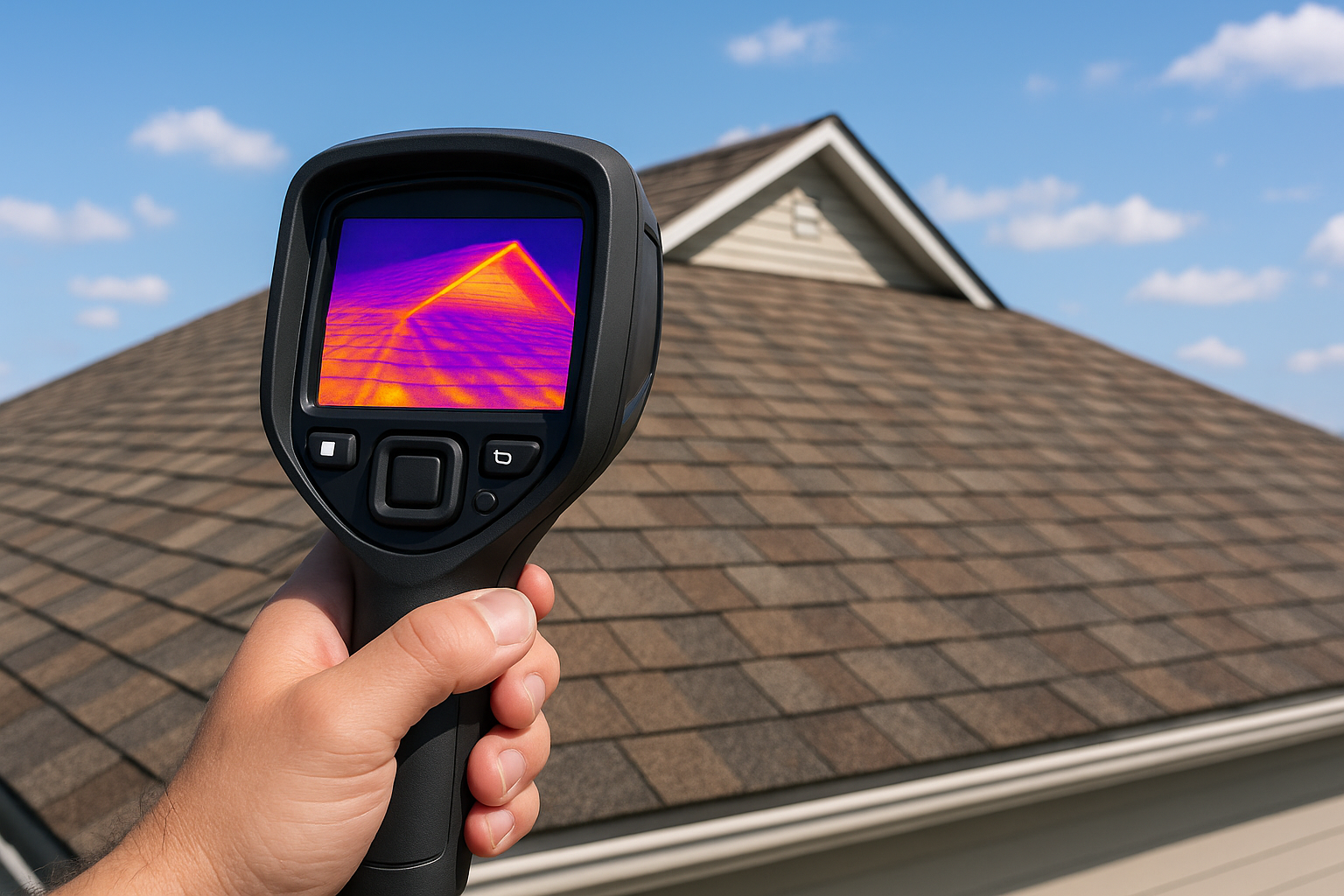
Paying more for this type makes sense because the equipment is highly specialized and interpreting thermal data accurately requires real training from a certified inspector. For an older roof or one with a history of leaks, that extra cost often pays for itself by catching damage early.
How to plan, compare quotes, and save money
Planning ahead before you book a roof inspection saves you money and reduces the chance of surprises on your final bill. The total roof inspection cost you pay depends partly on how well you prepare, what questions you ask, and whether you qualify for a free inspection through a roofing company or an insurance-related process. Taking a few straightforward steps before you pick up the phone makes a real difference in what you end up spending.
Get at least three quotes before you commit
Pricing varies significantly between contractors, even for the same inspection type on the same roof. Reach out to at least three local roofing companies and ask for itemized quotes rather than a single lump-sum number. An itemized quote tells you exactly what is included, whether the attic review, written report, and photo documentation are part of the base price or billed separately. That breakdown lets you compare quotes on equal footing instead of guessing what each one actually covers.
If one quote comes in dramatically lower than the others, ask specifically what it does not include, because an inspection that skips the attic or delivers no written report is not actually a bargain.
Ask the right questions before you book
Before you confirm any appointment, ask the contractor about their licensing and insurance, their experience with your specific roof material, and how long the inspection typically takes. Knowing the timeline matters because a rushed 20-minute walkthrough rarely produces the same quality report as a thorough 90-minute assessment. You should also confirm whether the quote covers both the exterior surface and the interior attic review, and what format the final report will be delivered in, since some lenders, buyers, and insurers require specific documentation formats.
Know when you can skip the fee entirely
Many reputable roofing companies offer free inspections as part of their service model, especially after a storm or when you are actively considering roof repair or replacement work. At Sunflowers Energy LLC, we provide free on-site inspections and estimates for both residential and commercial roofing and solar projects. If your roof recently took storm damage, your insurance company may also send an adjuster at no cost to you. Knowing these no-cost options exist means you may not need to pay out of pocket for an inspection at all, especially if your situation involves recent weather damage or a planned roofing project.
What to do after you get the report
Once you have the inspection report in hand, read through every item the inspector flagged, from minor maintenance notes to serious structural concerns. Priority repairs need your attention first, because small problems rarely stay small. A cracked flashing section or a few lifted shingles can escalate into significant water damage if you put it off.
Use the report to collect repair estimates from at least two contractors so you can compare scope and pricing directly. If the report documents storm damage, submit it to your insurance provider right away along with any photos included. Knowing your roof inspection cost upfront also makes it easier to weigh repair costs against your broader roofing budget and decide which projects to tackle first.
If you are ready to take the next step with repairs, a full replacement, or a solar installation, schedule your free on-site roof inspection with Sunflowers Energy LLC and put that report to work right away.