
Copper gutters are one of the most durable and visually striking gutter options you can add to a home or commercial property. But that quality comes at a price, and understanding the full copper gutter installation cost before you commit is essential to making a smart investment. Whether you’re replacing aging gutters or upgrading to copper for the first time, knowing what you’ll actually pay per linear foot in 2026 helps you compare quotes with confidence.
Several factors drive the final number on your estimate, from the thickness and style of the copper to the complexity of your roofline and local labor rates. Material costs alone can vary widely, and labor often accounts for a significant portion of the total project price. Without a clear breakdown, it’s easy to overpay, or underestimate what a quality installation truly requires.
At Sunflowers Energy LLC, we work with homeowners and business owners every day on roofing projects where gutter systems play a critical role in protecting the structure underneath. Our experience with residential and commercial roofing installations gives us a practical perspective on how gutter choices affect long-term performance and cost. In this guide, we’ll walk you through current copper gutter pricing, what influences your total cost, and how to evaluate contractor quotes so you can budget accurately.
What copper gutter installation costs in 2026
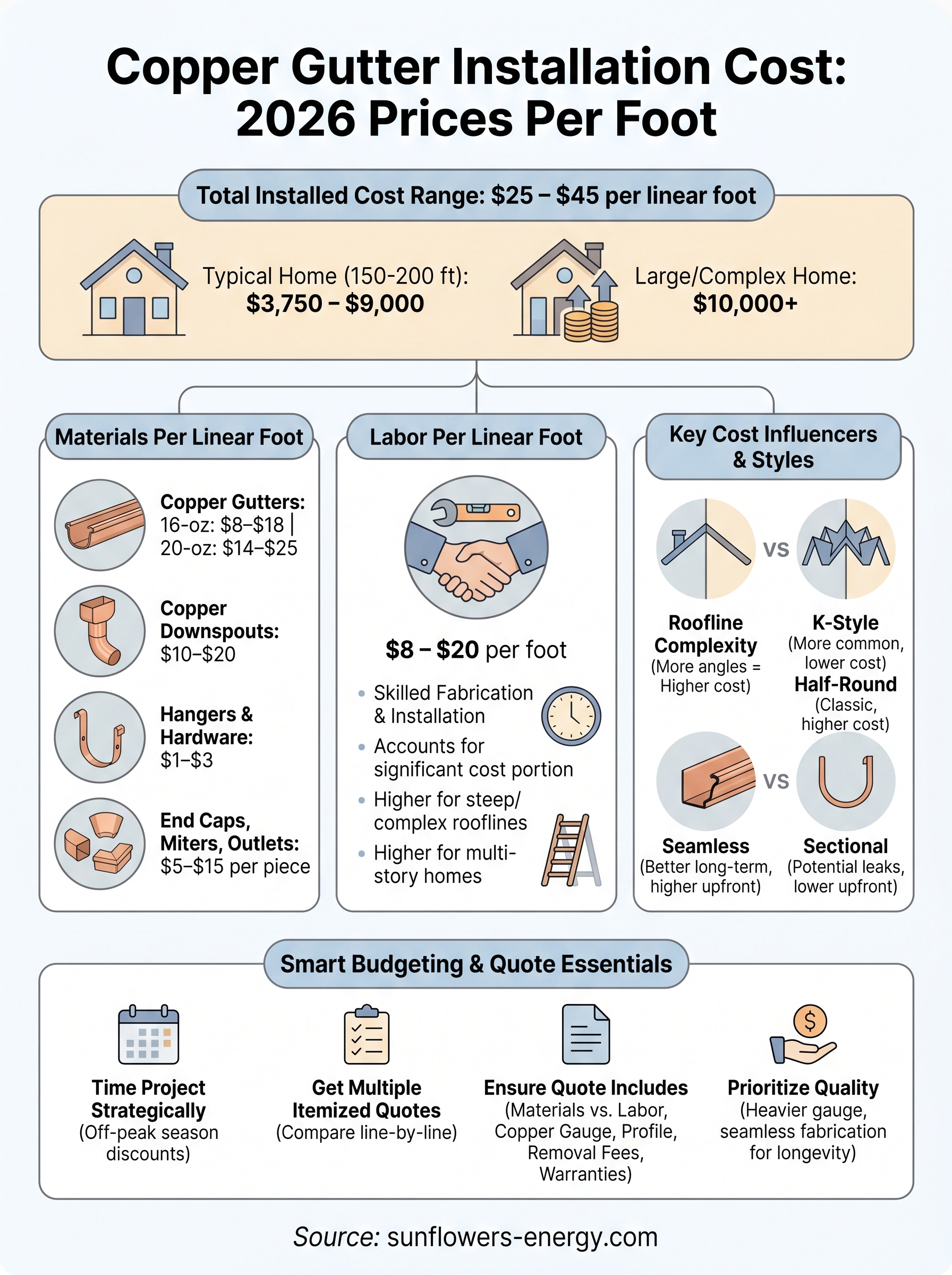
The copper gutter installation cost in 2026 sits in a wide range because copper is a commodity metal, and its price shifts with market conditions. As of this year, most homeowners pay between $25 and $45 per linear foot installed, which covers both materials and labor. For a typical single-family home with roughly 150 to 200 linear feet of guttering, that puts the total project cost somewhere between $3,750 and $9,000. Larger homes, more complex rooflines, or heavier copper gauges can push that figure higher.
On large or complex properties, total copper gutter projects routinely exceed $10,000, so getting multiple itemized quotes is worth your time before committing.
What materials alone will cost you
Copper gutter material on its own runs $8 to $25 per linear foot, depending on the gauge you choose and whether you go with stock sizes or custom fabrication. The most common option for residential use is 16-ounce copper, which strikes a solid balance between durability and cost. Heavier gauges like 20-ounce copper resist denting better and hold up longer under heavy snow or debris loads, but they add $4 to $8 per linear foot to your material bill. You also need to factor in hangers, end caps, downspouts, miters, and outlets, which can add another $200 to $600 to the total depending on the number of corners and drop locations.
| Component | Estimated Cost |
|---|---|
| 16-oz copper gutters | $8–$18 per linear foot |
| 20-oz copper gutters | $14–$25 per linear foot |
| Copper downspouts | $10–$20 per linear foot |
| Hangers and hardware | $1–$3 per linear foot |
| End caps, miters, outlets | $5–$15 per piece |
What labor adds to the total
Labor for copper gutter installation typically runs $8 to $20 per linear foot, and it accounts for a larger share of your total than most homeowners expect. Copper requires skilled fabrication and careful handling because it expands and contracts with temperature changes, and improper installation leads to joint failures and leaks over time. Contractors who specialize in copper work charge more than those who primarily install vinyl or aluminum, and that premium reflects the precision and expertise the material genuinely demands. On a 175-linear-foot job, labor alone can run between $1,400 and $3,500, depending on your location and the complexity of the work involved.
Roof pitch is another variable that directly affects what you pay. Steep rooflines require more safety equipment and slower, more deliberate work, which adds time to the job. If your home has multiple stories or a complex roofline with many angles, expect labor quotes toward the higher end of that range.
Price per foot by style and build type
The style of copper gutter you choose has a direct impact on your copper gutter installation cost per linear foot. Two main profiles dominate the market: K-style and half-round, and each carries a different price tag based on how they’re fabricated and how much material they use. Your home’s architectural style often dictates which option fits best, but budget plays a role too.
K-style vs. half-round copper gutters
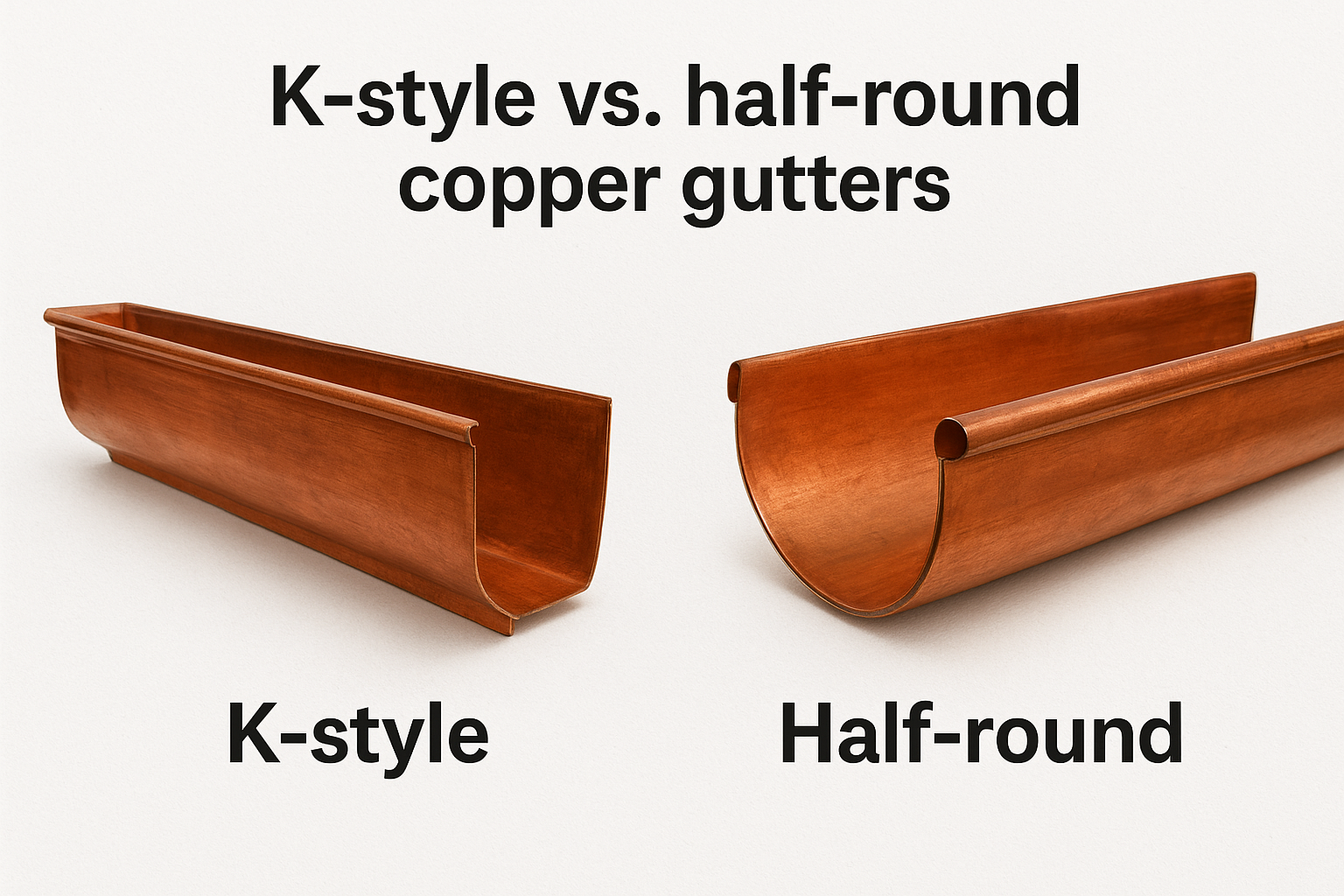
K-style copper gutters are the more common choice and generally cost less per linear foot than half-round options. Their flat back and decorative front profile handle high water volume well, making them practical for most residential rooflines. Half-round gutters have a classic, rounded look that suits older or historic homes, but their fabrication is more involved, which pushes the price higher.
| Style | Material Cost Per Linear Foot |
|---|---|
| K-style copper | $8–$18 |
| Half-round copper | $12–$22 |
Half-round copper gutters can add $4 to $6 per linear foot compared to K-style, so if aesthetics are driving your choice, factor that difference into your total budget early.
Seamless vs. sectional copper gutters
Seamless copper gutters are cut on-site to fit your exact roofline, which eliminates most joints and reduces the chance of leaks over time. They cost more upfront because the fabrication requires specialized equipment and skilled labor, but they deliver better long-term performance and require less maintenance than sectional alternatives.
Sectional copper gutters come in pre-cut lengths that connect at joints, making them slightly cheaper to purchase and install. However, each joint is a potential failure point, especially in climates with significant freeze-thaw cycles. If you’re investing in copper for its longevity, seamless is typically the smarter build choice.
What drives your total copper gutter price
Your copper gutter installation cost doesn’t settle at a single number because several project-specific variables push it up or down. Understanding what those variables are gives you a sharper eye when reviewing estimates and helps you spot what’s driving each line item on a quote.
Roofline complexity and accessibility
The shape of your roofline is one of the biggest cost drivers on any gutter project. Every outside corner, inside corner, and drop outlet requires additional materials and fabrication time, and copper takes longer to fit precisely than vinyl or aluminum. Multi-story homes also add cost because contractors need more equipment and careful rigging to work at height safely.
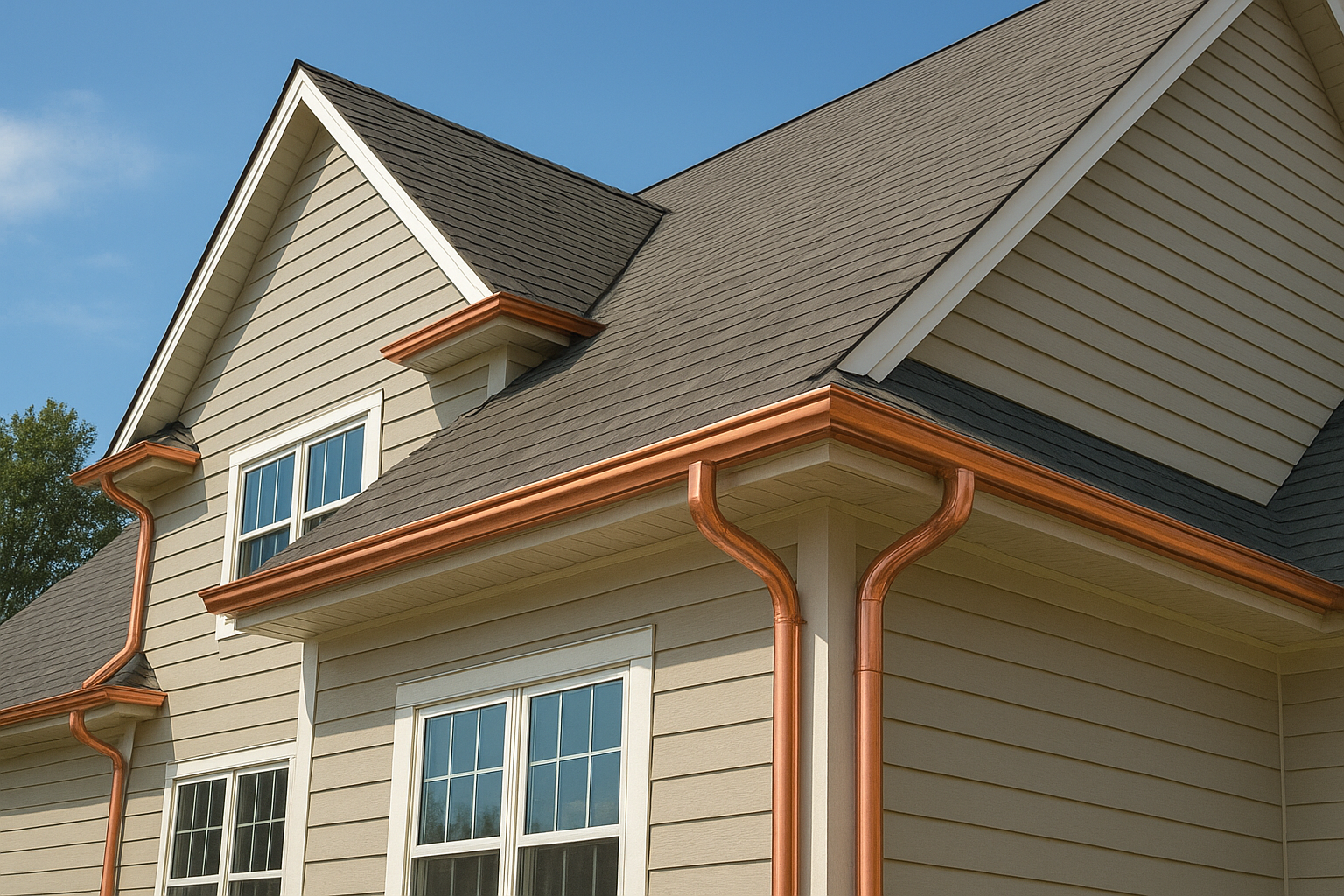
A home with four to six corners and a two-story structure can add $500 to $1,500 to your labor total compared to a straightforward single-story roofline.
Steep roof pitch is another factor that pushes your quote higher. Slower, more deliberate work is required on steep slopes, and that additional time shows up in your labor bill. If your home has both multiple stories and a steep pitch combined, expect your labor costs to land toward the top of any range your contractor provides.
Removal, location, and material market pricing
Removing your existing gutters typically adds $1 to $3 per linear foot to the project. On a 175-foot installation, that puts removal costs between $175 and $525 before new material goes up. Ask your contractor upfront whether removal and disposal are included in the base quote or billed separately.
Geographic location also shapes what you pay. Labor rates in high cost-of-living areas run significantly higher than rural markets, and copper as a commodity fluctuates in price throughout the year. Getting your quote locked in early in the project season can help you avoid material price increases tied to market shifts in copper pricing.
What a quote should include
When you’re comparing copper gutter installation cost estimates from different contractors, a vague lump-sum number gives you almost no useful information. A professional quote should break every major cost category into its own clearly labeled line item, so you can see exactly what you’re paying for and compare proposals side by side. If a contractor hands you a single figure with no breakdown, that’s a reason to ask for more detail before moving forward.
A detailed, itemized quote is one of the clearest signs that a contractor operates transparently and stands behind their pricing.
Line items for materials and labor
Every quote should separate material costs from labor costs and list each material component individually. You want to see the copper gauge specified (such as 16-ounce or 20-ounce), the gutter profile (K-style or half-round), downspout quantities, and all associated hardware. A quote that bundles everything into a single "materials and installation" entry makes it impossible to verify whether the contractor is using the copper grade you actually discussed.
| Line Item | What to Confirm |
|---|---|
| Copper gauge | 16-oz or 20-oz clearly specified |
| Gutter profile | K-style or half-round noted |
| Labor rate | Per linear foot or flat project fee |
| Removal and disposal | Included or billed separately |
| Warranty terms | Materials and workmanship both listed |
What to confirm before you sign
Before you approve any contract, confirm that removal and disposal of your existing gutters are explicitly included or excluded, so you aren’t hit with an unexpected fee after work begins. Also verify that both a materials warranty and a workmanship warranty appear in writing, along with their duration. Copper gutters are a significant long-term investment, and any contractor confident in their work will put both warranties clearly in the contract without you having to ask twice.
Ways to budget and save without cutting corners
Managing your copper gutter installation cost doesn’t require you to compromise on the material or the quality of the work. A few smart decisions early in the planning process can reduce what you spend without touching the factors that determine how long your gutters actually last.
Time your project strategically
Scheduling your installation during the off-peak season, typically late fall or winter in most regions, often results in lower labor rates and better contractor availability. Crews that are slower during these months have more flexibility to negotiate on labor, and material pricing for copper can also dip when construction demand slows across the market.
Getting your quote locked in before spring demand peaks can save you $200 to $500 on a mid-size project without changing a single specification.
Choose where to invest and where to simplify
Putting your budget toward heavier gauge copper and seamless fabrication over thinner stock and sectional pieces pays off in reduced maintenance and a longer service life. Those are the areas where spending more upfront genuinely protects your investment. Where you can simplify without consequence is downspout placement and quantity, since working with your contractor to optimize the number and location of drop outlets can trim material costs without affecting drainage performance.
You should also get at least three fully itemized quotes before committing to a contractor. Pricing varies more than most homeowners expect, and comparing line-by-line breakdowns helps you identify whether cost differences reflect genuine value or simply markup. Ask each contractor what copper gauge they’re quoting, confirm seamless versus sectional, and verify that warranties are included in writing. That level of comparison costs you nothing and gives you real leverage when you make your final decision.
Final takeaways
Copper gutters are a long-term investment, and understanding the full copper gutter installation cost before you sign anything puts you in a much stronger position. In 2026, most homeowners pay between $25 and $45 per linear foot installed, with total projects ranging from $3,750 to well above $10,000 depending on roofline complexity, copper gauge, gutter style, and local labor rates. Material and labor costs both vary, and neither should appear as a single bundled figure on a professional estimate.
Getting at least three itemized quotes, confirming seamless fabrication over sectional, and timing your project strategically can all reduce what you spend without affecting quality or longevity. Your contractor should specify the copper gauge, list warranties in writing, and account for removal separately. If you want expert guidance on how your roofline affects gutter performance and pricing, reach out to Sunflowers Energy LLC for a free on-site inspection and no-obligation estimate.