
Your roof does more than keep rain out, it also needs to breathe. Proper attic ventilation prevents moisture buildup, regulates temperature, and extends the life of your shingles. When it comes to exhaust ventilation, the ridge vent vs box vent debate is one of the most common decisions homeowners face. Both options work, but they do so in fundamentally different ways, and the right choice depends on your roof’s design, your climate, and your budget.
Poor ventilation is something we see regularly at Sunflowers Energy LLC during roof inspections. Trapped heat and moisture quietly cause premature shingle deterioration, ice dams, and mold growth, problems that lead to costly repairs down the road. Choosing the right vent type during a roof installation or replacement is one of the easiest ways to avoid those issues entirely.
This article breaks down how ridge vents and box vents compare across performance, cost, aesthetics, and durability. We’ll cover where each one excels, where it falls short, and whether combining the two makes sense. By the end, you’ll have the information you need to make a confident decision for your home.
Why attic ventilation matters for your roof
Your attic sits between your living space and your roof deck, and what happens in that space directly affects how long your entire roofing system lasts. Without proper ventilation, heat and moisture accumulate in ways that cause serious, compounding damage. Understanding these effects is exactly why the ridge vent vs box vent decision carries more weight than most homeowners realize.
Heat buildup and shingle damage
During summer, an unventilated attic can reach temperatures above 150°F on a hot day. That trapped heat bakes your shingles from the inside out, causing the asphalt to dry out, crack, and curl years ahead of schedule. Shingles rated for 25 to 30 years can fail well before that when the attic consistently runs too hot.
Poor attic ventilation is one of the leading causes of premature roof replacement, and it is almost entirely preventable with the right exhaust vent system.
Your roof deck takes a hit too. Plywood and OSB sheathing expand and warp when they absorb repeated heat cycles, which loosens fasteners, creates uneven surfaces, and opens pathways for water to get underneath your shingles.
Moisture, mold, and ice dams
Warm, humid air from your living space rises into the attic during winter. When that moisture hits the cold underside of your roof deck, it condenses into liquid water that soaks into wood framing, insulation, and sheathing, setting off mold growth and structural rot over time.
Ice dams form through the same process. Heat escaping unevenly through your roof melts snow in the middle sections, and that water refreezes at the cold eaves. The cycle builds up a ridge of ice that forces water under your shingles and into your walls. Consistent airflow keeps the roof deck uniformly cold, which stops the uneven melt pattern that creates ice dams in the first place.
Energy costs and insulation performance
A well-ventilated attic reduces the load on your air conditioning system during summer. When hot air exits through exhaust vents instead of radiating down into your living space, your home stays cooler without your HVAC running as hard, which lowers your monthly energy bills.
Wet insulation loses its R-value, meaning it can no longer resist heat transfer the way it was designed to. Moisture from condensation soaks into batts and loose-fill insulation, cutting their effectiveness significantly. Keeping your attic dry through proper ventilation protects that insulation so it keeps doing its job year-round.
How ridge and box vents actually move air
Both vent types rely on the same basic principle: hot air rises. As heat builds in your attic, it naturally moves upward and looks for any exit point near the top of the roof. Intake vents (typically soffit vents along the eaves) pull cooler outside air in from the bottom while exhaust vents at or near the peak let hot air escape. The difference between the ridge vent vs box vent debate comes down to how efficiently each one handles that exhaust job.
How ridge vents work
A ridge vent runs the entire length of your roof’s peak, creating one continuous exhaust opening from end to end. Installers cut a slot along the ridge board, then fasten a low-profile vent cap over it. Because the opening spans the full peak, hot air escapes at every point simultaneously rather than funneling toward a single location. Wind passing over the ridge creates a slight negative pressure that actively pulls air out of the attic, which makes ridge vents more effective in light-wind conditions than static alternatives.
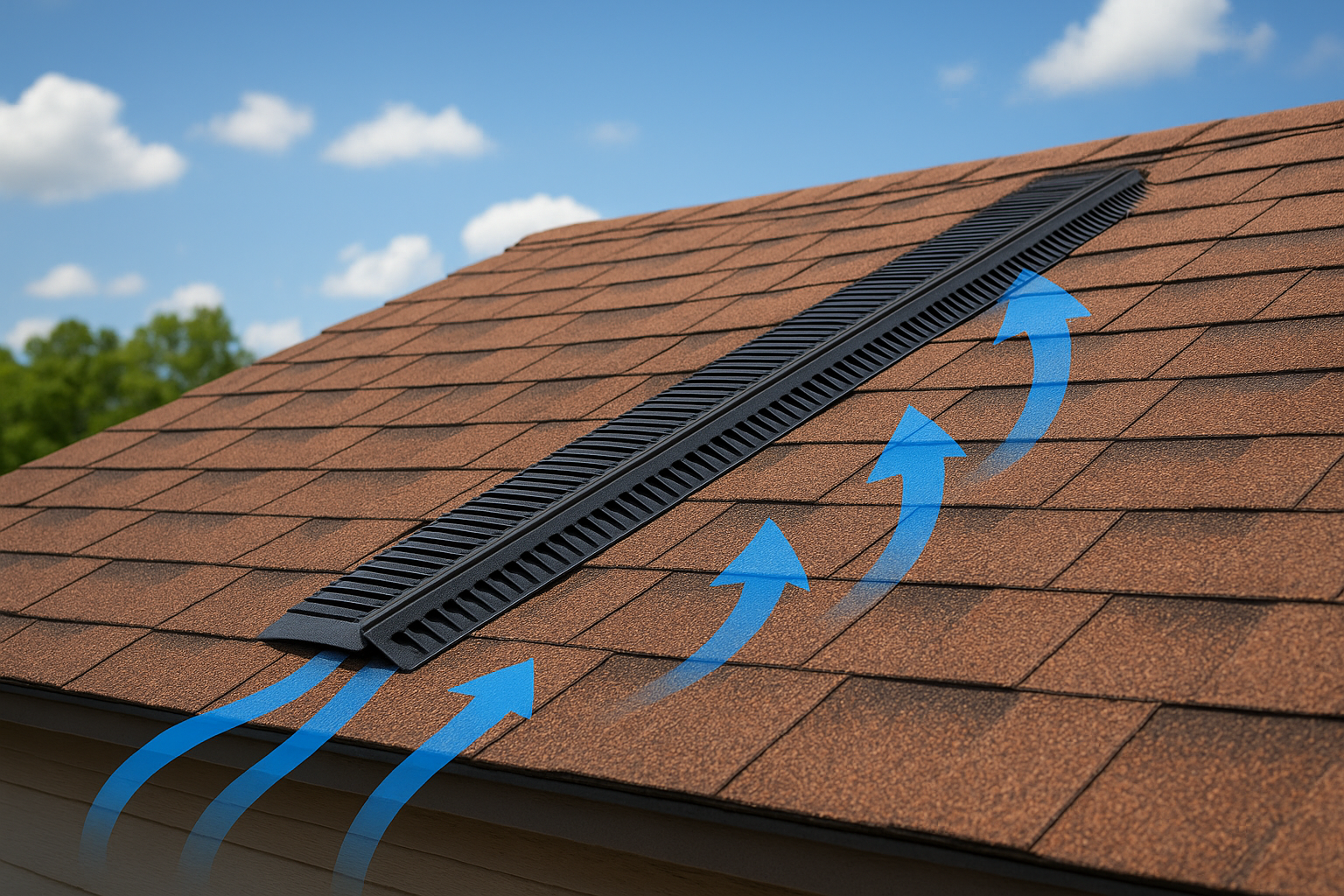
A continuous ridge vent paired with full soffit ventilation creates an uninterrupted airflow channel that covers your entire attic evenly.
How box vents work
Box vents are individual square or rectangular units installed at fixed points on your roof, typically near the ridge but not at the very peak. Each unit covers a specific square footage of attic space based on its net free area rating. Static airflow moves through them passively whenever there is enough temperature difference between your attic and the outside air. Placement matters significantly with box vents because areas of your attic that sit far from a vent unit receive less airflow than sections directly beneath one.
Ridge vents: pros, cons, and best fits
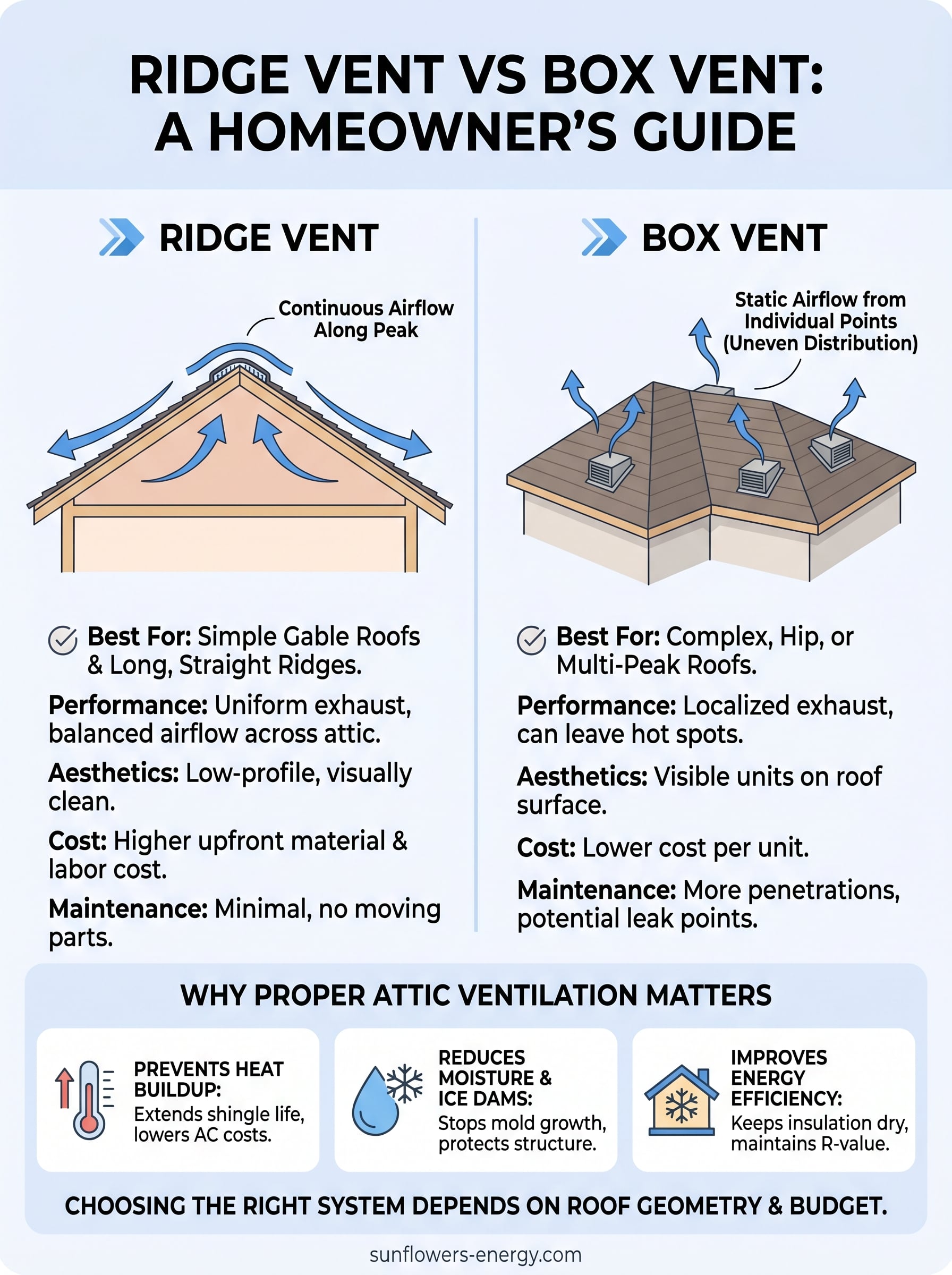
Ridge vents consistently rank as the top exhaust choice for most residential roofs, and for good reason. They distribute airflow evenly across the entire attic rather than concentrating it around a few fixed points, which makes them far more effective at controlling heat and moisture. In the ridge vent vs box vent comparison, ridge vents have a clear edge on performance for roofs with a continuous peak.
Advantages of ridge vents
The biggest selling point is uniform ventilation. Because the vent runs the full length of the ridge, every section of your attic gets roughly the same airflow, eliminating the hot spots that box vents leave behind. Ridge vents also sit low-profile against your roofline, which keeps your roof looking clean and reduces the visual clutter of multiple individual vent units.
A continuous ridge vent paired with properly sized soffit vents creates the most balanced passive ventilation system available for a standard residential roof.
Ridge vents require minimal maintenance over their lifespan. There are no moving parts, no screens to clean, and no individual units to replace if one develops a problem.
Drawbacks and limitations
Ridge vents only work on roofs with a continuous ridge, which rules them out for complex hip roofs with multiple intersecting peaks or roofs with dormers that break up the ridge line. They also cost more to install upfront than box vents, both in materials and labor, since the installer must cut a continuous slot along the entire peak before fastening the vent cap.
Best fits for ridge vents
Ridge vents work best on simple gable roofs with a single uninterrupted peak and homes in climates where consistent year-round ventilation matters most. If your roof has a long, straight ridge line and full soffit coverage, this option delivers the most reliable and even performance available.
Box vents: pros, cons, and best fits
Box vents offer a practical and flexible exhaust solution for roofs that don’t suit a continuous ridge vent. In the ridge vent vs box vent comparison, box vents hold their own on complex roof designs where running a single uninterrupted vent simply isn’t possible. Each unit installs independently, which gives you more control over placement when your roof has multiple peaks, hips, or intersecting planes.
Advantages of box vents
Box vents cost significantly less per unit than a full ridge vent installation, making them an attractive option when budget is a primary concern. You can add units incrementally as needed, and installation is straightforward since each vent only requires cutting a single opening rather than a continuous slot along the peak. Roofs with irregular shapes benefit from this flexibility because you can position individual units wherever ventilation gaps exist.
Box vents work well on hip roofs and complex roof designs where a ridge vent cannot run the full length of the peak.
Drawbacks and limitations
The main limitation is uneven airflow distribution. Each unit only exhausts heat from the attic space directly below it, which leaves areas farther from the vents running hotter and more humid. To cover your entire attic adequately, you typically need multiple units installed across the roof, which adds up in both material cost and labor hours. More penetrations in your roof deck also mean more potential failure points for leaks over time if any unit shifts or its flashing degrades.
Best fits for box vents
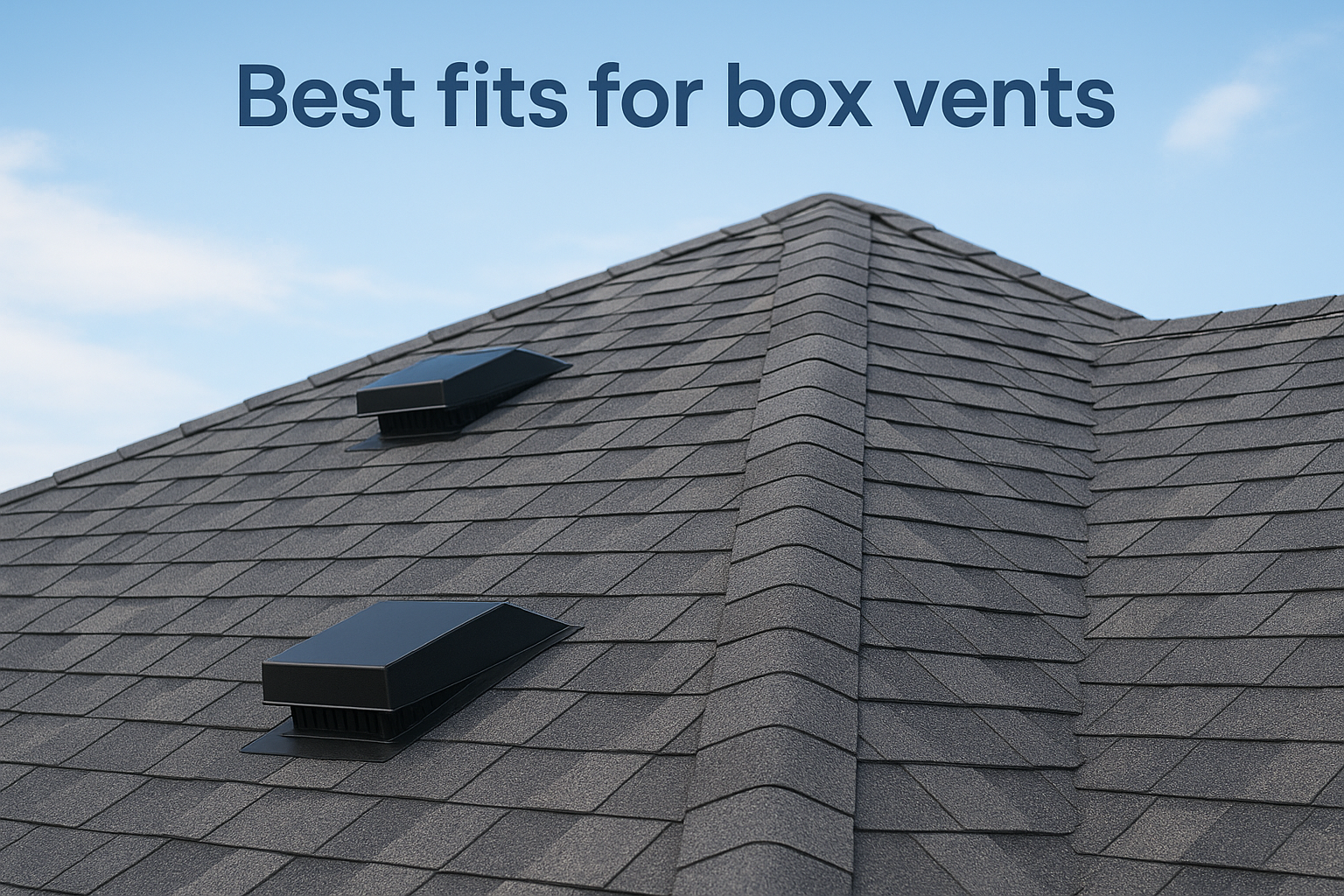
Box vents perform best on hip roofs, multi-peak designs, or any roof where the ridge line is too short or broken up to support a continuous ridge vent. They also work well as supplemental exhaust points when an existing ventilation system needs a targeted boost in a specific area of the attic.
How to choose and size the right system
The ridge vent vs box vent decision starts with two questions: what does your roof’s geometry allow, and how much net free area does your attic actually need? Answering both before you buy anything saves you from installing the wrong system, which is a mistake that shows up as uneven temperatures, condensation, or a roof that wears out too fast.
Match the vent to your roof shape
Look at your roof from the street first. A simple gable roof with a long, continuous ridge is the ideal candidate for a ridge vent because the opening spans the full peak and pulls air evenly from every corner of the attic. You won’t find a more efficient passive system for that roof type.
If your roof has multiple hips, dormers, or a short ridge, box vents give you the placement flexibility you need. You can position individual units across different planes of the roof to cover areas that a ridge vent simply can’t reach in a fragmented layout.
Calculate how much ventilation you need
The standard sizing rule is the 1/150 ratio: for every 150 square feet of attic floor area, you need 1 square foot of net free area (NFA) split equally between intake at the soffits and exhaust at the peak. A 1,500-square-foot attic needs 5 square feet of exhaust NFA and 5 square feet of intake NFA.
Getting your NFA numbers right matters as much as choosing the correct vent type, because an undersized system underperforms regardless of which product you install.
Ridge vents typically deliver 18 square inches of NFA per linear foot, while a standard box vent provides 50 to 75 square inches per unit. Measure your attic, check the product specs, and add units until your totals meet the 1/150 requirement.
Final checklist before you decide
Before you commit to either option in the ridge vent vs box vent decision, run through these key questions. Does your roof have a long, continuous ridge line? If yes, a ridge vent gives you the most even coverage with the least maintenance. Does your roof have multiple hips, short peaks, or irregular planes? Box vents offer the placement flexibility that fits those designs better.
Next, confirm your net free area numbers using the 1/150 ratio so your system actually meets the ventilation requirements for your attic size. Also factor in your climate: colder regions with snow benefit from the uniform airflow that ridge vents provide, while complex roofs in any climate do better with strategically placed box vents.
Getting ventilation right during installation saves you from moisture damage, premature shingle failure, and high energy bills. If you want a professional assessment of your roof, contact the team at Sunflowers Energy LLC for a free on-site inspection.