
Metal roofing has earned its reputation for a reason, it lasts decades, stands up to severe weather, and can cut energy costs significantly. But once you start shopping, you quickly realize that "metal roof" isn’t a single product. There are multiple types of metal roofing panels, each with a distinct profile, material composition, and price point. Choosing the right one matters.
Standing seam, corrugated, ribbed, steel, aluminum, copper, the options stack up fast. Some panels suit a modern home perfectly but don’t make sense for a commercial building. Others offer unmatched durability but come at a premium cost. Understanding these differences before you commit saves you money and headaches down the road.
At Sunflowers Energy LLC, we install and maintain roofing systems for both residential and commercial properties across the U.S. We work with these materials daily, so we know how each panel type actually performs, not just how it looks in a brochure. This guide breaks down seven common metal roofing panel types, covering their profiles, pros, cons, and realistic costs so you can make a confident decision for your next roofing project.
1. Standing seam panels
Standing seam is the most recognized of all types of metal roofing panels. Each panel features raised vertical seams that interlock along the roof surface, keeping fasteners completely hidden. That concealed-fastener design is what sets it apart from every exposed-fastener option on this list.
What it is and how the panels lock together
Each panel runs vertically from ridge to eave, with edges that fold or crimp together to form a raised seam, typically 1 to 2 inches tall. Two main locking methods exist: snap lock (pressed together by hand) and mechanical seam (rolled shut with a seaming tool). Mechanical seam produces a tighter, more water-resistant connection and handles low-slope applications better.
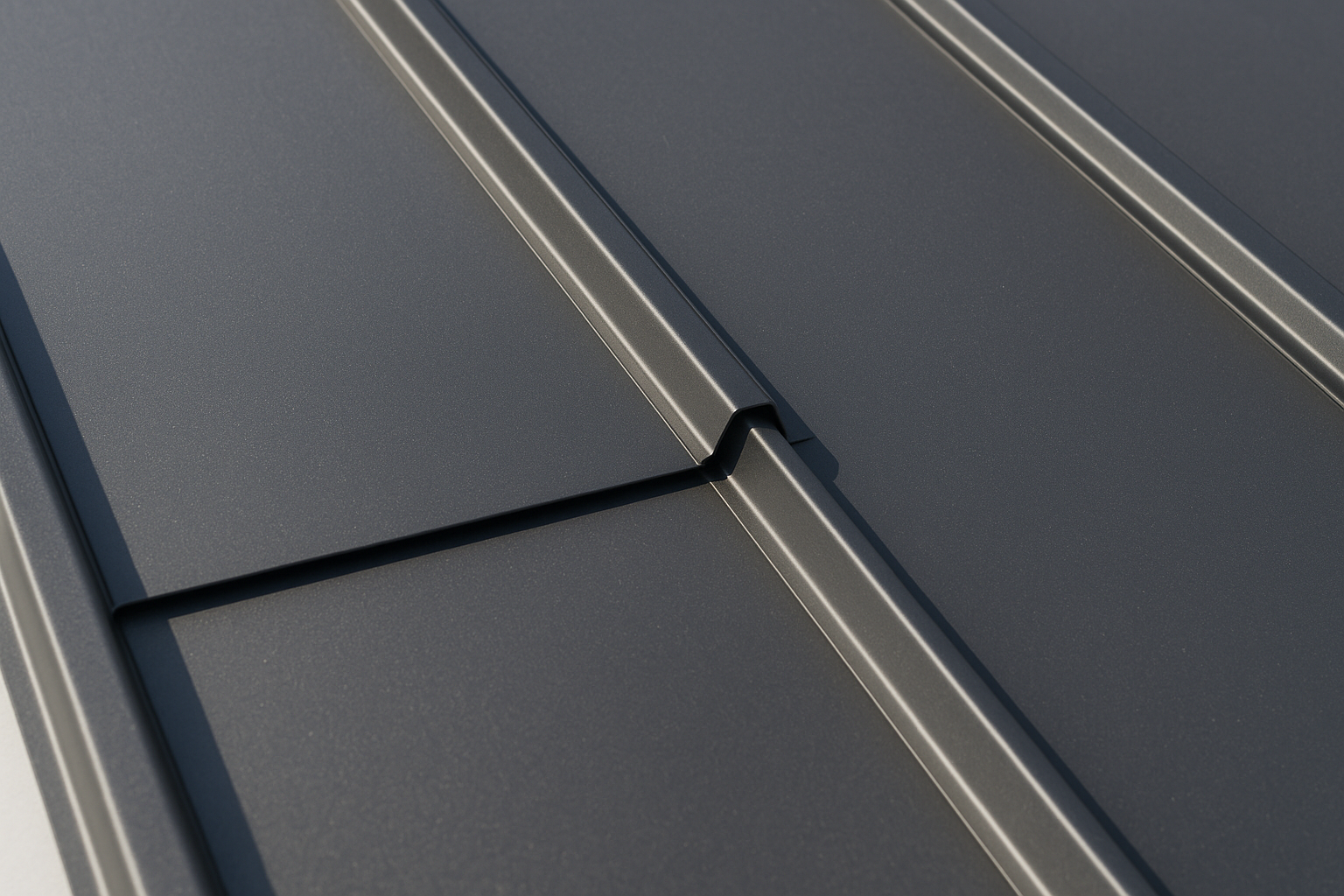
Mechanical seam standing seam panels can work on pitches as low as 1:12, making them one of the few metal panel options suitable for near-flat roofs.
Best uses by roof pitch, climate, and building type
This profile suits a wide range of roof pitches, from steep residential slopes to low-slope commercial roofs. It performs best in high-snow and high-rain climates because the raised seam prevents water infiltration and lets snow slide off cleanly. Residential homes, commercial buildings, and agricultural structures all benefit from this panel profile.
Pros and cons to know before you choose it
The biggest advantages are longevity and weather resistance. A properly installed standing seam roof can last 40 to 70 years with minimal maintenance. Hidden fasteners also eliminate the leak points that exposed fasteners create over time. The trade-off is cost and installation complexity, since standing seam requires experienced crews and specialized seaming tools that raise labor costs significantly compared to exposed-fastener panels.
Typical cost range and what drives price
Installed costs typically run $10 to $20 per square foot, depending on panel width, seam height, and material choice. Steel panels sit at the lower end, while aluminum and specialty coatings push the price higher. Roof complexity, including valleys, hips, and penetrations, adds to labor time and total project cost.
Material, gauge, and finish options that matter most
Steel is the most common choice, usually in 24 or 26 gauge. Thicker 24-gauge steel resists denting better in hail-prone areas. PVDF coatings like Kynar 500 offer the best color retention and chalk resistance over time, and most manufacturers back them with 30 to 40-year finish warranties.
Common installation and maintenance pitfalls
The most frequent mistake is improper seaming, either skipping the seaming tool entirely or under-seaming the joint, both of which create water infiltration points. You should also avoid mixing incompatible metals at flashings and trim, since combining steel with copper or uncoated aluminum triggers galvanic corrosion that shortens roof life considerably.
2. Snap lock panels
Snap lock is a variation within the standing seam family that uses a hand-pressed locking mechanism instead of a mechanical seaming tool. Among the types of metal roofing panels, it sits between exposed-fastener systems and full mechanical seam in both performance and cost.
What it is and how snap lock differs from mechanical seam
Snap lock panels feature male and female leg edges that press together by hand along each seam. Because no seaming tool crimps the joint shut, the connection is less watertight than a mechanical seam, which means the panel relies more on roof pitch to move water off the surface effectively.
Snap lock requires a minimum roof pitch of 3:12, while mechanical seam standing seam panels can handle pitches as low as 1:12.
Best uses by roof pitch, climate, and building type
This profile suits residential roofs at 3:12 pitch or steeper in moderate-to-high rainfall climates. Both homes and light commercial buildings benefit from its faster installation timeline compared to mechanical seam.
Pros and cons to know before you choose it
Faster installation is the primary advantage, which reduces labor costs compared to mechanical seam. The clear downside is limited performance on lower slopes, making snap lock a poor fit for near-flat or low-slope roofs.
Typical cost range and what drives price
Installed costs run $8 to $15 per square foot. Material choice and roof complexity create the most price variation, with aluminum panels and intricate rooflines pushing toward the higher end.
Material, gauge, and finish options that matter most
24-gauge steel with a PVDF coating gives you the best durability-to-cost ratio for snap lock panels. For coastal climates, aluminum is a better pick since salt air corrodes steel faster than it does aluminum.
Common installation and maintenance pitfalls
Installing snap lock on pitches below 3:12 causes water to back up under the seams and eventually infiltrate the roof assembly. Before work starts, confirm your installer understands these pitch limitations clearly.
3. Corrugated panels
Corrugated panels are among the oldest of all types of metal roofing panels still in common use. Their distinctive wave-shaped profile adds structural rigidity to thin sheet metal, making them surprisingly strong for their weight and cost.
What it is and how exposed fasteners work
Each panel features alternating ridges and valleys formed by rolling flat sheet metal into a repeating wave pattern. Screws with neoprene washers drive straight through the panel surface into the deck or framing below, leaving the fastener fully visible from outside. Those washers compress against the panel to seal the penetration and block water entry.
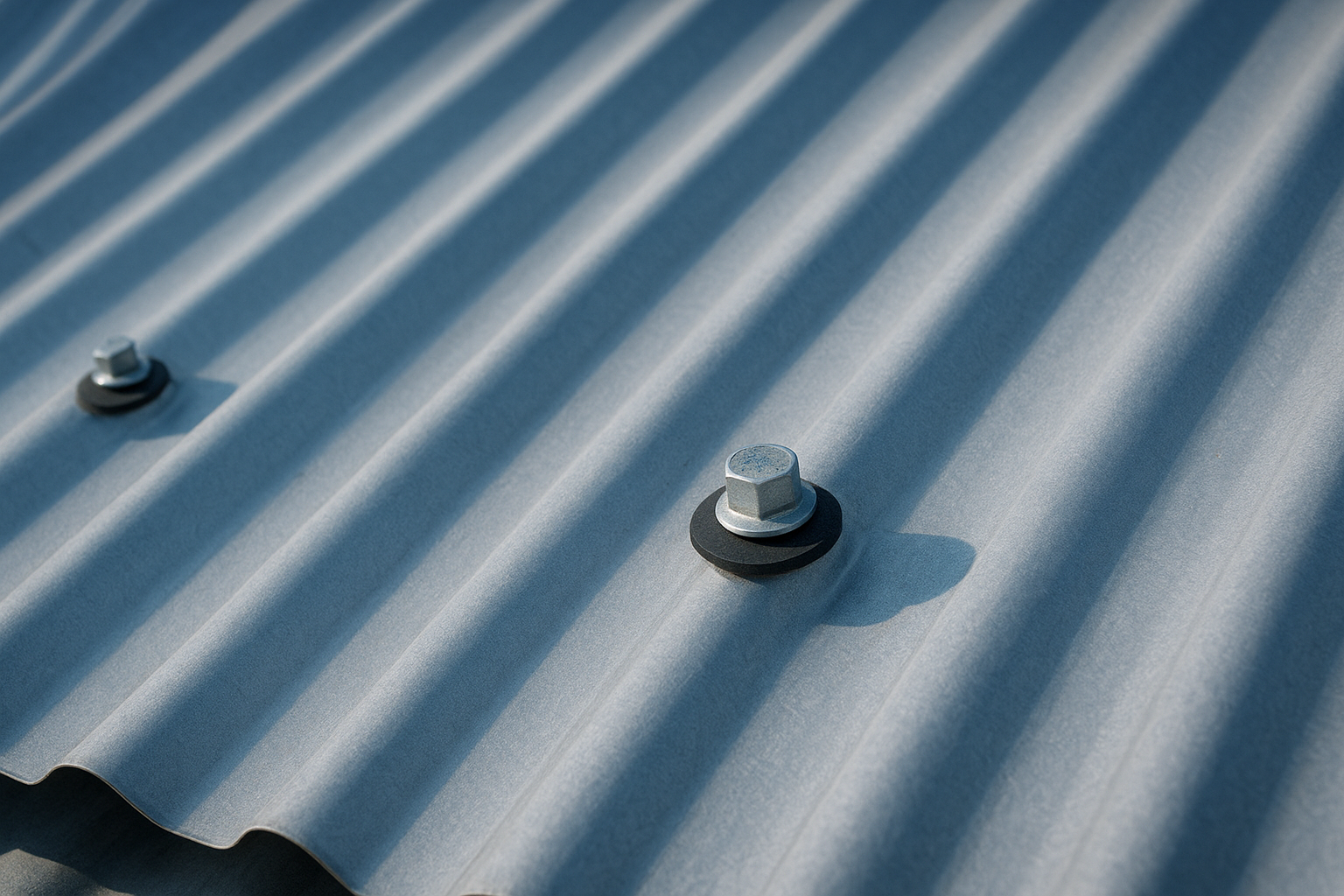
Over time, UV exposure and temperature cycling cause neoprene washers to degrade, which makes periodic fastener inspection a necessary part of owning a corrugated roof.
Best uses by roof pitch, climate, and building type
Corrugated panels perform best on pitches of 3:12 or steeper in dry-to-moderate rainfall regions. You will find them most on agricultural buildings, barns, and budget commercial structures, though residential projects aiming for a raw industrial look also use them regularly.
Pros and cons to know before you choose it
The primary advantage is low material cost combined with straightforward installation, which keeps both labor and total project expenses down. The clear drawback is that exposed fasteners introduce leak points across the entire roof surface, requiring consistent maintenance attention over the roof’s life.
Typical cost range and what drives price
Installed costs fall between $4 and $10 per square foot. Gauge thickness and coating quality account for most of the price difference within this range.
Material, gauge, and finish options that matter most
Galvanized steel in 26 or 29 gauge handles the majority of corrugated applications. Thicker 26-gauge steel resists hail denting better and lasts longer, while Galvalume-coated panels offer stronger corrosion resistance than standard galvanized finishes in humid climates.
Common installation and maintenance pitfalls
Over-tightening screws crushes the washer beyond its effective sealing point, causing premature cracking and leaks. You should schedule fastener inspections every three to five years and replace any screws showing rust streaking or washer deterioration before water infiltration begins.
4. R-panel panels
R-panel is a widely used exposed-fastener profile recognized by its single trapezoidal rib that runs along one edge of each panel. It remains a go-to choice for commercial and agricultural construction where budget and installation speed take priority over appearance.
What it is and how the rib profile handles span and loads
R-panel draws its structural strength from a tall trapezoidal rib that rises roughly 1.25 inches above the panel face. That rib stiffens the panel enough to span greater distances between supports without sagging under load, which reduces the amount of structural framing a building requires. Fasteners drive through the panel flat just inside the rib, keeping them in a consistent, uniform pattern across the roof surface.
R-panel can span up to 5 feet between purlins, making it one of the more structurally efficient exposed-fastener options available.
Best uses by roof pitch, climate, and building type
This profile performs best on pitches of 1:12 or steeper in moderate rainfall areas. You will see it most on commercial warehouses, agricultural buildings, and metal garages where large, simple roof surfaces are the norm.
Pros and cons to know before you choose it
The main advantage is a strong load-spanning capability at a low installed cost, which makes R-panel one of the more efficient types of metal roofing panels for large structures. The downside is that exposed fasteners need regular attention as neoprene washers deteriorate with UV and temperature cycling.
Typical cost range and what drives price
Installed costs run $5 to $12 per square foot. Gauge thickness and coating quality account for most of the price variation within this range.
Material, gauge, and finish options that matter most
Galvalume-coated steel in 26 gauge handles the majority of R-panel applications. In environments with heavy industrial or coastal exposure, a 24-gauge panel with a PVDF finish provides noticeably better corrosion and UV resistance over the long term.
Common installation and maintenance pitfalls
Over-driving screws crushes neoprene washers immediately, creating leak points before the roof even sees rain. You should also verify that fasteners land squarely on the panel flat rather than drifting toward the rib edge, since off-center screws weaken the seal and accelerate water infiltration.
5. PBR panels
PBR stands for Purlin Bearing Rib, and that single design feature is what separates this profile from a standard R-panel in terms of structural performance and building system compatibility.
What it is and why the purlin bearing rib changes strength
PBR panels feature a wider trapezoidal rib that is specifically engineered to seat directly over a structural purlin rather than span between them. That direct rib-to-purlin contact transfers roof loads more efficiently into the building frame, reducing stress on fasteners and improving overall panel performance across longer spans.
PBR panels are the standard choice for pre-engineered metal building systems precisely because the rib aligns directly with the structural frame below.
Best uses by roof pitch, climate, and building type
This profile suits pitches of 1:12 or steeper and handles moderate rainfall climates well. You will see PBR most on pre-engineered commercial warehouses, industrial facilities, and large agricultural buildings where panels attach directly to steel purlins as part of a complete structural package.
Pros and cons to know before you choose it
The primary advantage is strong structural efficiency at a competitive installed cost, which makes it one of the more practical types of metal roofing panels for large commercial spans. The downside is that exposed fasteners still require periodic inspection as neoprene washers break down with UV exposure and thermal cycling.
Typical cost range and what drives price
Installed costs typically run $5 to $13 per square foot. Panel gauge and coating quality account for most price variation within this range.
Material, gauge, and finish options that matter most
26-gauge Galvalume steel handles the majority of PBR applications reliably. For harsher industrial or coastal environments, 24-gauge steel with a PVDF finish delivers better dent resistance and long-term corrosion protection.
Common installation and maintenance pitfalls
Misaligning the rib away from the purlin shifts load stress onto the fasteners rather than the structure, reducing roof integrity over time. You should also schedule washer inspections every three to five years and replace any degraded fasteners before water infiltration begins.
6. U-panel structural panels
U-panel is a structural metal roofing profile designed to span between supports without a continuous deck underneath. Unlike most other types of metal roofing panels, U-panel carries roof loads directly through the panel itself, which reduces the framing and substrate materials a building requires.
What it is and when a structural panel makes sense
U-panel gets its name from the rounded U-shaped ribs that run lengthwise along each panel. Those ribs provide enough stiffness to span long distances between purlins without buckling under dead load, live load, or snow accumulation. A structural panel makes sense when you need to eliminate the cost of a continuous plywood or metal deck while still achieving a reliable roofing system.
U-panel is a strong fit for open-frame construction where decking the entire roof surface would add significant cost and weight to the building.
Best uses by roof pitch, climate, and building type
This profile performs best on pitches of 1:12 or steeper in moderate-to-low rainfall climates. You will see it most on industrial facilities, agricultural buildings, and open-frame warehouses where exposed structural bays are standard.
Pros and cons to know before you choose it
The key advantage is eliminating deck material costs on large spans, which keeps total project budgets lower on open-frame builds. The trade-off is that exposed fasteners still require periodic maintenance as neoprene washers degrade with UV exposure over time.
Typical cost range and what drives price
Installed costs typically run $5 to $12 per square foot. Panel gauge and coating quality account for most of the price variation.
Material, gauge, and finish options that matter most
26-gauge Galvalume steel handles the majority of U-panel applications. For harsher environments, upgrading to 24-gauge with a PVDF finish adds measurable corrosion and dent resistance.
Common installation and maintenance pitfalls
Incorrect purlin spacing overstresses the panel ribs and causes visible deflection under load. You should also inspect fasteners every three to five years and replace any screws showing washer deterioration before leaks develop.
7. Metal shingles and stamped panels
Metal shingles and stamped panels replicate the look of traditional materials like slate, wood shake, or clay tile using a metal substrate. Among the types of metal roofing panels, this category is the most aesthetically versatile, making it popular with homeowners who want metal performance without an industrial appearance.
What it is and how modular panels install
Each unit is a small, interlocking modular panel rather than a continuous sheet running ridge to eave. Panels fasten to the roof deck through hidden clips at the top edge, with the row above overlapping the fastener line to create a watertight, shingle-like appearance from the ground.
Best uses by roof pitch, climate, and building type
Metal shingles suit residential roofs at pitches of 3:12 or steeper across most climates, including high-snow and high-wind regions where the interlocking design holds up well.
Metal shingles are one of the few metal panel types that blend naturally into traditional neighborhood aesthetics without altering a home’s visual character.
Pros and cons to know before you choose it
The main advantage is strong curb appeal combined with metal durability, giving you a 40 to 50-year roof that mimics a classic look. The trade-off is that damaged individual panels are harder to source and replace than sections of standing seam or corrugated roofing.
Typical cost range and what drives price
Installed costs run $8 to $18 per square foot, with material type and stamped detail complexity driving most price variation.
Material, gauge, and finish options that matter most
Steel and aluminum in 26-gauge cover most residential applications. A PVDF finish extends color life and reduces long-term maintenance needs considerably.
Common installation and maintenance pitfalls
Improper interlocking during installation creates gaps that let wind-driven rain penetrate the roof assembly. You should also confirm your installer sources panels from a single production batch to avoid color variation across the finished roof surface.
Final thoughts
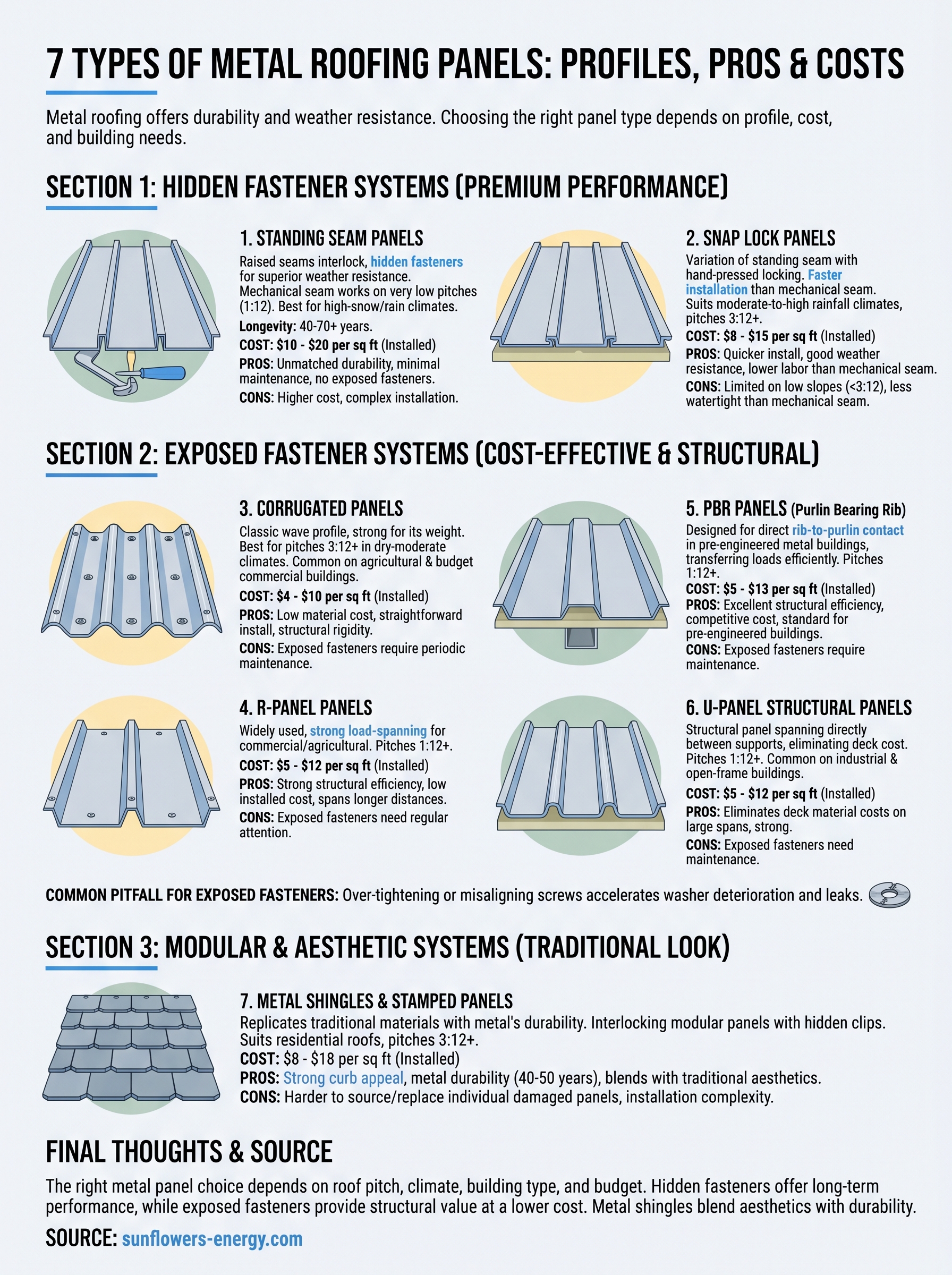
Every property has different demands, and the seven types of metal roofing panels covered here reflect that range. Standing seam and snap lock offer the cleanest, most watertight solutions for residential and commercial projects where long-term performance justifies the upfront cost. Exposed-fastener profiles like corrugated, R-panel, PBR, and U-panel deliver strong structural value at a lower price point, making them practical choices for agricultural and industrial buildings. Metal shingles give you metal durability without sacrificing traditional curb appeal, which matters for homeowners in established neighborhoods.
Choosing the right panel comes down to your roof pitch, climate, building type, and budget. Getting the wrong fit costs you money in repairs and replacements that a better initial decision would have avoided. If you want expert guidance tailored to your specific property, contact the Sunflowers Energy LLC team for a free on-site inspection and estimate before you commit to any panel type.

One Response