
A flat roof doesn’t last forever. When leaks start showing up, membrane seams pull apart, or ponding water becomes a recurring problem, it’s time to start thinking about flat roof replacement cost, and what that number actually looks like for your property. Whether you’re a homeowner with a flat-roofed addition or a business owner managing a commercial building, knowing what to expect financially puts you in a much stronger negotiating position with contractors.
The reality is that flat roof replacement costs vary widely. Material choice alone, TPO, PVC, EPDM rubber, modified bitumen, or built-up roofing, can swing your total by thousands of dollars. Add in labor rates, roof size, tear-off requirements, and regional pricing differences, and you’re looking at a range that demands a closer breakdown. National averages only tell part of the story. Your specific roof tells the rest.
At Sunflowers Energy LLC, we install and replace flat roofs on both residential and commercial properties using TPO, PVC, and rubber roofing systems built to perform. We put this guide together based on what we see in real-world projects, not recycled data from generic cost calculators. Below, you’ll find current price-per-square-foot breakdowns by material, the key factors that drive costs up or down, and the information you need to budget accurately or evaluate a quote you’ve already received.
Why flat roof replacement cost varies so much
Flat roof replacement cost doesn’t follow a simple formula. Unlike sloped roofs where asphalt shingles dominate the market, flat roofing involves multiple membrane systems that each carry different material costs, installation methods, and lifespans. On top of that, factors like your building’s size, local labor rates, and whether your existing roof needs a full tear-off before installation can push your total up by thousands of dollars. Understanding where these variables come from helps you figure out why two property owners with similar buildings can receive quotes that differ dramatically.
Material type drives the biggest price swing
The roofing membrane you choose is the single largest variable in your flat roof replacement cost. Each system carries its own material cost, installation complexity, and expected lifespan, and all three of those factors feed directly into the number on your final invoice. Here’s how the most common options stack up:
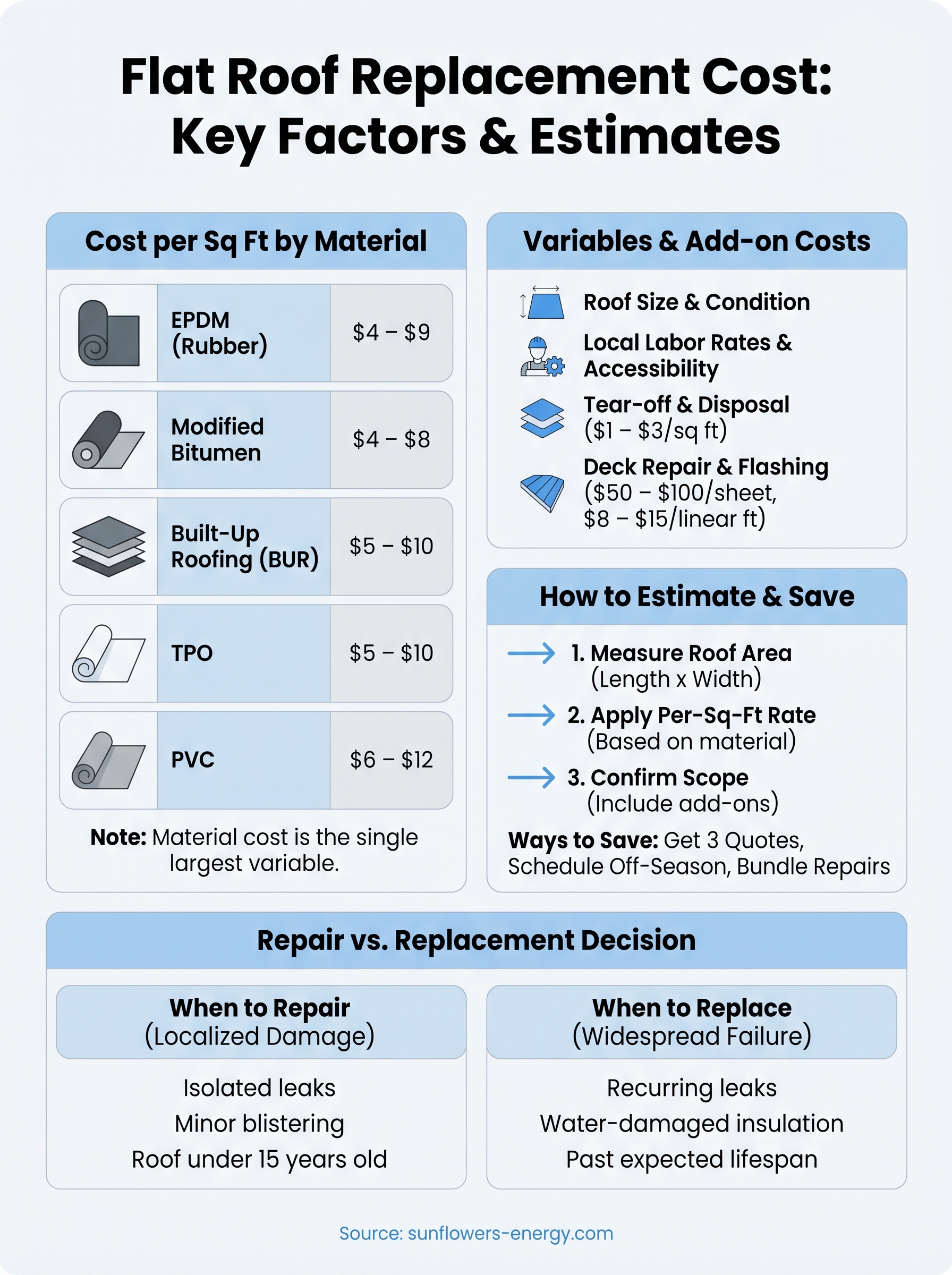
- TPO (Thermoplastic Polyolefin): A heat-welded white membrane that reflects UV rays. Lightweight and widely used on commercial roofs, it typically runs $5 to $10 per square foot installed.
- PVC (Polyvinyl Chloride): More resistant to chemicals and grease than TPO, making it common on restaurant and industrial rooftops. Expect $6 to $12 per square foot installed.
- EPDM (Rubber Roofing): A single-ply rubber membrane with a long track record. One of the more affordable options, usually $4 to $9 per square foot installed, though it absorbs more heat than reflective membranes.
- Modified Bitumen: An asphalt-based system applied in layers, often used on roofs with regular foot traffic. Costs run roughly $4 to $8 per square foot installed.
- Built-Up Roofing (BUR): Multiple alternating layers of asphalt and felt topped with gravel. Labor-intensive to install, it lands at $5 to $10 per square foot installed.
Choosing a membrane based only on upfront cost often backfires. A cheaper material with a shorter lifespan and higher maintenance needs can cost more over 20 years than a premium option installed correctly from the start.
Roof size and structural condition
Total square footage is straightforward: the larger the roof, the higher the total cost. Most contractors quote flat roofs in "squares," where one square equals 100 square feet. However, the structural condition underneath the membrane matters just as much as the surface area. If your roof deck shows signs of rot, water damage, or soft spots, those repairs get added to your bill before any new membrane goes down. A roof that looks like a simple swap from the outside can require significant deck work once the crew removes the old material.
Your roof’s age also signals what condition the deck might be in. A 25-year-old flat roof in a climate with heavy rainfall has almost certainly seen some moisture infiltration at the edges or around penetrations, even if it hasn’t produced visible interior leaks yet.
Labor rates, location, and tearoff requirements
Local labor rates vary considerably by region. Contractors in major metro areas typically charge 30 to 50 percent more than those in rural markets for identical scope, simply because their overhead and operating costs are higher. Beyond geography, tearoff requirements add another layer to your total. If your existing roof already has multiple membrane layers, many local building codes require a full tear-off before re-roofing, which means additional labor hours and disposal fees that can add $1 to $3 per square foot to your project.
Roof accessibility also plays a role in what contractors charge for labor. A low-slope commercial roof that a crew can move equipment across freely costs less to work on than a rooftop crowded with HVAC units, skylights, or raised parapet walls that require careful navigation and slower installation.
Flat roof replacement cost per square foot
When contractors quote you a per-square-foot price, that number typically includes both materials and labor for a standard installation on a structurally sound roof deck. It does not automatically include tear-off, deck repairs, or new flashing unless the contractor spells that out in writing. Getting clear on what your quote actually covers before you sign anything saves you from unexpected charges later.
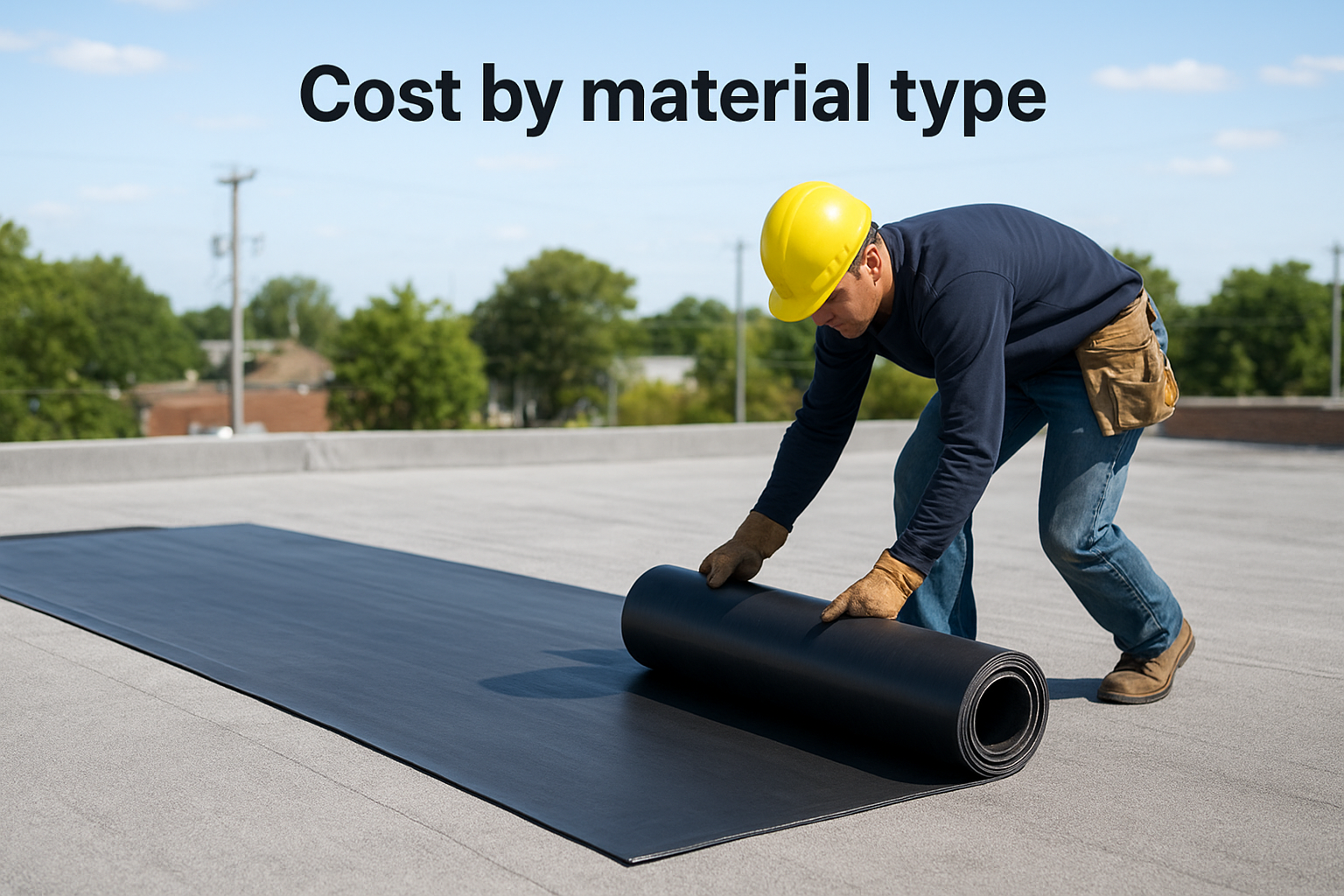
Cost by material type
The table below shows installed cost ranges for the most common flat roofing systems. These figures reflect national averages across typical residential and commercial projects and assume a single-layer installation on a deck that needs no structural repair.
| Material | Installed Cost Per Sq Ft | Typical Lifespan |
|---|---|---|
| EPDM (Rubber) | $4 – $9 | 20–30 years |
| Modified Bitumen | $4 – $8 | 15–20 years |
| Built-Up Roofing (BUR) | $5 – $10 | 20–30 years |
| TPO | $5 – $10 | 15–25 years |
| PVC | $6 – $12 | 20–30 years |
The cheapest material per square foot is rarely the cheapest option over the roof’s lifetime. Factor in expected maintenance costs and projected lifespan before making a final decision.
What drives cost within each material range
Every material listed above carries a price range rather than a fixed number because installation complexity and product grade vary significantly even within a single membrane type. A basic EPDM installation on a clean, unobstructed commercial roof sits at the low end of its range. That same material on a rooftop with multiple penetrations, tight corners, and parapet walls requires more precise cuts, more adhesive or sealant, and more labor hours, all of which push the per-square-foot flat roof replacement cost toward the upper end.
Product quality plays a direct role as well. Thicker membranes within the same material category typically carry a higher upfront cost but resist punctures better and hold up longer in climates with significant temperature swings. When comparing quotes, always ask contractors to specify the membrane thickness and manufacturer so you’re evaluating equivalent products rather than just matching dollar figures on paper.
How to estimate your flat roof replacement cost
You don’t need a contractor on-site to get a rough sense of what your project will cost. A basic estimate requires three inputs: your roof’s square footage, the installed cost range for your preferred material, and an honest assessment of whether your project involves any complicating factors. Running these numbers yourself gives you a realistic budget target before you start collecting formal quotes.
Measure your roof area
Start by measuring the length and width of your flat roof in feet, then multiply those two numbers together to get the total square footage. For a simple rectangular roof that’s 40 feet by 60 feet, your total is 2,400 square feet. If your roof has multiple sections or irregular shapes, break each section into rectangles, calculate each one separately, and add the totals together.
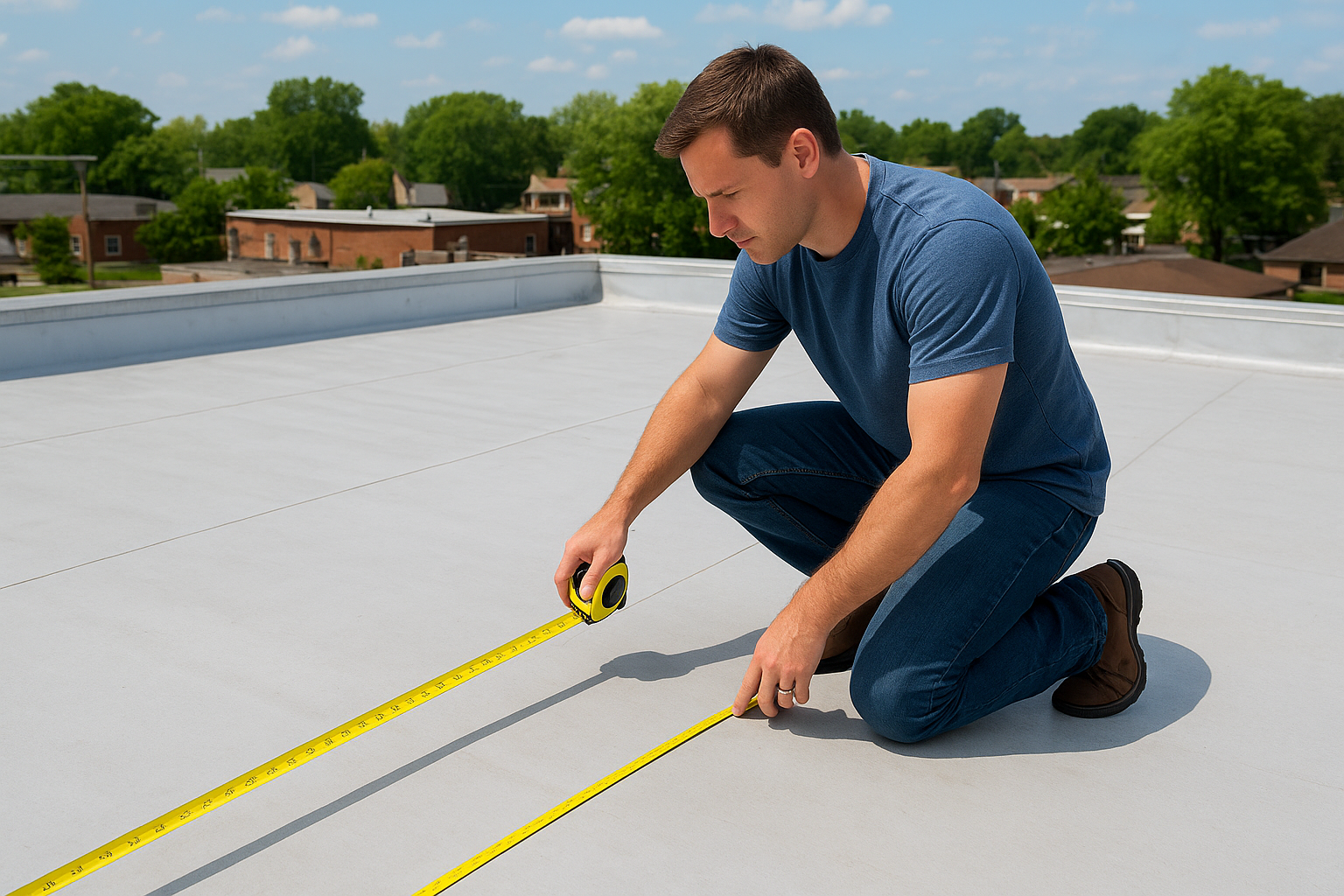
Convert your final square footage into roofing squares by dividing by 100. A 2,400-square-foot roof equals 24 squares. Most contractor quotes use this unit, so having your own number in squares makes it easier to cross-check what you’re being charged.
Apply the per-square-foot rate
Once you have your square footage, multiply it by the installed cost range for the membrane you’re considering. Using the material cost table from the previous section, a 2,400-square-foot roof with TPO at $5 to $10 per square foot produces a rough range of $12,000 to $24,000 before any add-ons.
Running this calculation before you contact contractors gives you a baseline that’s hard to fake. If a quote lands far below your estimate, ask what’s excluded. If it lands far above, ask what’s driving the difference.
That spread exists because your project specifics haven’t been applied yet. Roof condition, accessibility, and local labor rates all shift that number within the range, which is why getting at least three contractor quotes on identical scope always makes sense.
Confirm what’s included in any quote
Your estimate only holds up if you’re comparing it against quotes that cover the same work. Ask each contractor to itemize the scope in writing: material type and thickness, tear-off and disposal, deck inspection, flashing replacement, and warranty terms. A flat roof replacement cost estimate without a clear scope is just a starting number, and any contractor worth hiring will have no problem putting every line item on paper before work begins.
Add-on costs that change the final price
The base material and labor rate covers what goes on a clean, structurally sound roof deck. Most real-world projects involve at least one or two additional line items that weren’t visible until the crew started work, or that you’ll want to add proactively to protect your investment. Knowing what these add-ons cost before work begins keeps your flat roof replacement cost estimate from turning into an unpleasant surprise once the invoice arrives.
Tear-off, disposal, and deck repair
If your existing roof has multiple membrane layers, or your municipality’s building code requires a clean slate before re-roofing, full tear-off adds roughly $1 to $3 per square foot to your total. On a 2,400-square-foot roof, that’s $2,400 to $7,200 in additional charges just for removal and disposal. Some contractors bundle this into their quoted price; others list it separately, which is why you always need to confirm what the quote covers before signing.
Deck repair is harder to predict because the extent of damage only becomes clear after the old membrane comes off. Rotted or waterlogged sections of plywood or OSB decking typically cost $50 to $100 per sheet to replace, and a roof with years of minor leaks can require multiple sheets replaced across the surface. Ask your contractor how they handle unexpected deck damage, specifically whether they quote a per-sheet rate upfront so you aren’t negotiating mid-project.
Flashing, insulation, and penetrations
Flashing is the metal edging that seals the membrane at walls, parapets, and transitions. Old flashing rarely gets reused during a full replacement because worn flashing is one of the most common sources of leaks, and installers need a clean seal to back their warranty. Replacing flashing typically adds $8 to $15 per linear foot, and most roofs have enough perimeter footage to make this a meaningful line item.
Skipping flashing replacement to save money often leads to a leak within the first few years, voiding warranties and restarting the repair cycle entirely.
Roof penetrations like HVAC curbs, skylights, and vent pipes require additional flashing and sealant work around each opening. Expect $150 to $400 per penetration depending on size and complexity. Insulation upgrades add another $1 to $3 per square foot if your existing insulation is damaged or fails to meet current building code requirements in your state.
Repair vs replacement and ways to save
Not every flat roof problem demands a full replacement. Isolated leaks, minor membrane blistering, and small seam separations often qualify for targeted repairs that cost a fraction of what full replacement runs. Before you commit to a major project, a qualified contractor should walk your roof and give you an honest read on whether the membrane still has useful life left or whether repairs are just delaying the inevitable.
When repair makes sense
Repairs work best when damage is localized to one or two areas and the surrounding membrane remains in solid condition. A single puncture, a failed flashing joint, or a small section of delaminated membrane can typically be patched for $300 to $1,500 depending on scope, and the fix can add several more years to a roof that’s still structurally sound. If your roof is under 15 years old and hasn’t had recurring leak problems, repair is almost always worth exploring first.
When replacement is the smarter call
A roof that’s past its expected lifespan or showing widespread membrane failure gives you far fewer repair options. If water has infiltrated the insulation layer beneath the membrane, partial fixes rarely hold because moisture continues to move and damage surrounding areas. Repeated repair bills that add up to 30 percent or more of a full replacement cost are a clear signal that patching is throwing money at a problem that needs a permanent solution.
If your contractor recommends replacement on a roof under 10 years old without a thorough inspection and written justification, get a second opinion before moving forward.
Practical ways to reduce your flat roof replacement cost
A few deliberate decisions during the planning phase can meaningfully lower your final bill without cutting corners on quality.
- Get three written quotes on identical scope so you’re comparing real numbers, not estimates built on different assumptions.
- Schedule your project in late fall or early spring when roofing crews have more availability and some contractors offer better pricing to fill their calendars.
- Ask about manufacturer rebates on specific membrane brands, particularly TPO and PVC systems, which sometimes carry promotional pricing through certified installers.
- Bundle the project with any needed deck repairs rather than handling them separately, since mobilizing a crew twice costs more than completing everything in one visit.
- Address minor maintenance issues like clogged drains and debris buildup before they accelerate membrane wear and push you toward an earlier replacement timeline.
Next steps
You now have a clear picture of what drives flat roof replacement cost and how to evaluate the numbers in front of you. Whether you land on TPO, PVC, EPDM, or modified bitumen, the right material depends on your building type, your budget, and how long you plan to own the property. Use the per-square-foot ranges and estimation method in this guide to build a realistic budget before you talk to a single contractor, and always get three written quotes that spell out scope, materials, and warranty terms in full detail.
If your flat roof is showing signs of wear or you want a professional assessment before committing to anything, Sunflowers Energy LLC offers free on-site inspections with no obligation. Our team installs TPO, PVC, and rubber roofing systems on both residential and commercial properties across the region. Schedule your free flat roof inspection and get an accurate quote based on your actual roof.

2 Responses