
Replacing old, sectional gutters, or adding gutters to a home that doesn’t have them, starts with one question: what will it actually cost? The average seamless gutter installation cost falls between $6 and $17 per linear foot, but that range is wide enough to make budgeting feel like guesswork without the right context.
Material choice, home size, roof complexity, labor rates in your area, and even the number of stories on your house all push that final number up or down. A single-story ranch with a simple roofline won’t cost the same as a two-story colonial with multiple dormers and valleys. Getting an accurate estimate means understanding how each of these factors stacks up, and knowing what to look for when a contractor hands you a quote.
At Sunflowers Energy LLC, we work on roofs every day, and we see firsthand how gutters and roofing systems work together to protect a home from water damage. A solid roof without properly installed gutters is only doing half its job. That hands-on experience is exactly why we put this 2026 price guide together, to give homeowners a straightforward, no-fluff breakdown of what seamless gutter installation really costs, what drives those costs, and how to make sure you’re spending your money where it counts.
Below, you’ll find current pricing per linear foot by material, total project estimates based on home size, and the specific variables that contractors factor into their bids. Whether you’re replacing damaged gutters after a storm or upgrading to a seamless system for the first time, this guide will help you budget with confidence and evaluate any quote you receive.
Average seamless gutter installation cost in 2026
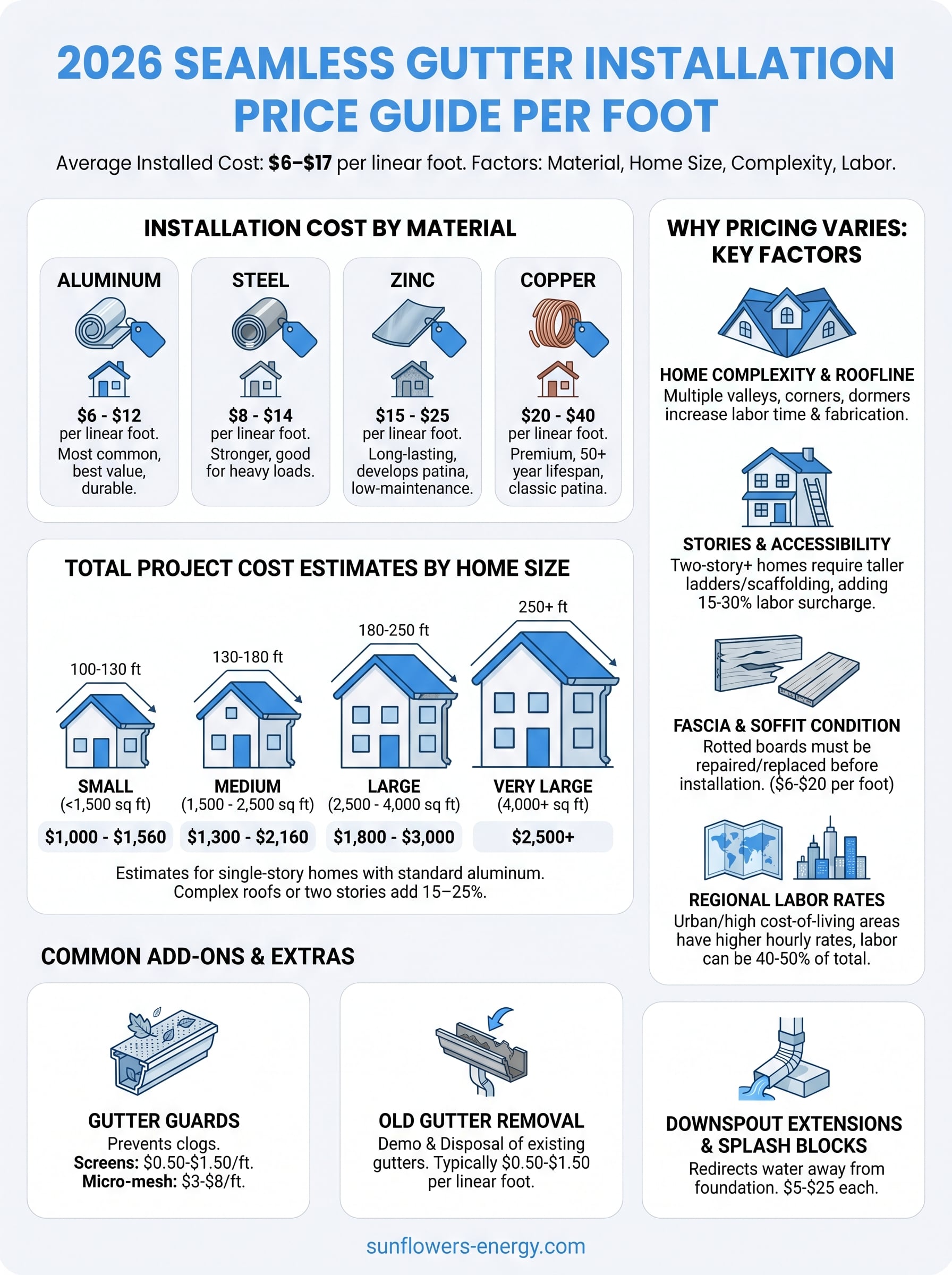
The typical seamless gutter installation cost in 2026 runs between $6 and $17 per linear foot, fully installed. That price covers both materials and labor. Where you land in that range depends on the material you choose, how complex your roofline is, and what labor rates look like in your area. Most homeowners end up somewhere in the middle, around $10 to $12 per linear foot, once all factors are accounted for.
What you pay per linear foot
Aluminum is the most common choice for residential gutters, and it tends to be the most affordable option. Aluminum gutters typically run $6 to $12 per linear foot installed, which keeps total project costs manageable for most homes. Copper sits at the top end of the scale, often running $20 to $40 per linear foot, but it brings decades of longevity and a distinct look that certain homeowners specifically want. Steel and zinc fall in between, with steel priced closer to aluminum and zinc closer to copper.
Picking the right material upfront protects you from replacing gutters again in 10 years. A properly installed seamless system outperforms cheap sectional gutters on every front, especially leak resistance.
The table below breaks down common gutter materials and their typical installed cost per linear foot in 2026:
| Material | Installed Cost Per Linear Foot |
|---|---|
| Aluminum | $6 – $12 |
| Steel | $8 – $14 |
| Zinc | $15 – $25 |
| Copper | $20 – $40 |
Material choice is the single fastest way to shift your project cost up or down. If you’re working with a tight budget, aluminum gives you the best value without sacrificing durability for most climates.
Total project cost by home size
Linear footage drives your total bill more than any other single variable. A smaller ranch-style home with a simple roofline might need 120 to 150 linear feet of gutter, while a larger two-story home with multiple roof sections can easily require 200 linear feet or more. Multiplying that footage by your cost per linear foot gives you a reliable working estimate before a contractor sets foot on your property.
Here’s what a typical project looks like across common home sizes, using a mid-range installed cost of $10 per linear foot for aluminum gutters:
| Home Size | Est. Linear Footage | Estimated Total Cost |
|---|---|---|
| Small (under 1,500 sq ft) | 100 – 130 ft | $1,000 – $1,560 |
| Medium (1,500 – 2,500 sq ft) | 130 – 180 ft | $1,300 – $2,160 |
| Large (2,500 – 4,000 sq ft) | 180 – 250 ft | $1,800 – $3,000 |
| Very Large (4,000+ sq ft) | 250+ ft | $2,500+ |
These figures assume a single-story home with a standard roofline. A two-story home introduces additional height and complexity, which typically pushes labor costs up by 15% to 25% on top of the base material price. Homes with dormers, steep pitches, or multiple roof valleys will also land on the higher end of any estimate. Treat these totals as a starting point, not a final number, until a contractor walks your property and measures your actual footage.
Why seamless gutter pricing varies
The seamless gutter installation cost range of $6 to $17 per linear foot isn’t arbitrary. Each project involves a combination of variables that contractors evaluate before writing a quote. Understanding those variables helps you read a bid more clearly and spot where costs are genuinely justified versus where there may be room to negotiate.
Material grade and profile size
Gutter profile refers to the shape and width of the gutter channel. The two most common residential options are 5-inch and 6-inch K-style gutters, with 6-inch profiles carrying a higher price due to the extra material involved. Wider gutters also handle heavier rainfall more effectively, which matters in regions prone to significant storms. Beyond size, the gauge of the metal plays a role. Thicker aluminum costs more per foot, but it resists denting and holds its shape longer, reducing the likelihood of premature replacement.
Paying slightly more for a heavier gauge upfront almost always costs less than replacing a thinner, cheaper system in 8 to 10 years.
Home complexity and site conditions
Roofline complexity is one of the biggest cost drivers on any gutter project. A simple rectangular home with clean corners takes far less time to measure, fabricate, and install than a house with multiple rooflines, dormers, valleys, or bay windows. Each corner transition and roofline junction requires precise fitting, and mistakes cost time. Contractors price that complexity into their labor rate.
Building height adds another layer. Single-story homes require standard ladders and minimal setup. Two-story or taller structures require taller ladders or scaffolding, slow down installation, and introduce more safety considerations for the crew. Most contractors add a surcharge for multi-story work, often between 15% and 30% above their base rate.
Regional labor rates
Labor costs vary significantly depending on where you live. Urban markets with higher costs of living, stronger union presence, or high demand for contractors generally see higher hourly rates than rural or mid-size markets. In high cost-of-living metro areas, labor alone can account for 40% to 50% of your total project cost, while in lower-cost regions it may land closer to 25% to 30%. Getting two or three local quotes helps you calibrate what’s standard in your specific market before you commit.
How to estimate your gutter footage and budget
Before you contact a contractor, running your own rough estimate gives you a useful baseline. Knowing your approximate linear footage and a realistic cost range means you can evaluate quotes with real context rather than accepting the first number someone gives you. You don’t need professional tools to get a working figure, just a measuring tape, your home’s dimensions, and a few minutes.
Measuring your home’s gutter runs
Gutters run along the eaves of your roof, which are the horizontal edges where water drains off. To estimate your footage, walk the perimeter of your home and measure the length of every edge that needs a gutter. For a simple rectangular home, this typically means two long sides and two short sides, minus any sections covered by garage walls or areas without overhangs. Add those measurements together and you have your rough linear footage.
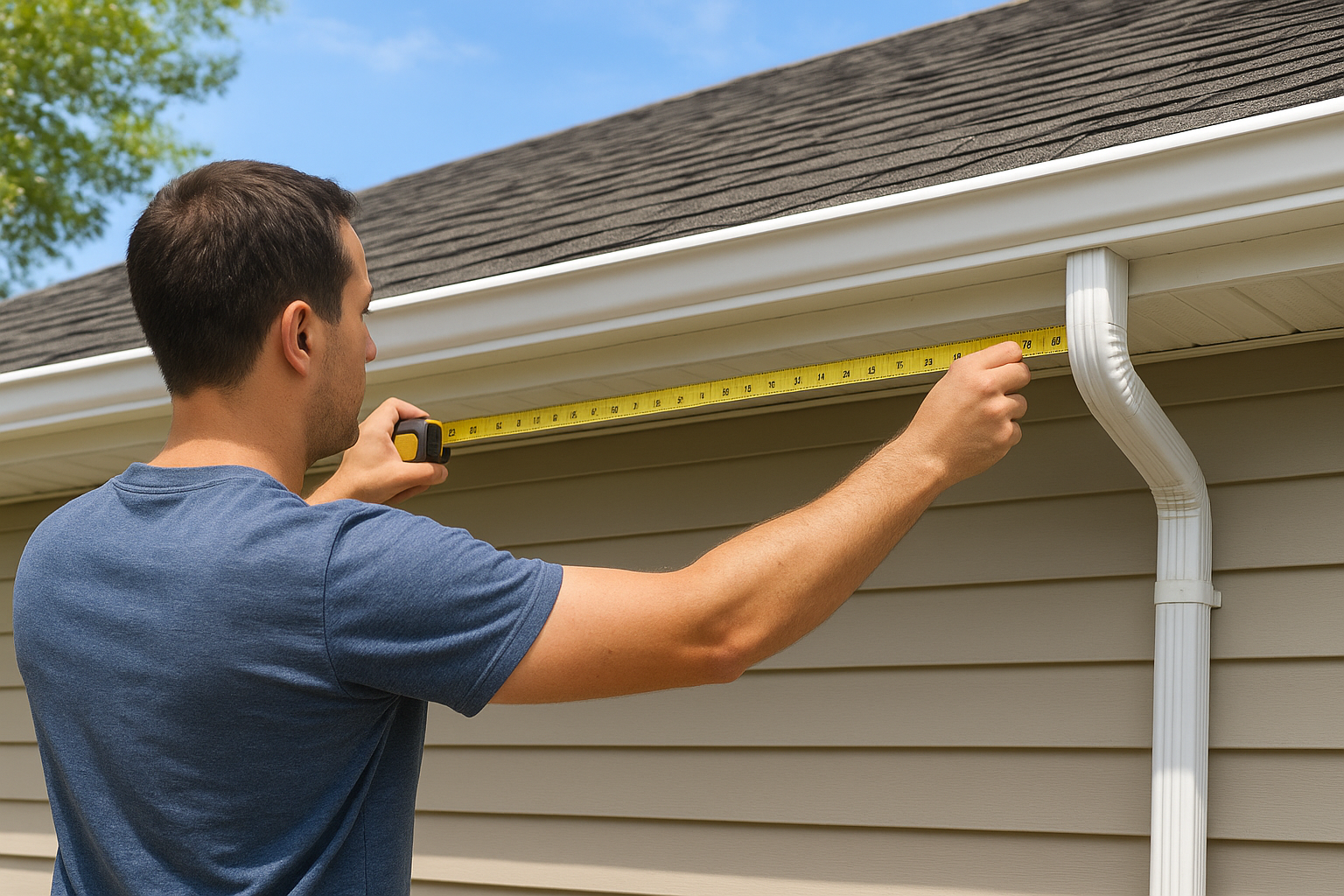
Don’t forget to account for downspouts, which typically run one for every 30 to 40 linear feet of gutter. Downspouts are usually priced separately from the gutter channel itself, often between $5 and $15 each installed, so they add a small but real line item to your total. If your home has multiple roof levels or an L-shaped or U-shaped footprint, trace each distinct eave line and add those measurements to your total.
A quick perimeter measurement before your first contractor call gives you a solid check against any quote that seems unusually high or low.
Building a working budget
Once you have your estimated linear footage, multiply it by your target material’s installed cost per linear foot to get a rough project range. For most homeowners going with aluminum gutters, multiplying your footage by $8 to $12 gives you a realistic working estimate that accounts for standard labor rates and basic roofline complexity. If your home is two stories or has a more complex roofline, add 15% to 25% to that figure to reflect the additional labor involved.
Building a budget also means setting aside 10% to 15% as a contingency. Contractors sometimes find rotted fascia boards or damaged soffit once they remove old gutters, and addressing that before new gutters go up is always the right call. Factoring that buffer into your seamless gutter installation cost estimate keeps you prepared if the project scope expands slightly.
Cost per linear foot by material
Material choice shapes your seamless gutter installation cost more than almost any other decision you make during the planning process. Each option has a different price point per linear foot, a different lifespan, and different maintenance requirements that affect your long-term cost of ownership. Knowing where each material lands helps you weigh the upfront price against what you’re actually getting over 20 or 30 years of use.
Aluminum and steel
Aluminum is the most widely installed seamless gutter material in the United States, and for good reason. It runs $6 to $12 per linear foot installed, resists rust, handles temperature swings well, and comes in a wide range of colors. Most residential contractors fabricate aluminum gutters on-site with a portable roll-forming machine, which is exactly what makes seamless installation possible without seams that can leak over time.
Aluminum offers the best balance of affordability and durability for most homeowners, making it the default choice unless your project has a specific design or performance need.
Steel gutters cost slightly more, typically $8 to $14 per linear foot installed, and carry more weight, which makes them a better fit for areas with heavy snow loads or significant debris accumulation. Galvanized steel resists rust for years, but it will eventually corrode without proper maintenance, while stainless steel costs more upfront and eliminates that concern entirely. If your home sits in a climate with harsh winters, steel is worth the additional cost per foot.
Zinc and copper
Zinc gutters fall in the $15 to $25 per linear foot installed range and appeal to homeowners who want a durable, low-maintenance system with a distinctive appearance. Zinc develops a natural patina over time, which some homeowners find attractive and others do not. The material itself is self-healing on minor scratches, which reduces long-term upkeep compared to painted aluminum or steel.
Copper sits at the top of the price range, typically costing $20 to $40 per linear foot installed depending on your market and the complexity of your roofline. Copper requires no painting, develops a classic patina, and can last 50 years or more with minimal maintenance. The trade-off is a significant upfront investment that only makes sense if you plan to stay in the home long-term or are working on a high-end property where aesthetics drive the decision.
Labor and home factors that affect installation cost
Material price gets most of the attention when homeowners research seamless gutter installation cost, but labor and site conditions often account for a larger share of your final bill than the gutters themselves. Understanding what contractors actually price into their labor rate helps you evaluate quotes fairly and avoid surprises once the job starts.
Crew time and labor rates
Labor typically makes up 35% to 50% of your total project cost, depending on your region and the complexity of the job. A contractor who charges $8 per linear foot installed isn’t quoting you $8 for the gutter alone. That figure includes the time to measure your roofline, set up equipment, fabricate the gutters on-site with a roll-forming machine, and fasten everything securely to your fascia. Experienced crews with proper equipment can complete a standard single-story installation in a single day, but a more complex roofline with multiple valleys or corners can stretch that into two days, which directly increases your labor cost.
Getting quotes from at least two local contractors gives you a clear picture of what labor rates look like in your specific market before you commit to anything.
Roof height and accessibility
Two-story homes cost more to gutter than single-story homes, and the reason is straightforward. Higher rooflines require taller ladders, additional safety equipment, and slower, more careful work. Most contractors add a surcharge of 15% to 30% to their base labor rate for two-story or taller structures. If your home has sections that are difficult to reach because of landscaping, fencing, or limited yard access, expect that to factor into your quote as well.
Fascia and soffit condition
Gutters attach directly to your fascia boards, which are the horizontal trim pieces that run along the edge of your roofline. If those boards are rotted, soft, or damaged, a contractor will typically pause installation until the fascia is repaired or replaced, since gutters won’t hold up long on compromised wood. Fascia board replacement runs $6 to $20 per linear foot depending on the material, so a full fascia repair on a medium-sized home can add several hundred dollars to your project total. Checking the condition of your fascia before you request quotes lets you factor that into your budget rather than getting caught off guard mid-project.
Add-ons that change your total project price
The base seamless gutter installation cost per linear foot covers the gutter channel, downspouts, and standard labor. What it doesn’t cover are the extras that often make sense to add while a contractor is already on-site and set up. Each of the following line items is optional, but skipping them can create bigger expenses down the road.
Gutter guards and covers
Gutter guards sit on top of your gutter channels and prevent leaves, pine needles, and debris from clogging the system. They come in several styles, from basic mesh screens to micro-mesh and reverse-curve designs, and the price range reflects that variety. Basic screen guards run $0.50 to $1.50 per linear foot, while premium micro-mesh systems can reach $3 to $8 per linear foot installed. On a 160-foot gutter system, that adds $80 to $1,280 to your total, depending on the product you choose.
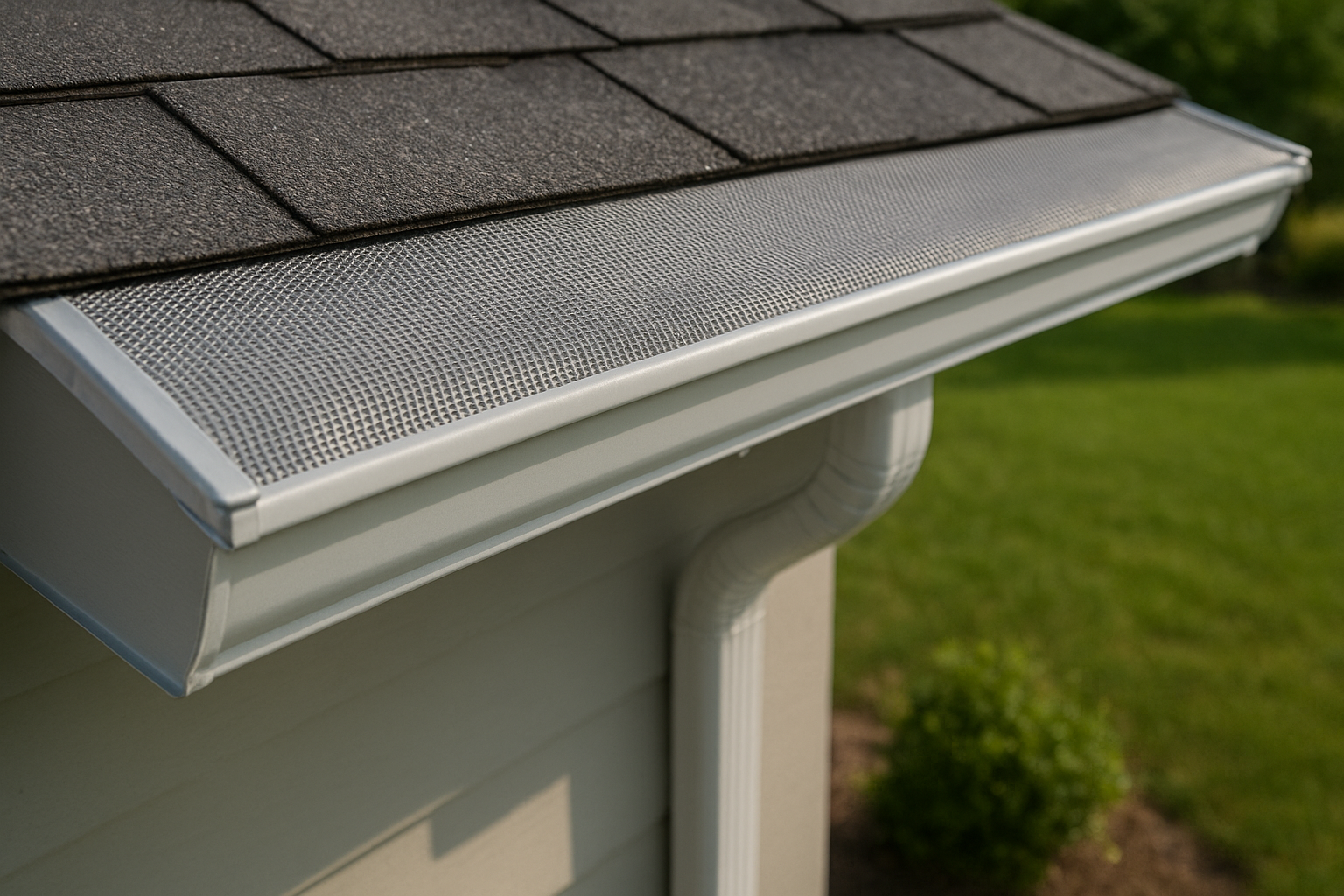
Installing guards at the same time as new gutters costs less in combined labor than scheduling them as a separate job later.
| Guard Type | Installed Cost Per Linear Foot |
|---|---|
| Basic screen | $0.50 – $1.50 |
| Foam insert | $1.50 – $3.00 |
| Micro-mesh | $3.00 – $8.00 |
Old gutter removal and disposal
If you’re replacing existing gutters, you need to factor in removal and disposal costs before the new system goes in. Most contractors charge $0.50 to $1.50 per linear foot for removing old gutters, which includes pulling them off the fascia, clearing any remaining hardware, and hauling the material away. On a medium-sized home with 150 linear feet of existing gutters, that adds $75 to $225 to your project bill.
Some contractors bundle removal into their installation quote, while others list it as a separate line item. Always ask explicitly whether demo and disposal are included in any bid you receive, because the difference in how contractors present this varies widely.
Downspout extensions and splash blocks
Downspout extensions redirect water further from your foundation, typically adding 2 to 4 feet of reach beyond where the downspout terminates. These run $5 to $20 per extension depending on material and length. Splash blocks sit below each downspout outlet and direct water away from the foundation, costing $10 to $25 each. Neither item is expensive on its own, but a home with six downspouts can add $100 or more to your total once you account for both extensions and blocks at each outlet.
DIY vs professional installation and what to expect
The decision between doing the work yourself and hiring a contractor comes down to one honest question: do you have access to a seamless gutter machine? Sectional gutters are available at home improvement stores and can be cut to length at home, but seamless gutters require a roll-forming machine that fabricates the gutter on-site to the exact length of each run. That machine costs several thousand dollars to buy and requires training to operate correctly, which is why seamless gutter installation cost almost always includes professional labor.
What DIY installation actually involves
If you’re set on a DIY approach, sectional gutters are your realistic option for a self-managed project. These come in pre-cut lengths that you join with connectors and sealant, and they’re available at most hardware stores in aluminum and vinyl. The trade-off is that every joint is a potential leak point, which is exactly what seamless gutters are designed to eliminate. Installing sectional gutters yourself costs roughly $1 to $3 per linear foot in materials, so the upfront savings are real, but factor in the likelihood of resealing joints every few years.
If long-term leak resistance is your priority, sectional DIY gutters trade installation savings for ongoing maintenance costs that add up over time.
Tools you’ll need for a DIY sectional install include:
- A sturdy extension ladder
- A hacksaw or tin snips for cutting
- A drill and gutter screws or hangers
- Waterproof sealant for joints and end caps
- A level to maintain proper slope toward downspouts
Why most homeowners hire a pro
Professional installers bring the roll-forming machine to your property, which means your gutters are fabricated to exact measurements with zero seams along each run. That single advantage eliminates the most common source of gutter leaks. Beyond equipment, an experienced crew reads roofline slope, positions downspouts correctly, and fastens gutters to your fascia at the right spacing to handle heavy rain without pulling away from the house over time. A proper slope of roughly 1/4 inch per 10 linear feet is critical for drainage, and getting that angle wrong causes standing water and accelerated wear. For most homeowners, the combination of seamless construction, correct slope, and secure fastening makes professional installation the straightforward choice.
Next steps to plan your gutter project
You now have the key numbers behind seamless gutter installation cost, from material prices per linear foot to the labor factors and add-ons that shape your final bill. The next move is straightforward: measure your home’s eave lines, pick the material that fits your budget and climate, and set aside a 10% to 15% contingency for any fascia repairs that come up during installation.
Your gutters and roof work as a system, and getting both right from the start protects your home from the water damage that drives expensive repairs. Hiring a contractor who understands how rooflines, fascia condition, and drainage all connect saves you from fixing problems that a specialist would have caught on day one. If you’re ready to get a professional assessment and an accurate quote, contact the team at Sunflowers Energy to schedule your free on-site inspection today.